Universe’s Missing Mass Found in Cosmic Web Filaments
Astronomers have finally detected the universe's missing baryonic matter, hidden within vast, hot gas filaments of the cosmic web stretching millions of light-years across intergalactic space. This discovery validates key cosmological models and opens new avenues for understanding cosmic evolution.

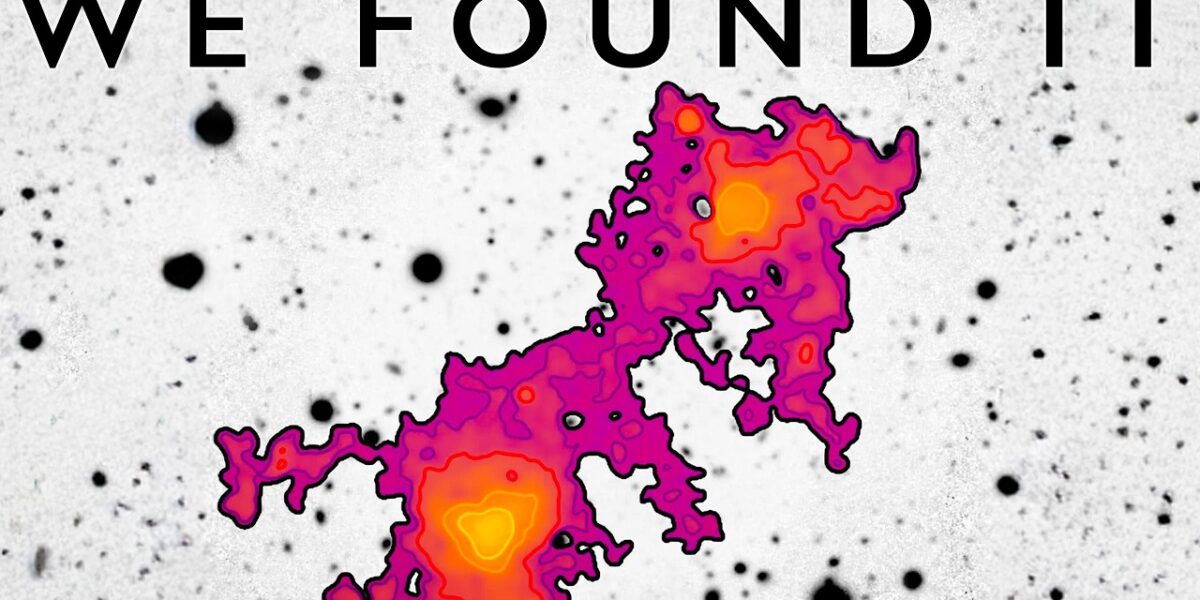
Cosmic Filaments Reveal Universe’s Hidden Baryonic Matter
For decades, astronomers have grappled with a perplexing cosmic conundrum: a significant portion of the universe’s ‘ordinary’ matter, the stuff that makes up stars, planets, and us, has been unaccounted for. While dark matter and dark energy dominate the cosmic inventory, a substantial fraction—up to 40%—of the visible, baryonic matter predicted by cosmological models has remained elusive, vanishing from sight despite our most powerful observational tools. Now, a groundbreaking discovery has illuminated these hidden reservoirs, revealing them as vast, tenuous filaments of hot gas stretching across intergalactic space, forming the very scaffolding of the cosmic web.
The Persistent Mystery of Missing Baryonic Matter
Our current understanding of the universe, derived from meticulous measurements of the Cosmic Microwave Background (CMB)—the faint afterglow of the Big Bang—dictates a precise cosmic budget. This budget indicates that the ordinary, baryonic matter should constitute about 5% of the universe’s total mass-energy content. The remaining 95% is attributed to the enigmatic dark matter (27%) and dark energy (68%). However, when astronomers tally up all the stars, galaxies, gas, and dust they can directly observe, they only account for roughly 60% of the expected baryonic matter. This discrepancy has been a persistent thorn in the side of cosmology, threatening the validity of our fundamental models.
The search for this missing baryonic mass has been a long and arduous journey. Unlike dark matter, which is inherently invisible as it doesn’t interact with light, baryonic matter is composed of protons and neutrons, which should, in principle, be detectable. Yet, it has proven incredibly difficult to pinpoint. Hypotheses ranged from matter locked away in faint, low-mass stars or rogue planets to diffuse gas clouds scattered throughout the vast cosmic voids.
The Cosmic Web: A Blueprint for Structure
The concept of the cosmic web, a vast, interconnected network of filaments and nodes, has long been theorized as the large-scale structure of the universe. This web is thought to have emerged from tiny density fluctuations in the early universe, observable in the CMB. Over billions of years, gravity has amplified these initial variations, drawing matter together along these filaments and concentrating it at their intersections, forming galaxy clusters. While we have mapped the distribution of galaxies along this web, the ‘strings’ connecting them—the filaments themselves—have remained largely invisible, especially the diffuse, hot gas predicted to reside within them.
Historical observations have provided tantalizing clues. In 2005, NASA’s Chandra X-ray Observatory detected diffuse gas clouds between galaxies, suggesting the presence of intergalactic material. Later, in 2012, the Hubble Space Telescope, through studying gravitational lensing effects, inferred the existence of a filament funneling matter into a galaxy cluster. A breakthrough came in 2014 when astronomers, using a bright quasar as a backlight, directly observed a nearly 2-million-light-year-long filament of hydrogen gas. By 2019, similar techniques revealed larger networks of these filaments. However, these observations relied on the presence of bright background sources, leaving the majority of the cosmic web, which exists in darkness, still hidden.
A Glimpse into the Intergalactic Medium
The true breakthrough in detecting the missing baryonic matter came with advancements in observational techniques and dedicated instruments. In 2023, the W. M. Keck Observatory employed a specialized instrument to map dim Lyman alpha emission, a spectral signature of hydrogen, enabling the creation of 3D maps of filaments. While promising, these observations often focused on cooler gas and the early universe.
The pivotal moment arrived in June 2025. A team of European researchers, led by Konstantinos Migkas at Leiden Observatory, utilized data from JAXA’s Suzaku X-ray space telescope, complemented by observations from the XMM-Newton observatory, to achieve a remarkable feat. They successfully isolated and spectroscopically measured the hot, low-density gas within an individual cosmic web filament in the local universe. This detection marks the first time the diffuse, warm-hot intergalactic medium, long predicted to harbor the missing baryonic mass, has been directly observed in our cosmic neighborhood.
The observed filament, located in the Shapley Supercluster, stretches an astonishing 23 million light-years. This immense structure is estimated to contain a mass equivalent to about 10 times that of our entire Milky Way galaxy. The gas within this filament is scorching, reaching temperatures of 10 million degrees Celsius. Its visual representation, appearing as a purple, honeycomb-like band connecting four galaxy clusters, offers an unprecedented view of how these massive structures are linked across colossal distances.
Implications and the Road Ahead
This discovery provides powerful validation for our current standard model of cosmology, the Lambda Cold Dark Matter (Lambda-CDM) model. The observed filament aligns remarkably well with predictions from large-scale cosmological simulations, bolstering confidence in our understanding of cosmic evolution. It directly addresses the long-standing deficit in baryonic matter, suggesting that a significant portion of it resides in these diffuse, hot gas filaments that form the backbone of the cosmic web.
However, this is just the beginning. To confirm our models definitively, scientists need to map more of this cosmic skeleton. Future missions like the European Space Agency’s Euclid, launched in 2023, are poised to play a crucial role. Euclid is designed to map the large-scale structure of the universe with unprecedented precision, measuring the distribution of galaxies and how their light is distorted by dark matter through gravitational lensing. This will allow scientists to infer the locations of dark matter filaments and, by extension, pinpoint areas where more baryonic gas filaments might be found.
By 2030, Euclid’s data could either provide robust confirmation of the cosmic web’s structure as observed in filaments like the one recently detected and as predicted by the CMB, or it could reveal fundamental discrepancies. Such discrepancies would necessitate a re-evaluation of our understanding of dark matter, gravity, or the very early universe. Regardless of the outcome, the ongoing exploration of cosmic filaments promises to revolutionize our understanding of cosmology and humanity’s place within the grand tapestry of the cosmos.
Source: We Finally Found the Universe's Missing Mass (YouTube)

Related Articles


Vera C. Rubin Observatory Begins Sky Survey
The Vera C. Rubin Observatory has officially begun its 10-year sky survey, promising to generate millions of astronomical alerts nightly. Meanwhile, new Webb images reveal Uranus in unprecedented detail, and the Artemis program faces timeline adjustments.


JWST Unveils Distant Galaxy’s Surprising Maturity
The James Webb Space Telescope has detected an ancient galaxy, JADES-GS-z13-0, existing just 320 million years after the Big Bang. Its surprising maturity challenges current theories about the rapid formation of early galaxies.


Earth’s Planetary Status Questioned, Figure-8 Orbits Debunked
Exploring Earth's planetary status, the impossibility of figure-8 orbits, the ongoing debate about dark matter's composition, and the future of human spaceflight.