Universe’s Missing Lithium Puzzles Big Bang Theory
The Big Bang Theory accurately predicts the abundance of light elements, but a significant deficit in observed lithium challenges our understanding. Scientists are exploring astrophysical, nuclear physics, and new physics explanations for this cosmic discrepancy.

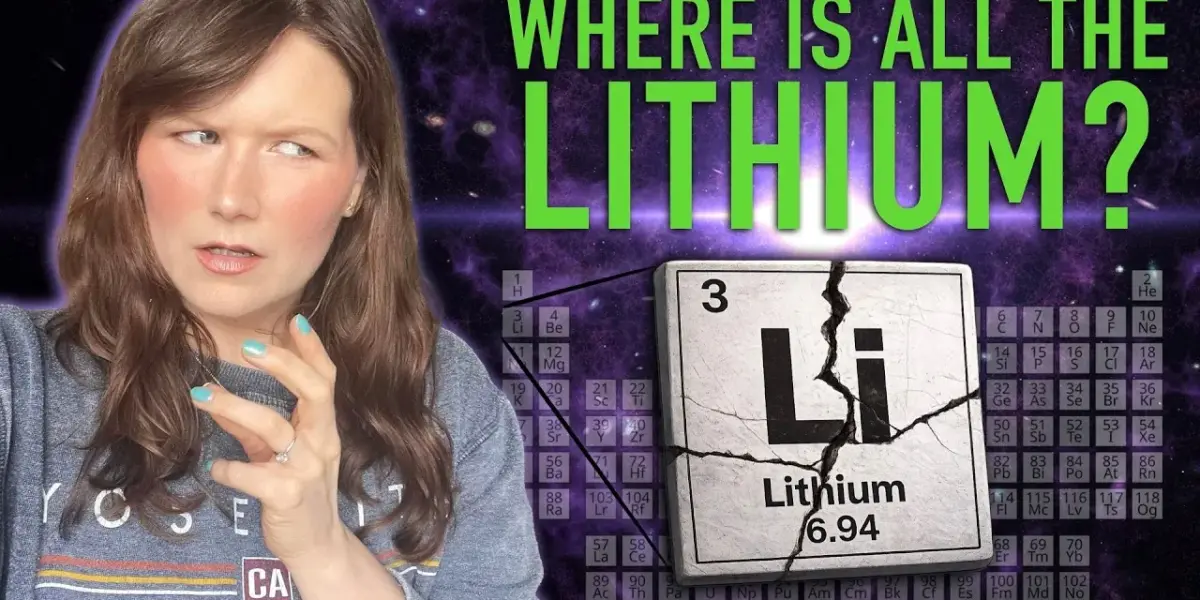
Universe’s Missing Lithium Puzzles Big Bang Theory
The Big Bang Theory, our leading cosmological model, describes the universe’s origin and evolution from a hot, dense state to the vast cosmos we observe today. It successfully explains the abundance of light elements like hydrogen and helium. However, a persistent discrepancy involving lithium—the third lightest element—presents a significant challenge, suggesting a gap in our understanding of the early universe.
The Genesis of Light Elements: Big Bang Nucleosynthesis
In the first few minutes after the Big Bang, the universe underwent a period of rapid expansion and cooling. This extreme environment allowed for the formation of the lightest atomic nuclei through a process known as Big Bang Nucleosynthesis (BBN). Within approximately 3 minutes, the universe was hot and dense enough for protons and neutrons to fuse, creating deuterium (heavy hydrogen), helium, and trace amounts of lithium and beryllium. As the universe expanded and cooled further, these nuclear reactions ceased, effectively freezing the elemental abundances.
The precise amounts of each element produced are predicted by BBN models, which rely on fundamental physics principles from the Standard Model of particle physics and nuclear physics, combined with our understanding of cosmology. The Standard Model describes subatomic particles like quarks and electrons, and forces like the strong and weak nuclear forces that govern their interactions. General relativity, meanwhile, describes gravity. These models predict a specific ratio of protons to neutrons and the influence of radiation (photons) on the nuclear reaction rates. Crucially, the ratio of normal matter to photons, determined from observations of the Cosmic Microwave Background (CMB) — the afterglow of the Big Bang — allows scientists to calculate the expected primordial abundances of hydrogen, deuterium, helium, and lithium.
Searching for Primordial Lithium
Observing these primordial elements presents distinct challenges. Deuterium and helium are relatively abundant and can be detected in vast gas clouds throughout the universe by analyzing the specific wavelengths of light they absorb or emit. The relative depths of these spectral ‘fingerprints’ allow astronomers to measure their abundances and compare them with BBN predictions. In both cases, observations align remarkably well with theoretical calculations.
Lithium, however, is produced in much smaller quantities during BBN. The diffuse gas clouds that are suitable for observing deuterium and helium lack sufficient concentrations of primordial lithium to leave a detectable spectral signature. Consequently, astronomers primarily search for lithium in the atmospheres of the oldest stars in our Milky Way galaxy. These stars, formed billions of years ago, are thought to retain the chemical composition of the early universe.
A key technique involves analyzing the light spectrum from these ancient stars. Lithium absorbs light at a specific wavelength, creating a dip in the star’s spectrum. By measuring the depth of this dip relative to the star’s hydrogen content, astronomers can estimate the star’s lithium abundance. To ensure they are observing primordial lithium, scientists focus on the hottest, oldest stars and use the abundance of iron as a proxy for stellar age. Iron is produced in supernovae, meaning its presence indicates that earlier generations of stars have already lived and died, enriching the interstellar medium.
In 1982, astronomers Agnes and Michel Spite observed a remarkable trend: the ratio of lithium to hydrogen in the hottest, oldest stars remained remarkably constant, regardless of their iron content. This ‘Spite plateau’ was initially interpreted as a direct measurement of the primordial lithium abundance, and it closely matched the predictions from BBN models available at the time.
The Lithium Problem Emerges
The discrepancy became starkly apparent in the 2000s with precise measurements of the matter-to-photon ratio from the CMB. These measurements significantly refined BBN predictions. When compared with the observed lithium abundances in old stars, a significant shortfall emerged. The Spite plateau indicated a lithium abundance roughly three to four times lower than what BBN theory predicted. This ‘lithium problem’ has persisted and even intensified as observational data has become more precise.
Potential Solutions to the Discrepancy
Scientists are exploring several avenues to resolve this cosmic conundrum, broadly categorized into three areas:
1. Astrophysical Explanations
This category suggests that our measurements are correct, but our understanding of how lithium behaves in stars is incomplete. One hypothesis is that lithium is gradually destroyed within stellar interiors over billions of years. As stars age, convection and turbulence can transport lithium from the outer layers down to the hotter core, where it can be consumed through nuclear reactions. Recent simulations (e.g., Borosov et al., 2024) incorporating these complex stellar processes show that lithium can indeed be depleted over a star’s lifetime, potentially explaining a plateau-like feature in observed abundances. However, current models do not fully account for the magnitude of the observed deficit.
2. Nuclear Physics Explanations
This line of inquiry questions the accuracy of BBN predictions themselves. It posits that unknown nuclear reactions in the early universe might have consumed lithium or converted it into heavier elements like carbon or beryllium, thereby reducing its primordial abundance. Despite extensive searches for such reactions, none have been definitively identified. Alternatively, the extreme conditions of the early universe might have enhanced the importance of certain nuclear reactions that are negligible under laboratory conditions on Earth, altering the predicted elemental ratios.
3. New Physics Beyond the Standard Model
The most profound possibility is that our fundamental understanding of physics is incomplete. The Standard Model, while successful, does not explain phenomena like dark matter, which constitutes about 85% of the universe’s matter. Hypotheses such as supersymmetry, which proposes partner particles for all known Standard Model particles, could offer candidates for dark matter and potentially influence early universe nucleosynthesis. If these hypothetical particles existed and decayed or interacted in the early universe, they could have altered the production rates of light elements. However, searches for supersymmetric particles at accelerators like the Large Hadron Collider have so far yielded no evidence.
Another avenue explores the possibility that fundamental physical constants, such as the fine-structure constant (which governs the strength of the electromagnetic interaction), might have varied in the extreme conditions of the early universe. Such variations could have significantly altered BBN predictions. Furthermore, our cosmological model itself might need revision. If the cosmological principle—the assumption that the universe is homogeneous and isotropic on large scales—is not entirely accurate, variations in the matter-to-photon ratio across different regions could lead to different primordial element abundances.
The Path Forward
The lithium problem remains one of the most compelling puzzles in modern cosmology. It highlights the intricate interplay between nuclear physics, astrophysics, and particle physics. Future research will likely involve more precise astronomical observations of ancient stars, refined BBN calculations incorporating new physics, and continued efforts to detect potential new particles or forces that could resolve this ancient cosmic mystery. Solving the lithium problem could unlock deeper insights into the universe’s earliest moments and the fundamental laws that govern it.
Source: The Big Bang has a Big Problem (YouTube)

Related Articles


2026: A Year of Cosmic Spectacles for Earth Gazers
2026 is set to be a banner year for celestial events, featuring a potentially naked-eye comet, a close conjunction of Venus and Jupiter, a total solar eclipse across Europe and North America, and two spectacular meteor showers.


Astronomers Capture First Real-Time Supernova Shape
Astronomers have captured the first real-time shape of a supernova explosion, thanks to the ATLAS survey and the Very Large Telescope. The event, SN 2024ggi, revealed a football-shaped blast, offering crucial data to refine theories on stellar death.


Cosmic Neighbors: Supernova Safety Zones and Interstellar Hitchhiking?
Explore the cosmic safety zones around supernovae, the elusive nature of dark matter interactions with neutrinos, and the feasibility of using interstellar objects for future space exploration. This article delves into the science behind these fascinating celestial phenomena.