Universe’s Expansion Outpaces Light Speed: A Cosmic Loophole
The universe's expansion appears to exceed the speed of light, but this doesn't violate Einstein's laws. It's the stretching of space itself, not objects moving through space, that causes distant galaxies to recede faster than light. The expansion rate, unlike speed, doesn't have a universal limit.

Universe’s Expansion Outpaces Light Speed: A Cosmic Loophole
One of the most mind-bending ideas in physics is that nothing can travel faster than the speed of light. This is a fundamental rule of our universe. Yet, we observe something that seems to break this rule every day: the universe itself is expanding at a rate that appears faster than light. Distant galaxies seem to be racing away from us at speeds exceeding the cosmic speed limit, a phenomenon known as superluminal motion. This might sound like a paradox, as if a core law of physics is being violated. However, the reality is more nuanced and entirely consistent with our understanding of the cosmos.
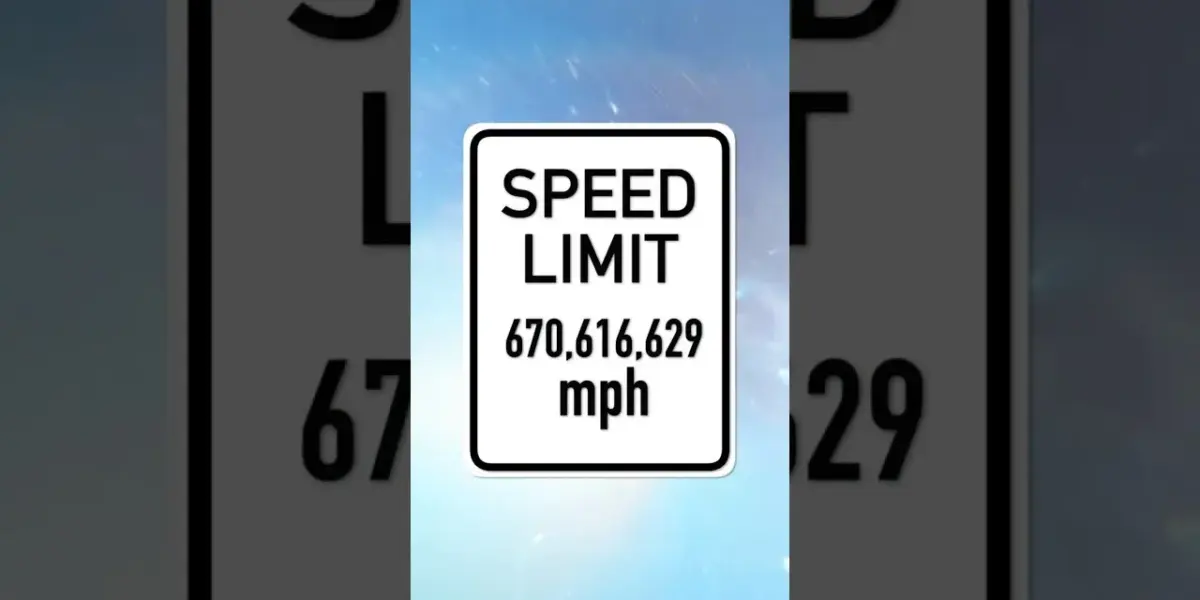
Albert Einstein’s theory of relativity, a cornerstone of modern physics, established that the speed of light is the ultimate speed limit. This speed is approximately 300,000 kilometers per second (or 186,000 miles per second). Nothing with mass can accelerate to reach this speed, let alone surpass it. So, when we see galaxies moving away from us faster than light, it’s natural to question how this is possible without breaking Einstein’s laws.
Space Itself is Expanding
The key to understanding this apparent contradiction lies in distinguishing between movement *through* space and the expansion *of* space itself. Objects like galaxies are moving within the fabric of spacetime. Their individual speeds are always bound by the speed of light. However, the space between us and these distant galaxies is stretching. Imagine dots drawn on a balloon; as the balloon inflates, the dots move farther apart. The dots themselves aren’t moving across the balloon’s surface faster than a certain limit, but the distance between them increases because the balloon’s surface is expanding.
This expansion of space is not an object moving through a pre-existing void. Instead, it is the creation of new space between objects. For galaxies that are extremely far away, the cumulative effect of this expanding space means that the distance between us and them can increase at a rate far exceeding the speed of light. This is why we observe superluminal motion in distant galaxies; they are not traveling through space faster than light, but rather, the space they inhabit is expanding so rapidly that their recession velocity appears faster than light.
The Expansion Doesn’t Have a Traditional Speed
Furthermore, asking if the universe expands faster than light is a bit like asking if a color has a weight. The expansion of space doesn’t operate with a speed in the way we typically understand it. Speed is a measure of distance covered over time. The expansion of the universe is a dynamic process that affects the scale of spacetime itself. It’s more accurate to talk about an expansion rate, often measured in kilometers per second per megaparsec (km/s/Mpc). A megaparsec is a unit of distance equal to about 3.26 million light-years.
This means that for every megaparsec farther away a galaxy is, it appears to recede from us an additional amount of kilometers per second due to the expansion of space. For very distant galaxies, billions of light-years away, this cumulative effect results in recession velocities that are significantly greater than the speed of light. However, this is not a violation of relativity because it’s not about local motion through space but about the global stretching of spacetime.
Historical Context and Future Implications
The concept of an expanding universe was first proposed by Alexander Friedmann in the 1920s, building on Einstein’s general relativity. Edwin Hubble later provided observational evidence in the late 1920s, showing that galaxies are generally moving away from us, and the farther away they are, the faster they recede. This relationship is now known as Hubble’s Law.
In the late 1990s, observations of distant supernovae revealed that the expansion of the universe is not only happening but is also accelerating. This discovery, attributed to astronomers Saul Perlmutter, Brian Schmidt, and Adam Riess, led to the concept of dark energy, a mysterious force believed to be driving this accelerated expansion. Understanding the nature of dark energy is one of the biggest challenges in modern cosmology. It makes up about 68% of the total energy content of the universe.
What Comes Next?
The ongoing expansion and its acceleration pose profound questions about the ultimate fate of our universe. Will galaxies eventually recede so far that they disappear from our observable horizon? Will the universe continue expanding forever, leading to a cold, dark end known as the Big Freeze? Or could other scenarios, like a Big Rip where spacetime itself is torn apart, come into play?
Future missions and advanced telescopes, like the James Webb Space Telescope and upcoming observatories, are crucial for gathering more precise data on the expansion rate, the properties of dark energy, and the large-scale structure of the cosmos. By studying these phenomena, scientists aim to refine our cosmological models and gain deeper insights into the fundamental laws governing the universe. This quest for knowledge helps us understand our place in the vastness of space and the ultimate destiny of everything we know.
Source: Does the Universe expand faster than light? #shorts (YouTube)

Related Articles
Universe Expands Faster Than Light, Defying Physics Laws
The universe appears to be expanding faster than the speed of light, a phenomenon that seems to contradict Einstein's laws. However, this cosmic speedster doesn't break physics rules because it's space itself expanding, not galaxies moving through space. This mind-bending concept reveals the universe's true scale and dynamics.


Universe’s Expansion Accelerates, Then ‘Jerks,’ New Data Reveals
New data from the DESI project suggests the universe's expansion is not only accelerating but that the rate of acceleration is also changing. This phenomenon, known as a 'jerk' in physics, challenges current models and points to new mysteries about dark energy and cosmic evolution.


Alien Life May Be Extinct, Loeb Suggests
Harvard professor Avi Loeb suggests the first evidence of alien intelligence may come from extinct civilizations. He argues that most stars are billions of years older than our Sun, making it likely that alien life arose and potentially vanished long ago. This shifts the search from active signals to ancient technological artifacts.