Universe Expands Faster Than Light, Defying Physics Laws
The universe appears to be expanding faster than the speed of light, a phenomenon that seems to contradict Einstein's laws. However, this cosmic speedster doesn't break physics rules because it's space itself expanding, not galaxies moving through space. This mind-bending concept reveals the universe's true scale and dynamics.

Universe Expands Faster Than Light, Defying Physics Laws
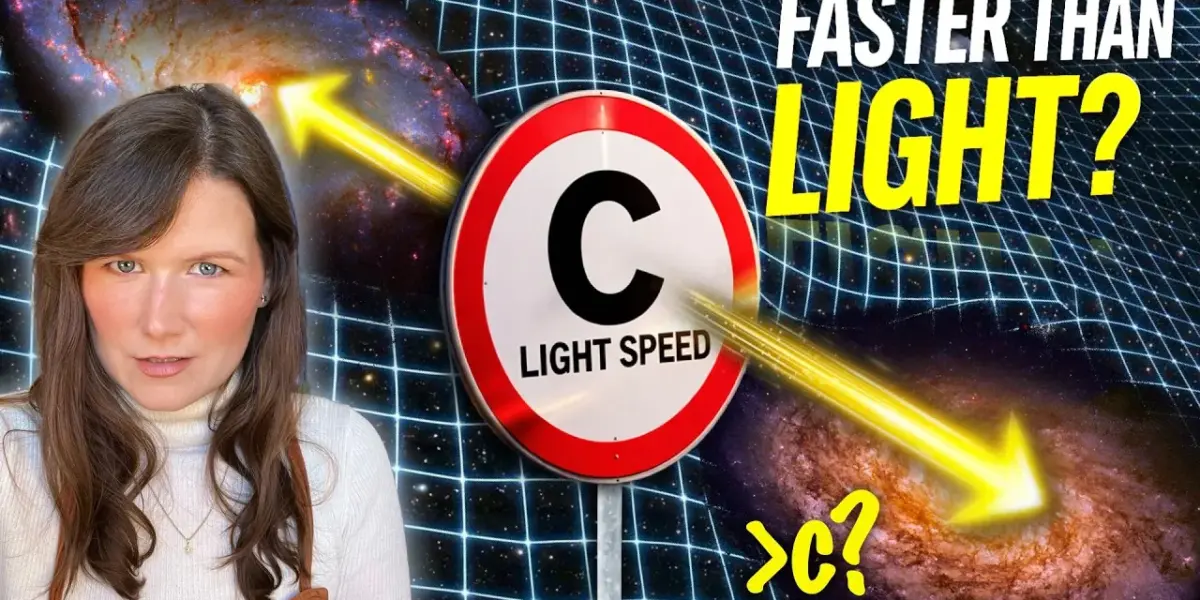
The universe appears to be expanding faster than the speed of light, a concept that seems to shatter one of physics’ most fundamental rules. However, this cosmic speedster doesn’t actually break Einstein’s famous law. The key lies not in galaxies moving through space, but in the very fabric of space itself stretching. This phenomenon, known as superluminal motion, is a mind-bending consequence of cosmic expansion, and understanding it reveals profound truths about our universe.
Galaxies on the Move: An Illusion of Speed
For decades, astronomers have observed that distant galaxies are moving away from us. In the 1920s, Edwin Hubble’s observations showed a clear pattern: the farther away a galaxy is, the faster it recedes. This isn’t because galaxies are hurtling through space at incredible speeds. Instead, the space between us and these distant galaxies is expanding, carrying them along for the ride.
Think of it like baking a fruitcake. The galaxies are like raisins embedded in the batter. As the cake bakes and the batter expands, the distance between the raisins increases. The raisins themselves aren’t moving through the batter; the batter itself is growing. This expansion stretches the light waves emitted by these galaxies. As the wavelength of light gets longer, it shifts towards the red end of the spectrum, a phenomenon called redshift. Scientists measure this redshift to determine how fast galaxies appear to be moving away.
For nearby galaxies, this redshift translates to speeds of a few hundred kilometers per second, a fraction of the speed of light. But for incredibly distant galaxies, like GN-z11, the numbers become astonishing. GN-z11, once the most distant galaxy known, has a redshift factor of 10.603. This indicates its light has traveled for about 13.36 billion years. When astronomers account for the expansion of space during this vast journey, they calculate that GN-z11 appears to be receding at 2.44 times the speed of light. This is where the apparent paradox arises, seemingly violating the universal speed limit of approximately 300,000 kilometers per second (186,000 miles per second) set by Einstein’s theory of relativity.
Peculiar Velocity vs. Cosmic Expansion
It’s crucial to distinguish between a galaxy’s actual motion through space and the apparent motion caused by cosmic expansion. Galaxies do have their own individual movements, influenced by gravity. These are called peculiar velocities, typically ranging from a few hundred to a few thousand kilometers per second. For our own Milky Way galaxy and its neighbor Andromeda, gravity is pulling them together, and they are expected to collide in a few billion years. These peculiar velocities are minuscule compared to the speed of light, representing only about 0.1% of it at maximum.
The superluminal recession observed in the most distant galaxies isn’t due to their own motion. It’s a direct result of the vast amount of space that has expanded between us and them over billions of years. The galaxies are simply passengers on this expanding cosmic fabric.
Why Space Expansion Has No Speed Limit
Einstein’s theory of relativity states that nothing with mass can travel faster than the speed of light. This limit arises because as an object approaches the speed of light, its mass increases, requiring infinite energy to reach that speed. However, this limit applies to objects moving *through* space, requiring a reference point to measure relative speed.
The expansion of the universe is different. It’s not about objects moving through space; it’s about space itself expanding. There is no medium or fixed point against which to measure a relative speed for this expansion. Asking if the universe is expanding faster than the speed of light is like asking if you are heavier than you are tall – the question doesn’t make sense because the units and concepts don’t align.
Scientists measure the expansion rate of the universe not as a speed (distance over time), but as a rate per unit of time. For example, the rate of expansion is often expressed in kilometers per second per megaparsec (a unit of distance). This means that for every megaparsec farther away a galaxy is, it appears to recede faster. When these units are analyzed, they cancel out the distance component, leaving only a rate per unit of time, akin to saying something doubled in size every second. This rate is not a speed in the traditional sense and is therefore not bound by the speed of light limit.
The Observable Universe and Beyond
The fact that space can expand indefinitely has profound implications. It means that at vast distances, galaxies can recede from us faster than light. Consequently, there are regions of the universe beyond our observable horizon – galaxies so distant that the light they emit will never reach us, no matter how long we wait. These galaxies are effectively lost to us forever, carried away by the relentless expansion of space.
Understanding cosmic expansion helps us grasp the true scale and dynamics of our universe. It highlights that our perception of speed is relative and deeply tied to the medium through which motion occurs. While galaxies may appear to break the speed limit, it is the universe itself, in its grand, ever-expanding nature, that defies our everyday intuitions about speed and distance.
Looking Ahead
The ongoing study of cosmic expansion, driven by advanced telescopes and cosmological models, continues to refine our understanding of the universe’s history and its ultimate fate. Future missions will aim to measure the expansion rate with even greater precision, seeking to unravel mysteries like dark energy, the force believed to be accelerating this expansion. These efforts promise to deepen our appreciation for the cosmos and humanity’s place within it.
Source: Expanding Faster Than Light? How the Universe "Breaks the Rules" (YouTube)

Related Articles


10-Year-Old’s Plea to NASA: Make Pluto a Planet Again!
A 10-year-old girl's passionate letter urging NASA to make Pluto a planet again has gone viral, prompting a direct response from the space agency. Kayla's heartfelt reasoning, including the idea that it would make people happy, has captured public imagination. NASA Administrator Jared Isaacman has stated the agency is "looking into this," sparking hope and discussion about Pluto's status.


Universe’s Expansion Accelerates, Then ‘Jerks,’ New Data Reveals
New data from the DESI project suggests the universe's expansion is not only accelerating but that the rate of acceleration is also changing. This phenomenon, known as a 'jerk' in physics, challenges current models and points to new mysteries about dark energy and cosmic evolution.


Stars Could Power Galaxy-Sized Starships
Scientists explore the feasibility of Jupiter becoming a star to power galaxy-sized starships and revisit Project Orion's nuclear propulsion concept. The article also delves into the science behind meteor storms, lunar water ice, ring galaxies, and the exciting return of human missions to the Moon with Artemis.