Ukraine’s Drone Doctrine Reshapes Global Warfare
Ukraine's hard-won lessons in drone warfare and air defense economics are rapidly reshaping global military strategies. From the U.S. adopting low-cost attack drones inspired by Iranian designs to Israel accelerating laser defense development, the battlefield is embracing affordable mass and layered defenses.


Ukraine’s Drone Doctrine Reshapes Global Warfare
Four years ago, the conflict in Ukraine began to fundamentally alter the calculus of modern warfare. A brutal lesson emerged from the battlefield: the potent combination of inexpensive drones and cheap munitions could systematically overwhelm and bankrupt even the most sophisticated and costly air defense systems. This paradigm-shifting understanding, honed through years of relentless conflict, has now seemingly crossed continents, manifesting in recent events over Iran, where American offensive capabilities and Israeli defensive technologies echo Ukraine’s hard-won playbook.
The war in Ukraine has not merely introduced new weaponry; it has catalyzed a profound shift in military thinking. It has compelled a re-evaluation of concepts like mass, cost, detection, and air defense survivability. This evolution is vividly illustrated by the increasing prominence of two key systems: the U.S. Loitering Unmanned Combat Attack System (LUCAS), a one-way attack drone, and Israel’s Iron Beam laser air defense system. These are not isolated technological advancements but rather tangible expressions of a global strategic reorientation, driven by the stark realities of the Ukrainian experience.
The Rise of Affordable Mass
Central to this transformation is the proliferation of drones. As the transcript highlights, drones became cheaper, more plentiful, and sufficiently effective. Their strength lay not in perfection but in sheer numbers, designed to force difficult and costly decisions upon defenders. Ukraine found itself in a constant, high-stakes dilemma: expend expensive interceptors on low-cost drones threatening critical infrastructure, or risk damage and conserve resources for higher-tier threats like cruise missiles? The options were stark: rely on less reliable gun systems, accept unavoidable damage, or ration precious inventory for future engagements.
This agonizing daily calculation became the operational rhythm of the Ukrainian war. It underscored a critical insight: quantity, coupled with affordability, could be a decisive weapon. The transcript notes that in 1991, air superiority might have been viewed as a binary condition. Today, it is increasingly defined by economic sustainability and logistical capacity. The question is no longer just *if* an intercept can be made, but *how long* the defense can sustain the expenditure of missiles, money, and patience.
The Iranian-designed Shahed-136 drone, locally known as Geran, became a symbol of this new reality. Russia’s extensive use of these drones against Ukrainian cities normalized their presence as a nightly threat. Characterized by their low cost, rudimentary engines, simple navigation, and sufficient payload to disable infrastructure, their primary strength was their mass. The objective was clear: compel Ukraine to deplete its limited supply of advanced interceptors and valuable attention on disposable targets.
Ukraine’s response was a testament to adaptability and survival. They employed every available means: Patriot systems when necessary, NASAMS, anti-aircraft guns, searchlights, mobile machine-gun teams, and even innovative airborne countermeasures. The goal was not elegance but sheer persistence and the preservation of critical assets.
The Ukraine Lesson Goes Global
The irony is palpable: reports now indicate the U.S. has employed low-cost, one-way attack drones, explicitly modeled on the Shahed design, in strikes against Iran. The LUCAS system, with a reported unit cost around $35,000, represents a deliberate strategic choice. This adoption of a reverse-engineered concept stems directly from Ukraine’s proof of concept: affordable mass has tangible, outsized operational and economic effects. Ukraine demonstrated that quantity itself could be a weapon, and the U.S. has evidently decided to adopt a similar approach.
The Defensive Imperative: Lasers and Layered Defense
Ukraine’s role as an unwilling instructor extends to air defense. Every time a cheap drone is downed by an expensive missile, the immediate engagement is won, but a piece of the war of endurance is lost. This economic attrition, faced nightly by Ukraine, has propelled directed energy weapons, like lasers, from theoretical concepts to urgent procurement priorities.
Ukraine’s public claims of developing laser weapons capable of downing targets at altitude, alongside reporting on the evolving capabilities of systems like the “Tisub,” underscore the strategic imperative. The conversation has shifted from a distant possibility to a present reality: missiles do not scale effectively against swarms of cheap drones. This is particularly relevant for Israel, which has long sought a cost-effective solution to counter persistent, low-cost threats, often emanating from Iran.
While Israel’s Iron Beam laser system predates the Ukraine war, the conflict has undeniably accelerated its perceived necessity. Ukraine’s experience has validated the idea that cheaper engagement options are crucial. The strategic effect of Ukraine publicly discussing laser capabilities, even in nascent forms, reinforces Israel’s pursuit of a system that dramatically collapses the marginal cost per shot. In an era dominated by drones and rockets, this cost-effectiveness is paramount.
Ukraine has also illuminated the other side of the mass equation: the complexity of modern attacks. These are not simple waves of drones but mixed salvos, incorporating decoys, timed to exploit defender reload windows, and designed to induce misidentification and rushed engagements. In such an environment, a laser defense layer acts as a pressure release valve. It allows defenders to conserve expensive interceptors for high-value targets and prevents the bleeding of resources one interceptor at a time. Ukraine has made the economics of air defense impossible to ignore, and Israel’s Iron Beam represents a sophisticated response to this challenge.
Integration and the Future Outlook
Beyond specific weapon systems, Ukraine’s air defense survival has hinged on integration. The effective fusion of sensors, queuing, handoff protocols, and layered engagement zones has been critical. Relying on a single sensor type or effector makes defenses vulnerable to circumvention or saturation. Ukraine’s national detection network, its integration of Western and legacy Soviet systems with indigenous AI-driven software, and its incorporation of acoustic sensors, mobile phones, and spotter networks into its air defense picture demonstrate this principle.
The U.S. offensive use of LUCAS and Israel’s defensive investment in lasers are both logical outcomes of the feedback loop created by the Ukraine war. Cheap drones spurred defensive adaptations, leading to layered sensors and cheaper countermeasures. Attackers responded with stealthier, more complex tactics, forcing further defensive evolution. This cycle has now gone global.
The recent conflict involving Iran, where the U.S. reportedly employed a mix of LUCAS drones, TAM drones, and air-launched munitions, exemplifies the Ukrainian playbook: blend mass with precision effects to force defenders to address multiple threats simultaneously. Israel’s move towards lasers aligns with the same logic – adding a cost-effective layer to avoid expending high-value assets on low-cost threats.
Why This Matters
The Ukraine war has irrevocably altered the landscape of air and missile defense. It has demonstrated that cost-per-shot and sustainability are as vital as technological sophistication. Militaries worldwide are now compelled to embrace affordable mass and architect layered, integrated defense networks where economic endurance can determine battlefield success. Ukraine, through immense sacrifice, has become the unwilling proving ground for these concepts, and the lessons are rapidly being absorbed and implemented by other global powers.
Implications and Future Outlook
The implications are far-reaching. We can expect a continued proliferation of cheap, mass-produced drones, alongside increasingly sophisticated counter-drone systems, including directed energy weapons and advanced automation. The tempo of modern warfare is accelerating, driven by technological advancements that often outpace diplomatic or strategic adaptation. The global military landscape is now more dynamic, with a premium placed on rapid adaptation, economic resilience, and the intelligent integration of diverse capabilities. The lessons learned in Ukraine are not confined to Eastern Europe; they are reshaping global defense strategies and will undoubtedly define future conflicts.
The transcript concludes with a stark reminder: “Ukraine taught that class. Everyone else is just copying their homework.” This assertion underscores the profound and often unacknowledged impact of Ukraine’s struggle on contemporary military doctrine. The planet watched, and now, the world is adapting.
Source: Ukraine’s Drone War Playbook Just Hit Iran (YouTube)

Related Articles
Ukraine War Experts Train British Army in Drone Warfare
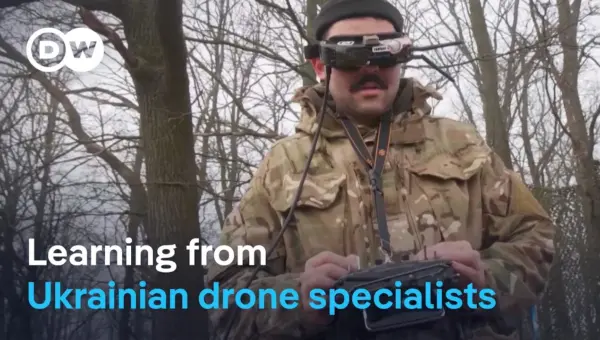
Ukrainian soldiers, masters of drone warfare, are sharing their battlefield expertise with the British Army in a secret training program. This exchange offers invaluable insights into the realities of modern conflict, particularly the extensive use of drones. The initiative also includes innovative uses of 3D printing for drone production.


Ex-Army Major Warns of ‘Death Trap’ for US Troops in Iran Conflict
A recent Iranian strike injuring 12 U.S. troops in Saudi Arabia highlights the vulnerability of American forces, according to former Army Major Harrison Mann. He warns that proposed ground operations, particularly on islands like Kharg, could become a "death trap" due to Iran's missile capabilities and the lack of adequate defenses.


Kremlin Shakes: Elite Discontent Fuels Putin’s Paranoia
Internal turmoil and paranoia are reportedly gripping the Kremlin as President Putin faces growing elite discontent and the realities of the Ukraine war. Meanwhile, Russia's strategic involvement in the Iran conflict highlights complex calculations and potential risks, even as a wider global war remains unlikely.