Ukraine Aid Cuts Cost Americans More Than Support
Cutting support for Ukraine has cost Americans more in increased energy prices than the aid itself would have, a new analysis suggests. The decision has also damaged global trust, with far-reaching implications.


Ukraine Aid Cuts Cost Americans More Than Support
Sometimes, what seems obvious on the surface is actually the opposite when you look closer. This is especially true in politics, where people often only hear one side of a story. A recent analysis suggests that Americans are now losing more money because the U.S. cut back on supporting Ukraine than they would have if the U.S. had continued its support. This might sound strange, but it comes from looking at the bigger picture and how decisions affect everything else.
The Energy Crisis and Ukraine’s Strikes
The current energy crisis is partly linked to Ukraine’s actions against Russian energy targets. Ukraine has started hitting Russian oil export terminals, stopping about 40% of Russia’s exports. This is a big deal because it affects global energy prices. Interestingly, the U.S. and its allies had asked Ukraine to stop these attacks. However, Ukraine has continued because the U.S. no longer has much influence over Ukraine after reducing its support.
This change in Ukraine’s strategy, driven by less U.S. support, is now costing the average American consumer more. The speaker argues that the increased price of gasoline alone, due to these events, costs Americans more per month than supporting Ukraine would have. This is just one example; other costs, like damage to global relationships and increased military spending, are harder to measure but also significant.
Historical Context: Early War Restrictions
Early in the war, Ukraine was very dependent on support from the U.S. and Europe. Because of this, Ukraine had to follow the rules set by its Western partners. This meant Ukraine couldn’t always use the weapons provided to strike Russian targets, even when it was strategically important. For example, Russia had aircraft parked near the Ukrainian border that Ukraine could have destroyed, but they didn’t have permission from their Western partners to do so.
Similarly, Russia was able to gather troops near the Ukrainian border without Ukraine being able to stop them effectively. The U.S. also explicitly told Ukraine not to attack Russian energy infrastructure. The reason given was to avoid increasing global energy prices, which could hurt U.S. politicians at the polls. This pressure limited Ukraine’s options and allowed Russia to continue generating revenue to fund its war machine.
The Shift in Strategy and Its Costs
Now, Ukraine has decided to strike Russian energy targets despite U.S. pressure. This is because U.S. support is no longer as meaningful to them, and they are willing to risk losing it. If the U.S. had continued to provide strong support, Ukraine might have had more options. One possibility is that Ukraine could have won the war by now, leading to peace talks where Russian energy would remain on the market. Alternatively, if support had continued, Ukraine likely would not have attacked Russian energy infrastructure, as they didn’t do so earlier in the war.
Measuring the Financial Impact
The analysis attempts to measure the financial cost. Increased global energy prices, partly due to Ukraine’s strikes on Russian exports, mean the average American consumer spends an extra $35 to $45 per month on gasoline alone. When factoring in other increased costs, this could reach $200 per month. The speaker estimates that about 12.5% of these price increases can be attributed to Ukraine’s actions against Russia’s oil exports.
This 12.5% of $200 comes out to about $25 per month for the average American consumer. This figure is presented as a direct cost resulting from Ukraine’s new strategy. In comparison, the total U.S. military aid provided to Ukraine was about $70 billion over three years. Divided among all Americans, this amounts to roughly $6 per person per month. Even if the U.S. had provided double or triple that amount, it would still be less than the $25 per month increase in energy costs.
Re-evaluating the Cost of Aid
The $70 billion figure for aid is also questioned. The speaker argues that this number often represents the replacement cost of equipment, not its actual value. Much of the equipment sent was already slated for decommissioning and would have cost money to scrap. Instead, the U.S. paid to ship it to Ukraine. Furthermore, replacing this equipment meant money was spent within the U.S. economy, paying American businesses and workers.
The real cost to the average American for aid might have been closer to $3 to $4 per month. This is significantly less than the $25 per month increase in energy costs. The argument is that supporting Ukraine financially would have been the better deal, not only saving money but also preserving Ukrainian lives and cities.
Broader Benefits and Global Trust
Beyond direct costs, supporting Ukraine offered benefits to the U.S. The U.S. military budget is vast, with a significant portion dedicated to countering Russia. Ukraine, at a relatively low cost to the U.S., has effectively weakened an adversary that the U.S. spends billions to counter annually. This could be seen as a significant bargain for the American people.
However, withdrawing support from Ukraine, especially in the way it was done, has damaged global trust in the U.S. This loss of trust can disrupt global trade and U.S. influence, which have historically benefited the American economy. The U.S. has benefited greatly from its role in the global system, partly due to its military’s protective role and its reserve currency status. Damaging this system by not being a reliable partner comes at a high, though unquantifiable, cost.
Why This Matters
This analysis highlights the importance of looking beyond surface-level political narratives. Decisions, especially in geopolitics, have complex ripple effects. The argument presented is that the U.S. focus on the upfront costs of supporting Ukraine, rather than the long-term benefits and consequences of withdrawing support, has proven to be a costly mistake. It suggests that a more systemic view, considering all outcomes, is crucial for effective policy-making.
Implications and Future Outlook
The situation underscores how internal political debates can lead to decisions with significant unintended consequences on a global scale. The increased energy costs for consumers are a direct, measurable outcome. The erosion of global trust is a less tangible but potentially more damaging long-term effect. As geopolitical alliances and economic systems continue to evolve, nations that prioritize strategic, long-term thinking over short-term political gains may find themselves better positioned.
Source: Abandoning Ukraine Has Backfired on the U.S. MASSIVELY (YouTube)

Related Articles

Bolton: Trump’s Iran Threats Show Panic, Not Strategy
Former National Security Adviser John Bolton characterized Donald Trump's strong rhetoric towards Iran as a sign of panic driven by domestic political concerns. He believes Trump's decision-making lacks strategic depth, potentially creating international instability. Bolton also discussed the upcoming talks involving Vice President JD Vance and the ongoing risks of escalation.


US Troops Surge as Iran Conflict Looms Again
US forces are surging into the Middle East amidst a fragile ceasefire with Iran. Heavy troop and equipment movements suggest preparation for renewed combat operations if diplomatic talks fail. The closure of the Strait of Hormuz remains a critical point of tension with significant global economic impacts.

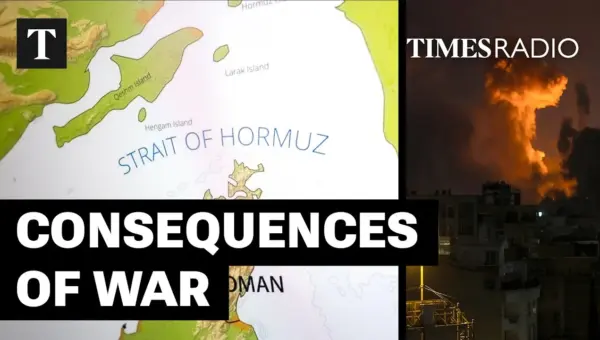
Iran Gains Strait of Hormuz Control Amidst War
Top US officials are traveling to Pakistan for critical talks with Iran, facing preconditions including a ceasefire in Lebanon and the release of blocked assets. Iran's de facto control over the Strait of Hormuz has emerged as a significant leverage point in the escalating regional tensions. The negotiations are expected to be tough, with both sides holding firm positions on key issues.