UConn’s Depth, UCLA’s Grit Shine in Final Four
Andraya Carter breaks down the Final Four-bound UConn and UCLA teams, highlighting UConn's depth and UCLA's resilience. She also discusses coach Geno Auriemma's concerns about tournament scheduling and its impact on player performance.

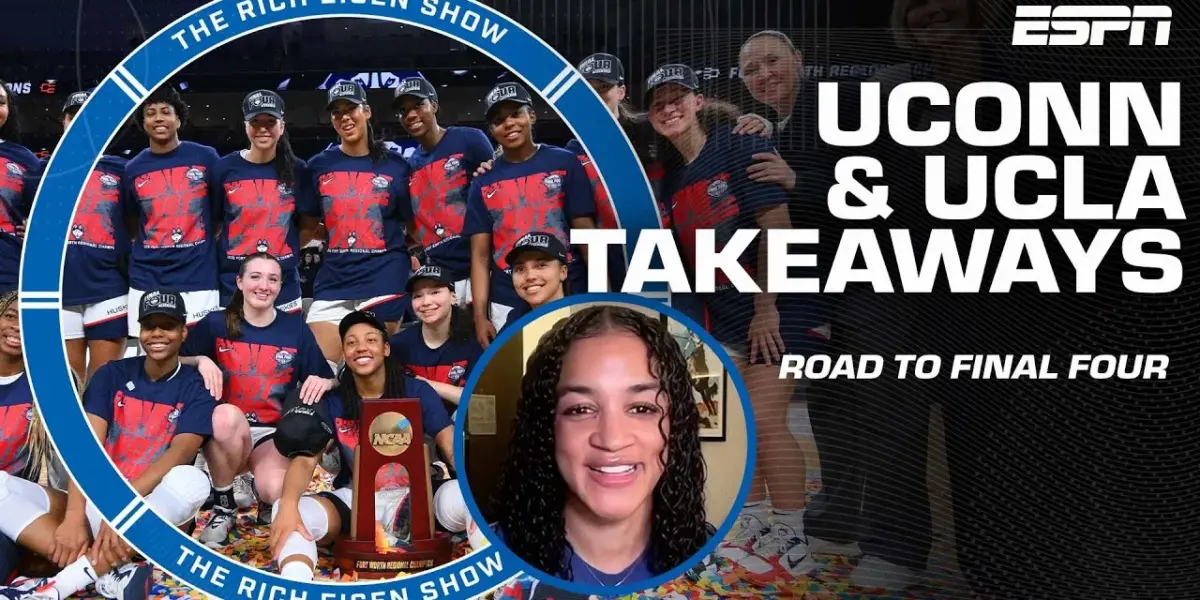
UConn’s Depth, UCLA’s Grit Shine in Final Four
The NCAA Women’s Final Four is set, and two powerhouse teams, UConn and UCLA, have punched their tickets with impressive wins. UConn showed its incredible depth and versatility, while UCLA battled through a tough game against Duke, proving their resilience. Analyst Andraya Carter broke down what we learned from their victories on The Rich Eisen Show.
UConn’s ‘Plug and Play’ Pieces Impress
Connecticut faced tough competition on their road to the Final Four, battling through games against North Carolina and Notre Dame. Coach Geno Auriemma mentioned he didn’t like aspects of the Notre Dame matchup, especially against player Hannah Hidalgo, who had a special run. However, UConn’s strength lies in its adaptability and talent across the roster.
Sarah Strong stood out with her versatility. Although she’s a post player, she can bring the ball up the floor and participate in guard actions, keeping the offense flowing smoothly. This flexibility is a major asset. Carter noted that Notre Dame struggled to guard Sarah Williams, prompting Auriemma to use Jana L. Alfie more in the second half because she’s a better perimeter shooter.
The depth of UConn’s team was a key takeaway. When star player A’ja Wilson struggled to hit her usual three-pointers, with opponents running her off the line, it was Breaonna Kinyones who stepped up off the bench. Kinyones was called the biggest difference-maker in several games, providing crucial scoring when Wilson had a quiet day. This ability to ‘plug and play’ different players and pieces makes UConn a formidable opponent.
Auriemma, heading to his 25th Final Four, highlighted that this is a first-time experience for many of his players, like Kaylee Heckle and Kinyones. Carter found this sentiment particularly special, showing the coach’s focus on developing his team beyond just his own achievements.
UCLA Overcomes Pressure, Led by Betts
UCLA also secured their spot in the Final Four, overcoming a strong challenge from Duke. Duke played well and had the lead for much of the game, but UCLA managed to pull out the win. Carter pointed out the significant impact of UCLA’s center, Lauren Betts.
Defending Betts is a taxing task for opponents. Her presence on the floor wears teams down, and even if they can contain her for a half, UCLA found ways to get her the ball. A key moment Carter highlighted was a sideline out-of-bounds lob pass to Betts on the block, leaving Duke with no answer. Coach Cori Close found creative ways to utilize Betts in the second half, helping secure the win.
The pressure was on UCLA, as Duke had nothing to lose. Despite this, UCLA didn’t fold and managed to secure the victory, impressing Carter with their ability to handle the intense situation.
Auriemma’s Concerns About Tournament Structure
A significant discussion point was Auriemma’s post-game comments regarding the NCAA tournament’s structure. He expressed frustration with the scheduling and preparation times for teams, suggesting it negatively impacts the quality of play, particularly three-point shooting.
Auriemma pointed out the limited shootaround times, often early in the morning, and the late practice slots for opposing teams. He questioned whether those making the decisions ever consult coaches or players about what works best. He also mentioned the issue of using new basketballs straight out of the box, which can affect shooting.
Carter fully agreed with Auriemma’s points. As a former player, she understands how crucial shootaround times are for getting familiar with the rims, the arena, and the overall environment. These factors play a big role in a player’s performance.
She recalled a time during the regular season when teams could choose from a few basketballs to find one that felt best. This kind of familiarity with equipment and venue is common in professional sports, like NBA and WNBA teams getting into arenas early to practice. Carter emphasized that in any profession, you want to be familiar with the tools you’ll be using.
The limited time for shootarounds, packed schedules, and 30-minute practice sessions don’t promote the best product on the floor. Carter believes that more time for players to get comfortable is essential, especially in high-pressure, win-or-go-home games. She hopes that changes will be made to value players and help them feel their best heading into crucial matchups.
Auriemma suggested that perhaps media obligations could be shifted, with postgame media followed by a morning session the next day, rather than late-night and early-morning sessions. Carter agreed, questioning the need for two media sessions so close together, especially when players need rest. She believes finding ways to give players more time to prepare is vital for the game’s growth.
Looking Ahead to the Final Four Matchups
The conversation then turned to the upcoming Final Four games. Carter expressed excitement for the matchups, particularly highlighting her surprise and admiration for Michigan’s poise.
She noted that Michigan’s young sophomores, like Laila Swartz, Emily Dowd, and Jordan Holloway, have shown incredible composure. This poise will be tested against Texas’s relentless defense, led by coach Vic Schaefer, known for his defensive schemes.
Carter believes Michigan’s players are fearless, citing examples like Swartz forgetting missed shots and Olivia Olson scoring 27 points in a second half after a scoreless first half. This ability to move on to the next play is crucial against a tough Texas team.
For South Carolina, their on-the-ball defense against ball screens will be a key factor. Coach Dawn Staley has worked on this all season, and it will be put to the ultimate test against Olivia Miles, who is exceptional at using ball screens. Joyce Edwards will also need to perform well.
However, Carter was particularly impressed by South Carolina’s guards, Raven Johnson, Tessa Johnson, and MiLaysia Fulwiley, in their game against Oklahoma. If these three guards play with collective confidence and offensive aggression, it could be the key for South Carolina not only to beat TCU but also to compete for a national championship.
A Friendly Wager Settled
The show also revisited a friendly bet between Rich Eisen and Andraya Carter concerning Michigan and Tennessee. Carter had bet Eisen that if Michigan lost to Tennessee in the Elite Eight on the men’s side, she would have to sing Tennessee’s fight song, ‘Rocky Top,’ and wear Reese’s candy.
As it turned out, Michigan defeated Tennessee. Eisen humorously had Carter sing Michigan’s fight song, ‘The Victors,’ instead. Carter admitted she hadn’t even looked up the lyrics for ‘The Victors’ because she was so confident Tennessee would win. Eisen playfully teased her about it, calling it ‘salt in the wounds’ for her bet loss.
The segment ended with Carter looking forward to seeing Eisen again, promising to run back the bet in other sports like baseball or softball, as Tennessee is an ‘everything school.’ Eisen acknowledged the ongoing friendly rivalry.
Source: Andraya Carter’s lessons learned from UConn and UCLA’s run to the Final Four | The Rich Eisen Show (YouTube)

Related Articles


Karaban’s Movie Moment Seals UConn’s Final Four Berth
Alex Karaban describes the thrilling final moments of UConn's Elite Eight win over Duke, where a clutch pass led to a game-winning shot. He credits intense practices and deep trust for the team's composure under pressure. The Huskies now set their sights on winning a national championship, with Karaban acknowledging the historic opportunity before them.

Texas Heads to Final Four, Beats Michigan 77-74
The Texas Longhorns are heading to the Final Four after a thrilling 77-74 victory over the Michigan Wolverines in the Elite Eight. Madison Booker and Jordan Lee led the charge for Texas, securing their second consecutive Final Four appearance. Michigan fought valiantly but couldn't overcome the Longhorns' late-game execution.

UCLA’s Floor Party Ignites: BJ Doss’s Dance Magic!
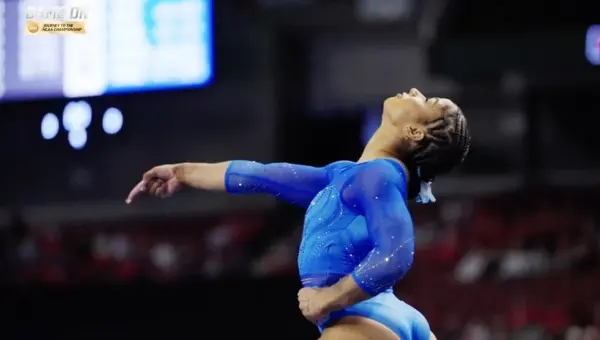
BJ Doss is transforming UCLA's floor routines with her professional dance background. Her creative choreography has led to individual championships and perfect 10s, making the 'floor party' a highlight of college gymnastics.