Turkey Navigates Tense Iran-US Standoff After Missile Incident
Turkey reported its NATO air defenses intercepted an Iranian ballistic missile near its airspace, escalating regional tensions. The incident places Ankara in a precarious position, balancing its NATO commitments with its complex relationship with Iran, a nation with which it shares deep interdependencies.

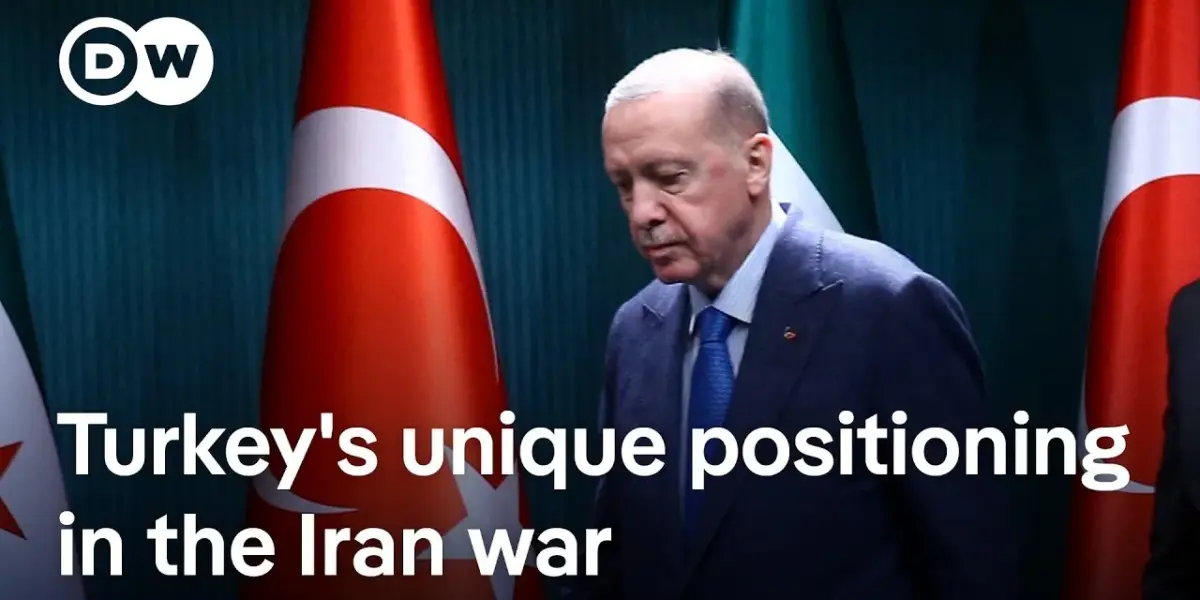
Turkey Intercepts Iranian Missile Near Its Airspace
Ankara, Turkey – Tensions flared in the Middle East this week as Turkey reported that NATO air defenses intercepted an Iranian ballistic missile fired towards its airspace on Wednesday. While Iran has denied targeting Turkish territory, the incident marks a significant escalation, bringing the widening regional conflict perilously close to a key NATO member. This event has placed Turkey, a nation with intricate geopolitical ties, in an even more precarious position, attempting to balance its allegiance to the United States and NATO with its complex relationship with its powerful neighbor, Iran.
Ankara’s Balancing Act: Between NATO Ally and Regional Power
The missile incident, though no one was injured, underscores the growing risks for countries bordering the escalating conflict zones. Turkey hosts crucial NATO military installations, including the Incirlik Air Base, which has been home to U.S. forces for decades. These sites are precisely the kind of strategic locations Iran has previously warned it would target in the event of an American attack. The easy answer to why Iran might hesitate to strike such targets is Turkey’s NATO membership and the mutual defense clause of Article 5, which would draw the entire alliance into any conflict. However, the relationship between Turkey and Iran is far more nuanced than a simple military alliance would suggest.
Deep Interdependencies Shape Turkey-Iran Relations
Despite being regional rivals, Turkey and Iran share a unique interdependency, characterized by energy pipelines and a lengthy shared border. This deep connection sets their relationship apart from those of other regional pairings. Historically, both nations have striven to avoid direct confrontation, a strategy that has helped Ankara carefully calibrate its response to the ongoing crisis. Turkish President Recep Tayyip Erdoğan has been vocal in his criticism of U.S.-Israeli strikes, deeming them illegal, and has offered condolences for the death of Iran’s Supreme Leader Ali Khamenei. Furthermore, Turkey has insisted that its territory and airspace would not be used for operations against Iran. Yet, President Erdoğan has also condemned Iran’s retaliatory attacks and called for de-escalation from all parties.
“Our priority is to achieve a ceasefire and open the door to dialogue. Let me be very clear. If the necessary intervention is not made, the conflict will have serious consequences for regional and global security.”
Geographical Risks and Refugee Concerns
Beyond the strategic and political considerations, Turkey’s geography presents another compelling reason to avoid further escalation. With a border stretching over 500 kilometers with Iran, any instability on the other side could trigger significant refugee flows, economic disruptions, and security concerns, particularly related to Kurdish militant groups operating in Iran. These are challenges that would be exceedingly difficult for Turkey to manage, further reinforcing Ankara’s commitment to maintaining a delicate balance.
Turkey’s Unique Diplomatic Position
For now, Turkey is attempting to walk a tightrope, aiming to avoid being drawn into the conflict while preserving functional relations with both its NATO ally, Washington, and its neighbor, Tehran. This strategic positioning has made Turkey one of the few NATO capitals capable of engaging in dialogue with Tehran, Washington, and Gulf nations simultaneously. The moment Turkey is perceived as a belligerent party, this unique diplomatic value diminishes, a fact well-understood by both Iran and the United States, and actively managed by President Erdoğan.
Concerns Over Shifting U.S. Goals and Kurdish Separatism
Experts suggest that Turkey’s cautious approach is also influenced by concerns over shifting U.S. objectives in Iran. Initially focused on Iran’s nuclear and ballistic missile capabilities, the situation is increasingly being viewed as a potential regime-change operation, a prospect that deeply alarms Ankara. The possibility of instability within Iran, potentially leading to ethnic fighting or civil war, coupled with fears of renewed migration flows, is a significant concern. Moreover, reports of potential U.S. engagement with Kurdish forces within Iran have further strained Turkish-U.S. relations. Turkey has long opposed any moves towards Kurdish autonomy on its borders, especially if they involve groups with ties to the PKK, such as the PYD, which it views as a direct threat.
A Curious, Long-Standing Relationship
The relationship between Iran and Turkey is often described as curious. As centuries-old neighbors with one of the oldest shared borders in the world, they are neither allies nor friends but historic rivals. As the strongest Shia and Sunni states in the region, they have engaged in proxy battles in Syria and Iraq. However, their relationship is fundamentally built on the principle of non-interference in each other’s internal affairs, a policy that has endured for approximately 400 years. Despite concerns over Iran’s nuclear program and ballistic missiles, Turkey has no desire to be involved in the overthrow of the Iranian regime.
NATO’s Role and Future Uncertainty
The recent missile incident highlighted the critical role of NATO’s air defense systems in Turkey’s security, underscoring the value of its long-standing alliance despite periods of tension and Turkey’s pursuit of strategic autonomy. Looking ahead, the prognosis for the region remains uncertain, with a potential for prolonged chaos and instability. Turkey’s ability to influence this outcome is currently limited, but its diplomatic channels may become crucial should the situation evolve. The U.S. administration’s goals in Iran appear increasingly geared towards a long-term, open-ended, and potentially chaotic scenario, leaving Ankara bracing for instability and seeking off-ramps for de-escalation.
Source: Can Turkey keep walking the Tehran-Washington tightrope? | DW News (YouTube)

Related Articles

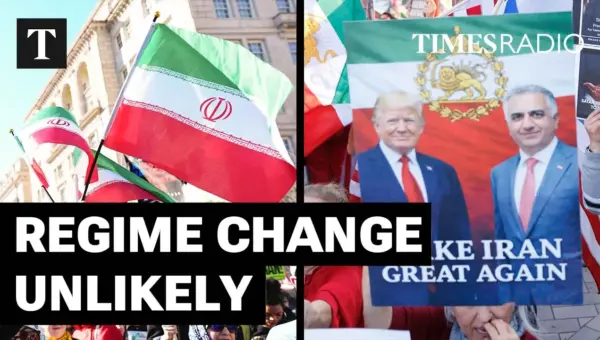
Iran’s Regime Change: Experts Doubt Uprising’s Success
Experts believe a large-scale uprising for regime change in Iran is unlikely due to a lack of organization and a coherent political alternative. While 80% of Iranians desire change, the path forward remains challenging, with internal organization being key.


Iran Unleashes Brutal Weapons Amid Escalating Regional Conflict
Iran is deploying "horrific weapons," including cluster munitions, in an escalating conflict with Israel and other regional targets. The US responds with precision strikes as the war intensifies.


Iran’s President Rejects Unconditional Surrender Amid Tensions
Iranian President Massud Peshkan has apologized to neighboring countries, stating Iran will not attack unless provoked. This comes as US President Trump demands unconditional surrender and warns of severe retaliation.