Trump’s Iran War Plan Sparks Confusion Amidst Shifting Narratives
President Trump's handling of the escalating conflict in Iran is facing intense scrutiny due to conflicting statements and a perceived lack of strategic planning. Concerns are mounting over the war's objectives, its origins, and its potential to destabilize global security.


Trump’s Iran War Strategy Under Scrutiny After Conflicting Statements
New questions are emerging regarding President Donald Trump’s strategy in Iran following a series of recent public statements that have fueled concerns about a lack of clear planning and consistent messaging. The president’s remarks, made in the wake of an Iranian drone attack that killed six U.S. soldiers in Kuwait last week, have drawn sharp criticism from analysts and former officials who argue the administration’s approach is dangerously improvisational.
‘Boots on the Ground’ and Shifting Blame for School Bombing
Speaking to reporters aboard Air Force One after attending a dignified transfer ceremony for the fallen soldiers, Trump did not rule out the possibility of deploying U.S. troops into Iran, stating he would do so “possibly for a very good reason.” He also expressed a desire to prevent Kurdish forces from entering Iran, fearing it would further complicate an already complex conflict. Compounding the confusion, Trump repeatedly asserted that Iran, not the United States, was responsible for bombing an elementary school in southern Iran. This claim stands in stark contrast to statements made by Defense Secretary Pete Buttigieg, who confirmed the U.S. was investigating the incident. According to Reuters, two U.S. officials indicated that military investigations suggest U.S. forces were likely responsible for the deadly strike, a detail Trump has yet to substantiate with evidence.
“Trump has treated the opening week of the war as an improvisational jazz session, riffing on different analyses, strategies and endgames… This is not deliberate strategic ambiguity to throw an adversary off base, but rather a symptom of genuine confusion.”
The Atlantic
Analysts Decry ‘Cacophony’ of Strategy
Rick Stengel, an MSNBC political analyst and former Undersecretary of State for Public Diplomacy and Public Affairs, expressed grave concerns about the administration’s approach. “If you don’t know where you’re going, any road will take you there. That seems like the strategy in Iran,” Stengel stated. He highlighted the president’s inability to articulate a clear objective, whether it be regime change, eliminating nuclear weapons, or aiding Israel. Stengel described the current situation not as strategic jazz, but as “cacophony,” deeming it “very, very, very dangerous.” He lamented the launch of such a large-scale war with what appears to be minimal planning and strategy, invoking Sun Tzu’s adage that prioritizing tactics over strategy is a recipe for disaster.
Israel’s Role and Divergent U.S.-Israeli Interests
The transcript also points to Israel’s significant influence in the escalation of the conflict. Reports suggest that Israel was considering a strike in the summer of 2026, but this was moved up following discussions between the Israeli Prime Minister and President Trump, reportedly due to protests in Iran the previous month. This timing raises questions about whether the U.S. was reacting to an Israeli opportunity rather than executing a pre-meditated strategy. Stengel noted the disturbing nature of launching a war of this magnitude based on reactive circumstances. He emphasized that evidence suggests Israel has been a driving force behind the conflict, and critically, that U.S. and Israeli interests are not aligned. The bombing of Lebanon by Israel and the elimination of Iran’s second and third-tier leadership, which Trump acknowledged were potential successors, are cited as examples of this divergence.
Propaganda and the Tarnished U.S. Brand
The administration’s public diplomacy efforts surrounding the conflict were also scrutinized. A montage of promotional clips featuring dramatic music, movie references, and assertive slogans like “I am the danger” and “Maximum method” was presented. Stengel characterized these as “straight up propaganda” and “pretty juvenile,” suggesting they evoke an image of the U.S. as the “ugly American” where power precedes all else. He argued that while America’s technological prowess is acknowledged, using it for lethal purposes damages the U.S. brand and global reputation.
National Security Ramifications and Global Ripple Effects
Beyond the immediate conflict, significant national security concerns are being raised regarding the war’s broader economic and geopolitical consequences. The Treasury Department’s decision to relax sanctions, allowing India to purchase oil and energy from Russia, was presented as a response to high gas prices. This move, however, is seen as contradictory given Russia’s alleged involvement in aiding Iran’s targeting of American service members. Representative Ruben Gallego’s tweet highlighted the apparent oversight: “Nobody in the White House thought starting the war in the Middle East might affect oil prices.” Stengel echoed these concerns, worrying that the administration has not fully considered the ripple effects of its actions, potentially creating new messes or national security vulnerabilities.
The decision to ease sanctions on Russia while it allegedly assists Iran in targeting U.S. troops was described as “gobsmackingly awful” and indicative of hypocrisy, potentially driven by concerns over upcoming elections and gas prices. Furthermore, the conflict’s impact on China, a significant importer of Iranian oil and Persian Gulf energy, was also discussed. China’s potential reaction and its own geopolitical ambitions could be emboldened by U.S. actions in the region. Stengel concluded that the administration, along with Israeli actions, has provided “permission slips” for Russia and China to disregard international norms and rules, undermining global stability and American public diplomacy.
Looking Ahead: Awaiting Strategic Clarity
As the conflict in Iran unfolds, the international community and domestic observers will be closely watching for any signs of a coherent strategy emerging from the Trump administration. The apparent lack of clear objectives, the conflicting narratives surrounding key events, and the potentially destabilizing geopolitical ripple effects necessitate a swift clarification of the U.S. endgame. The coming weeks will likely reveal whether the current approach is a deliberate, albeit complex, maneuver or a dangerous continuation of reactive decision-making.
Source: Trump’s top promises IMPLODE with Iran War and job losses (YouTube)

Related Articles
Bombed Hospitals, Deported Families: War’s Hidden Human Cost
Beyond the geopolitical headlines, the true cost of escalating conflicts like the one involving Iran, Israel, and the U.S. is borne by civilians. Doctors Ida Brown and Sonia Sloan highlight the devastating impact on healthcare infrastructure, the erosion of moral authority, and the dangerous desensitization to mass atrocities. The piece also exposes a profound hypocrisy within the U.S., where military service members can face deportation for their undocumented family members.
US Iran War: Trump’s Policy Shakes Allies, Risks Election
The United States has launched an unexplained war in Iran, sparking concern among allies and domestic voters. The conflict's unclear objectives and potential impact on upcoming elections are major points of contention. Russia's global standing is also affected, with its alliances weakening.
GOP Rhetoric Fuels Christian Nationalist ‘Crusade’ Fears
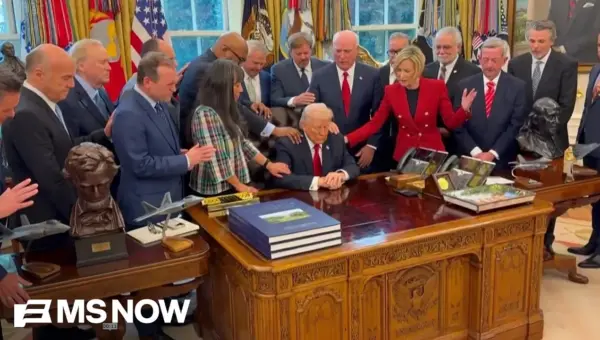
Concerns are rising over the infusion of Christian nationalist ideology into U.S. foreign policy, with critics warning of a 'crusade' mentality. Rhetoric from some Republican figures frames international conflicts and domestic issues through a specific religious lens, sparking fears of alienation and a departure from secular governance.