Trump’s Greenland Ultimatum: Europe Urged to Stand Firm Against Tariff Threats
Donald Trump has announced a significant tariff threat against eight European nations, escalating to 25% by June 1st, if they do not support the sale of Greenland to the United States. This ultimatum has prompted strong calls for Europe to abandon appeasement strategies and stand firm against what is described as a dangerous weaponization of trade for territorial gain, with significant implications for transatlantic relations and the global order.


Trump’s Greenland Ultimatum: Europe Urged to Stand Firm Against Tariff Threats
In a dramatic escalation of international tensions, former U.S. President Donald Trump has announced a looming tariff threat against eight European nations. The ultimatum, set to commence on February 1st with a 10% tariff, will escalate to 25% by June 1st if these countries do not agree to support the controversial sale of Greenland to the United States. This move has reignited a debate over Trump’s intentions regarding the autonomous Danish territory, with observers now confirming his “deadly serious” commitment to the acquisition.
A Bold Demand and Escalating Tariffs
The announcement sends ripples across the transatlantic alliance, presenting European leaders with a stark choice. The proposed tariffs target countries that have reportedly agreed to send forces to Greenland, a detail that adds another layer of complexity to the geopolitical maneuver. While the specific nations remain unnamed in the initial announcement, the threat of punitive economic measures underscores a renewed aggressive stance from the former U.S. leader.
Greenland, an autonomous territory within the Kingdom of Denmark, holds significant strategic importance due to its vast natural resources, including rare earth minerals, and its critical geographical position in the Arctic. Its location offers potential military advantages for monitoring sea lanes and ballistic missile defense, making it a coveted asset in an increasingly competitive geopolitical landscape. Trump’s previous expressions of interest in purchasing Greenland during his presidency were met with firm rejection by Denmark, which dismissed the idea as “absurd.” This latest tariff threat suggests a non-traditional, economically coercive approach to achieve the same objective.
The Perils of Appeasement: A Call for European Resolve
Against this backdrop, a prominent American voice has issued a strong appeal to European allies: do not back down. Critics of past European strategies argue that a policy of appeasement towards Trump has proven ineffective and detrimental to European interests. “Do not back down in this confrontation,” advises a notable American political observer, reflecting a sentiment that previous concessions have only emboldened rather than mollified the former President.
Historically, European powers and the European Union have often navigated relations with Trump through a strategy of offering concessions, flattery, and even personal gifts. This approach, intended to de-escalate tensions and preserve vital transatlantic ties, is now widely viewed as a failure. “This strategy has not worked and should be abandoned immediately,” argues the observer, characterizing Trump as a “bully who wants to dominate everyone around him” and who “despises weakness and those who display it.”
A case in point frequently cited is a trade deal struck between the EU and the Trump administration in a previous term. This agreement saw the EU accept a 15% tariff on European goods without implementing reciprocal tariffs on American products. This decision is now critiqued as a “bad decision,” highlighting a missed opportunity for the EU, an economic bloc comparable to the United States in population and wealth, to demonstrate a unified and retaliatory stance.
Greenland: A Precedent for Future Demands?
The core concern among those urging European resistance is the precedent that conceding Greenland would set. The argument is that acquiescing to such a demand would not satisfy Trump but rather encourage further territorial or economic demands down the line. “What makes any European think that conceding Greenland will mollify Trump? He will simply come back for more later,” warns the observer, underscoring the belief that a policy of appeasement merely invites further aggression.
The implications of such a concession extend far beyond the immediate issue of Greenland. It raises fundamental questions about national sovereignty, international law, and the integrity of the global trading system. Allowing a major power to use economic leverage to force the sale of territory from an ally could destabilize established norms and create a dangerous new precedent for international relations.
Challenging the Rationales for Concession
European leaders have often justified a concessionary policy by citing their reliance on the United States for security, particularly in managing threats from Russia, and a desire to avoid a mutually destructive trade war. However, these justifications are increasingly being challenged.
The argument regarding security dependence is countered by the observation that “Trump’s America has amply demonstrated that it will not be a reliable ally when push comes to shove.” Evidence cited includes the perceived abandonment of Ukraine and a shift in American priorities, as indicated in its national security strategy document, which suggests Europe has fallen behind the Western Hemisphere in terms of U.S. focus. This perceived unreliability undermines the traditional security rationale for appeasement, forcing European nations to re-evaluate their strategic autonomy.
Furthermore, the fear of a trade war is increasingly seen as an unavoidable reality rather than a deterrent. Proponents of a firmer stance point to the experience of other major global economies, such as Brazil, India, and China, which stood up to Trump’s threats during his previous term. These nations, it is argued, “have actually done well for themselves,” increasing domestic support and, in the case of China, even forcing America to back down on certain trade issues. This suggests that a united front and a willingness to retaliate can yield positive outcomes, challenging the notion that capitulation is the only viable path to avoid economic conflict.
The Broader Stakes: Transatlantic Alliance and Global Order
The current confrontation over Greenland and the accompanying tariff threats pose significant risks to the transatlantic alliance, a cornerstone of global stability since World War II. The North Atlantic Treaty Organization (NATO), built on principles of collective defense and shared values, could be severely strained by such aggressive economic and territorial demands from a key member or potential future leader of the United States. Should these threats materialize, they could weaken the alliance’s cohesion, complicate joint defense efforts, and embolden adversaries.
Beyond the immediate economic impact, the weaponization of trade for territorial acquisition represents a profound challenge to the rules-based international order. This approach deviates sharply from traditional diplomatic norms and could usher in an era where economic might is used to redraw maps and undermine national sovereignty. For the global economy, a full-blown trade war, with the U.S. imposing tariffs and other nations retaliating, could trigger a global recession, disrupting supply chains, increasing consumer costs, and slowing economic growth worldwide.
Distinguishing Trump from the United States
A critical nuance in this debate is the distinction between Donald Trump and the broader American populace. “My European friends need to keep in mind that Donald Trump is not the United States,” emphasizes the observer. A significant portion of the American public is reportedly “dismayed and outraged by his policies” and is likely to express this sentiment in upcoming elections. This perspective suggests that European leaders should not view Trump’s demands as representing the collective will or long-term foreign policy objectives of the United States, but rather as the actions of a specific political figure.
This distinction provides a framework for European nations to resist without necessarily alienating the American people or undermining the long-term potential for a strong transatlantic partnership. It implies that a firm stance against Trump’s policies could even be seen as aligning with the values and desires of a significant segment of the American population.
Conclusion: A Moment of Truth for Europe
The confrontation over Greenland marks a pivotal moment for Europe. The choice between appeasement and resistance carries profound implications for its economic future, security, and standing in the global order. While the prospect of a global recession due to escalating trade conflicts is daunting, the argument for standing firm is rooted in the belief that allowing a U.S. politician to weaponize trade for territorial gain is a dangerous precedent that must be stopped. The world, it is suggested, may have to endure short-term economic pain to uphold fundamental principles of international relations and prevent the erosion of national sovereignty.
As the February 1st deadline approaches, European capitals face a critical decision that will undoubtedly shape the future of transatlantic relations and the global geopolitical landscape for years to come.
Source: Europe: Don't Back Down (YouTube)

Related Articles

Trump Open to Iran Talks After Attacks, Shifts on Regime Change
President Trump has agreed to negotiate with Iran's new leadership following recent U.S. and Israeli attacks, signaling a potential shift from his regime change objective. The move has drawn scrutiny from former officials who question the strategic coherence of U.S. policy.

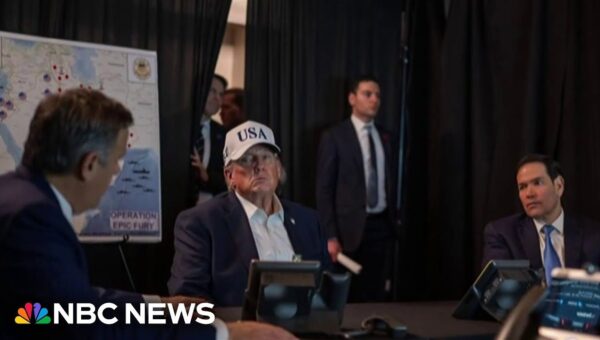
Trump: Iran Strikes Ahead of Schedule, Expects ‘Great Deal for World’
Three U.S. service members have been killed amid escalating conflict with Iran, President Trump confirmed. He stated that strikes are ahead of schedule, with senior Iranian leaders killed, and expressed optimism for a "great deal for the world" despite ongoing talks with Iranian officials.
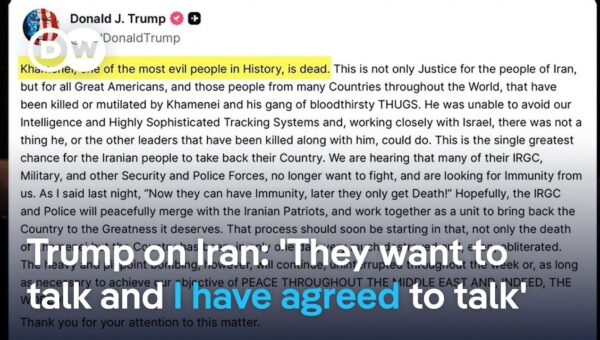
Trump Agrees to Talks with Iran After Major Strikes
President Donald Trump has agreed to talks with Iran's leadership following coordinated strikes that reportedly killed key figures, including the Supreme Leader. While Trump claims significant military successes, U.S. strategy remains unclear, and public opinion shows limited support for the actions amid rising American casualties.