Trump Vows ‘Hard Hit’ on Iran Amid Escalating Conflict
President Trump has vowed Iran will be "hit very hard" imminently as the conflict escalates. Reports suggest Israeli airstrikes have occurred, while U.S. troop deployment on the ground in Iran is reportedly under consideration. Experts voice concerns over the administration's strategy and escalating rhetoric.


Trump Vows ‘Hard Hit’ on Iran Amid Escalating Conflict
President Donald Trump issued a stark warning on Saturday, declaring that Iran would be “hit very hard” imminently, as the conflict between the United States and Iran entered its second week. The statement came amid reports of Israeli airstrikes and growing speculation about the potential deployment of U.S. troops on the ground within Iran.
Israeli Forces Strike Iranian Targets
Overnight, the Israeli military reported launching 230 munitions against several military sites across Tehran. Iranian state media indicated that some strikes impacted areas surrounding Marabad Airport. These actions underscore the escalating tensions and the active military engagement in the region.
Presidential Visit and Troop Deployment Rumors
Later today, President Trump is scheduled to travel to Dover Air Force Base to attend a dignified transfer of six U.S. service members who were killed in the conflict. Meanwhile, NBC News reported that Trump has privately expressed significant interest in deploying American troops on the ground inside Iran. This report, citing two U.S. officials, a former U.S. official, and another individual with knowledge of the discussions, has been dismissed by the White House as assumptions from anonymous sources. It is important to note that this dismissal does not constitute an explicit denial of the report’s claims.
Unconditional Surrender Demand and Iranian Response
The President’s rhetoric has been consistently firm. Yesterday, Trump posted on Truth Social, stating, “THERE WILL BE NO DEAL WITH IRAN EXCEPT UNCONDITIONAL SURRENDER.” He further elaborated to Axios that this demand extends beyond a formal surrender, suggesting it could also mean a state where Iran “can’t fight any longer because they don’t have anyone or anything to fight with.”
Iran’s president responded to this demand, characterizing unconditional surrender as a “dream that the U.S. should take to their grave.” However, he also announced this morning that Iran would cease attacking neighboring countries, a statement made amidst growing uncertainty surrounding the initial motives for the war.
Shifting Rationales for Conflict
The Trump administration’s justifications for the conflict have evolved throughout the week. Initially, the rationale presented was preemptive action to prevent Iranian attacks on American forces. “We knew that there was going to be an Israeli action. We knew that that would precipitate an attack against American forces. And we knew that if we didn’t preemptively go after them before they launched those attacks, we would suffer higher fire casualties,” one administration official stated. When questioned if Israel forced the U.S. hand, the response was, “NO. I MIGHT HAVE FORCED THEIR.” Another justification cited was the belief that Iran attempted to kill President Trump, and that the U.S. possessed the “last weapons of the nuclear weapon.”
Experts Raise Concerns Over Strategy and Rhetoric
Former CIA Director John Brennan and The Atlantic staff writer Vivian Salama expressed significant concerns regarding the administration’s approach. Brennan characterized the situation as a lack of forethought and a “hapha-zard approach to something very, very serious and very, very consequential.” He noted the difficulty of achieving unconditional surrender given Iran’s size and the likely defiance of its security forces.
“I think it really looks like they’re making it up as they go along, both the rationale as well as the objectives. I think it demonstrates the lack of forethought in terms of what the implications of engaging in these military operations would be.” – John Brennan, former CIA Director
Salama echoed these sentiments, highlighting the president’s consistent use of aggressive language, reminiscent of his “fire and fury” rhetoric towards North Korea. “This is how he tends to talk… to keep us talking about it, to keep the American people talking about it and also to strike fear in the hearts of adversaries,” she said. However, she cautioned that such rhetoric can lose its impact over time, especially as Iran remains defiant and views the conflict as existential.
Potential for Escalation and Ground Operations
Regarding the president’s social media post on Saturday, which stated, “TODAY IRAN WILL BE HIT VERY HARD!” and mentioned “complete destruction and certain death” for certain areas and groups due to Iran’s behavior, Salama suggested expecting a “second wave, a harder wave.” The specifics of this wave, its objectives, and targets remain unclear, raising questions about transparency with the American public, especially given that the conflict has proceeded without explicit congressional declaration of war.
The possibility of U.S. troops on the ground adds another layer of complexity and risk. Brennan argued that achieving unconditional surrender would necessitate tens of thousands of U.S. troops, a scenario he deemed “mindless.” He suggested that the president’s escalating rhetoric might stem from increasing concern that the conflict is not proceeding as hoped.
Uncertainty and Future Outlook
The conflict’s duration remains undetermined, contingent on the capabilities of both Israeli and U.S. forces, and Iran’s ability to retaliate. Experts believe the situation is likely to remain volatile and dangerous, with potential for prolonged chaos and violence. The path forward is fraught with uncertainty, as the administration’s strategic objectives and the ultimate outcome of this escalating confrontation remain unclear.
Source: BREAKING: Trump says “TODAY IRAN WILL BE HIT VERY HARD!” (YouTube)

Related Articles

Snyder: Democracy Demands Citizen Action, Not Passive Hope
Historian Timothy Snyder asserts that democracy's survival depends on active citizen participation, not passive hope. He analyzes the fraying 'veneer of invincibility' surrounding Donald Trump and stresses the vital role of grassroots action and a vigilant press in bolstering democratic institutions.
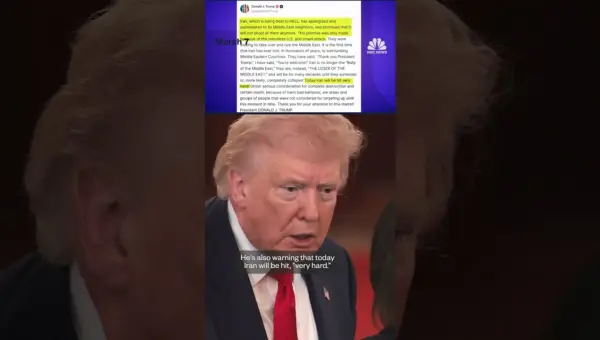
Iran’s President Rejects Unconditional Surrender Amid Tensions
Iranian President Massud Peshkan has apologized to neighboring countries, stating Iran will not attack unless provoked. This comes as US President Trump demands unconditional surrender and warns of severe retaliation.
Bondi Faces Epstein Fallout Amidst Trump’s Cover-Up Shield
Congressman Dan Goldman discusses the complex situation surrounding Pam Bondi's potential involvement in the Epstein cover-up. He argues that unlike other officials, Bondi's deep knowledge of 'Epstein secrets' and potential leverage over Donald Trump makes her firing unlikely, highlighting concerns about a broader accountability gap in the current political climate.