Trump Faces Trade Hurdles Ahead of Xi Jinping Meeting
A recent Supreme Court ruling has curtailed Donald Trump's ability to use emergency tariffs, impacting his upcoming meeting with China's Xi Jinping. Meanwhile, geopolitical tensions remain high, with discussions on Iran and the Russia-Ukraine conflict ongoing, while shifting voter sentiment poses challenges for Trump.

Supreme Court Ruling Undermines Trump’s Tariff Strategy
Former President Donald Trump is set to meet with Chinese President Xi Jinping on March 31st, but a recent Supreme Court ruling has significantly hobbled his ability to use emergency tariffs as a negotiating tactic. The court invalidated Trump’s April 2025 declaration that granted him unilateral power to impose tariffs on any country for an indefinite period. This decision places Trump at a distinct disadvantage, particularly against an adversary he has struggled to convince to grant better trade access to the United States.
During his first term, Trump famously escalated tariffs and blocked Chinese products in an effort to coerce favorable trade conditions. This strategy ultimately failed, leading to a modest trade deal that reportedly cost American farmers billions of dollars. Now, as he prepares for another round of discussions with Xi Jinping, the very trade barriers he relied upon have been removed, leaving his strategic options uncertain.
Constitutional Questions Surround Tariff Authority
The Supreme Court’s decision on Trump’s tariff powers has raised questions about the lengthy process it took to reach the verdict. The U.S. Constitution clearly designates Congress as the sole body responsible for levying taxes and tariffs. Many found it puzzling that it took so long for the court to address a matter that appeared, on its face, to be unconstitutional.
Ultimately, the ruling saw six justices in favor and three against, with the final, extensive opinion citing centuries of historical precedent. The court concluded that the former president had acted in a manner that was “blatantly unconstitutional.” This ruling has significant implications for Trump’s economic policies. His signature legislative achievement, the Tax Cuts and Jobs Act, is estimated to have added nearly $4 trillion to the national deficit. The potential revenue from tariffs, previously a significant factor in offsetting this deficit, is now largely gone, suggesting a further explosion in the budget deficit.
Institutions Show Resilience Amidst Political Division
Despite the politically charged nature of the ruling, the decision is being viewed as a positive sign for the resilience of American institutions. Notably, several conservative justices, many of whom were appointed by Trump himself, authored the key opinions in the case. This adherence to the constitutional text, which explicitly grants tariff authority to Congress, demonstrates a commitment to long-standing legal principles.
The situation also highlights the ongoing ideological battles within the Republican Party post-Trump. Figures like former Vice President Mike Pence are establishing think tanks to redefine Republicanism for the future, arguing that Trump’s actions and policies deviate from traditional conservative principles. These groups are pushing back against Trump’s perceived willingness to infringe on organizational rights and dictate acceptable public discourse, a departure from the laissez-faire priorities that have long defined conservatism.
Geopolitical Tensions: Iran and Russia-Ukraine Conflict
The discussion also touched upon escalating geopolitical tensions, including the possibility of a U.S. military strike against Iran. The United States has significantly increased its air power in the region surrounding Iran, a posture that analysts suggest positions the U.S. for a major air offensive. The question remains whether any potential action would be a limited strike to facilitate negotiations or a full-scale bombing campaign.
Regarding the Russia-Ukraine peace talks, a new round of discussions is anticipated. Ukraine has consistently signaled its willingness to engage in dialogue, but challenges persist. Some parties, reportedly supported by a U.S. special envoy, continue to prioritize discussions about Ukraine ceding territory, a notion Ukraine vehemently rejects, citing its constitutionally defined borders. Furthermore, Ukrainian officials emphasize the necessity of including accountability for war crimes committed by Russia as a non-negotiable component of any potential agreement.
Trump’s Approach to Putin and Shifting Voter Sentiment
A significant point of discussion was Trump’s perceived inaction in pressuring Vladimir Putin to negotiate. Unlike his approach to China, Trump has largely refrained from leveraging available sanctions against Russia. Despite possessing broad executive authority to impose sanctions on countries already targeted by Congress, Trump has not exerted maximum pressure on Putin. This reluctance to apply pressure, even against adversaries, has been a consistent feature of his foreign policy approach, often extending to allied nations as well.
Concurrently, reports indicate a decline in Trump’s approval ratings, particularly among independent voters. These voters, who often make their decisions closer to election day, have reportedly grown disillusioned with Trump’s unfulfilled promises regarding lower prices, inflation reduction, and salary increases. This erosion of support among a crucial demographic could significantly impact his party’s prospects in upcoming elections, especially in closely contested districts.
Potential for Trilateral Talks and Instability in Mexico
While the possibility of trilateral talks involving Trump, Xi Jinping, and Vladimir Putin has been raised, Trump’s willingness to engage is contingent on the prospect of a successful outcome. He has previously expressed frustration when negotiations did not yield desired results, as seen after the Alaska meeting. Any future high-level meeting would likely require demonstrable progress or external pressure on Russia to de-escalate the conflict in Ukraine.
The situation in Mexico also presents a complex challenge. Increased cartel violence has disrupted tourism and led to airport security concerns, particularly in response to the execution of a local cartel leader. The extent of U.S. involvement, whether through intelligence or law enforcement assistance to Mexican authorities, remains unclear. The instability caused by the disruption of local power dynamics among cartels could lead to prolonged civil unrest until a new balance of power is established, either through a new leadership agreement or increased government control.
Source: ⚡️Putin and Zelensky are waiting for a response! Trump will meet with Xi. Next step is… (YouTube)

Related Articles

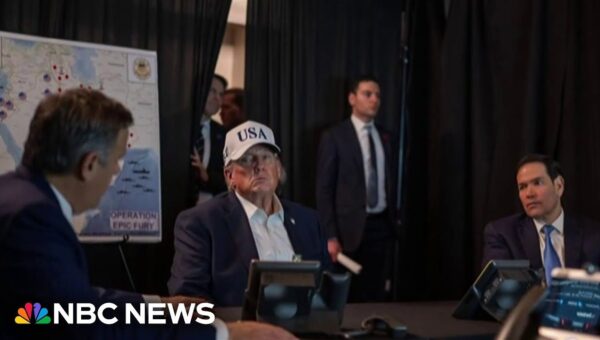
Trump: Iran Strikes Ahead of Schedule, Expects ‘Great Deal for World’
Three U.S. service members have been killed amid escalating conflict with Iran, President Trump confirmed. He stated that strikes are ahead of schedule, with senior Iranian leaders killed, and expressed optimism for a "great deal for the world" despite ongoing talks with Iranian officials.
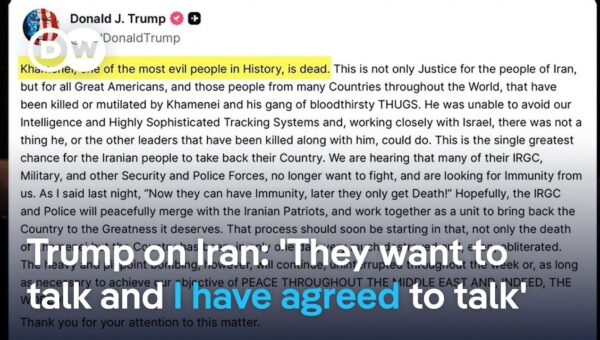
Trump Agrees to Talks with Iran After Major Strikes
President Donald Trump has agreed to talks with Iran's leadership following coordinated strikes that reportedly killed key figures, including the Supreme Leader. While Trump claims significant military successes, U.S. strategy remains unclear, and public opinion shows limited support for the actions amid rising American casualties.

Trump’s Putin Stance: US Strategy and Global Implications
Analysis suggests Donald Trump's approach to the Ukraine war involves pressuring Kyiv, but US involvement is crucial for resolution. China's influence and the 'MAGA' agenda's geopolitical implications are key factors.