Trump Faces Few Options as Iran War Strains US Economy
The U.S. war in Iran has entered its 27th day, bringing economic pain like rising fuel prices and inflation. President Trump faces limited options for ending the conflict, with Pentagon plans for a "final blow" involving ground troops raising concerns about prolonging the war.


US War in Iran Enters Day 27 Amid Economic Fallout
Day 27 of the war with Iran has brought significant economic challenges for the United States. Rising fuel prices have led the U.S. Postal Service to implement an 8% surcharge on all packages. Inflation is also a growing concern, with one estimate predicting it will top 4%.
President Trump’s Limited Options for Ending Iran Conflict
President Donald Trump, who initiated the war, finds himself with dwindling options to end the conflict. Growing public frustration over the economic hardships caused by the war is mounting. Recent reporting from The Wall Street Journal indicates that Trump has privately told advisors he believes the war is nearing its end. He is urging them to adhere to the publicly stated four-to-six-week timeline.
White House Denies Desperation, Focuses on Military Escalation
Despite this reporting, President Trump publicly denied he is desperate, stating he is “the opposite of desperate.” However, the reality on the ground suggests a complex situation with few clear paths forward. The Iranian regime has rejected a U.S. peace proposal, and there are currently no active negotiations between the two nations.
Pentagon Considers “Final Blow” with Ground Troops
Axios reports that the Pentagon is developing plans for a “final blow” that could involve deploying U.S. ground troops into Iran. Several potential military actions are being considered. These include seizing Karg Island, a key oil export hub for Iran, capturing Iranian territory to ensure safe passage through the Strait of Hormuz, or blocking Iranian oil exports.
Concerns Over Prolonging and Intensifying the Conflict
Many of these proposed scenarios carry significant risks. Axios warns that several options could prolong and intensify the fighting, rather than leading to a swift conclusion. This is a concern for President Trump, who reportedly wishes to avoid such an outcome.
Reluctance to Deploy Troops Amid Strategy Concerns
U.S. officials speaking with The Wall Street Journal suggest President Trump is willing to order U.S. troops onto Iranian soil. However, he is hesitant due to fears it could derail his goal of a quick end to the war and potentially increase U.S. casualties. This presents a difficult dilemma for the president, who is facing limited choices for a resolution that aligns with his initial objectives.
Expert Analysis: Tactics Without Strategy
Former Defense Secretary Jim Mattis’s recent comments, stating “targetry never makes up for a lack of strategy,” resonate with the current situation. Experts like Lieutenant General Mark Hertling (Ret.), former commanding general of the U.S. Army in Europe, express concern over the Pentagon’s proposed actions. “We’re talking about different courses of action to bring a political solution to this, and you’re not going to do that with troops on the ground,” Hertling stated.
“We’re seeing battles, kinetic strikes, the potential use of military forces… But again, what are you trying to achieve. Now it seems it’s an economic purpose, open the Straits of Hormuz, try and get the markets back. I’m not so sure that’s the best way to use military forces. Unless you have a political end state, you’re going to waste a lot of lives.”
— Lieutenant General Mark Hertling (Ret.)
Diplomatic Challenges and Unintended Consequences
Former Deputy Secretary of State Wendy Sherman, who led the U.S. negotiating team for the Iran nuclear deal, highlighted the diplomatic challenges. While a credible threat of force is important in negotiations, Sherman pointed out that the Strait of Hormuz was open before the war began. “The closure of the strait is a consequence of the war, not a cause of it,” she explained.
Sherman also noted the difficulties in reaching an agreement, citing Iran’s rejection of a U.S. peace proposal. The situation is further complicated by reports of a missile strike on the Pakistani embassy in Tehran, a potential unintended consequence of the ongoing conflict. “All we have accomplished here painfully… is that we now have a more radical, the hardliners, the IRGC… is now in charge,” Sherman added.
Calls for Regime Change and Increased Nationalism
Some close to President Trump are reportedly urging a harder stance, suggesting regime change in Iran could be a legacy-defining achievement. However, experts like Sherman caution against this approach. “That is going to take a lot of troops. That is going to take boots on the ground,” she said.
Instead of achieving the desired outcome, these tactics may be increasing nationalism within Iran. “This is a country with a great history of pride and resilience. And resistance. And all we have done, I believe, is increase their resistance,” Sherman stated. Iran possesses asymmetric tactics and is unlikely to capitulate easily.
Looking Ahead: A Path to De-escalation Remains Unclear
As the war enters its second month, the U.S. faces a difficult strategic challenge. The economic strain on the home front is growing, while military options in Iran appear increasingly risky and may not lead to the desired political end state. Without a clear strategy and a viable diplomatic path, de-escalation and a resolution to the conflict remain uncertain.
Source: Trump claims he is ‘the opposite of desperate’ as options for exit-ramp for War in Iran dwindle (YouTube)

Related Articles

China Fights Back: Tariffs Loom Ahead of Trump Visit
China is retaliating against US trade investigations that could lead to higher tariffs. This escalating trade tension occurs just before a planned visit by President Trump. The dispute involves accusations of unfair practices and impacts global supply chains.


Israelis Forge Resilience Amidst Constant Bomb Shelter Drills
Life in Israel is a blend of resilience and constant vigilance, with many families adapting to frequent bomb shelter drills and even sleeping in makeshift shelters. Despite ongoing missile attacks, Israelis strive to maintain normalcy, though businesses face disruption and emotional fatigue is a growing concern.
Iran War Exodus: Refugees Flee to Turkey Amidst Bombings
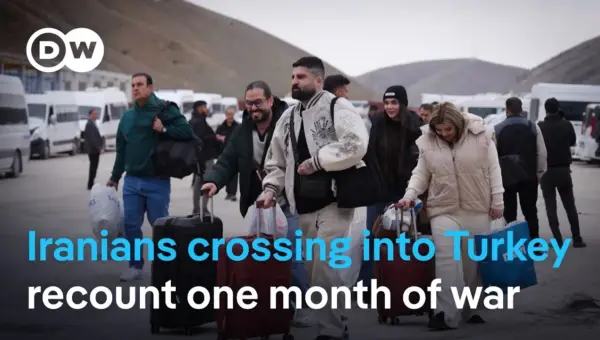
A train from Tehran brings refugees to Turkey, fleeing daily bombings and economic collapse. Many express deep fear for loved ones left behind, while some hold onto national pride and hope for victory. The conflict's impact is also felt economically in Turkey, with rising gas prices.