Titan’s First Images Promise Stunning Views
Explore stunning images expected from Titan's Dragonfly mission, the challenges of spotting Artemis 2 with telescopes, and the fascinating science behind moons having moons. Discover the future of lunar navigation and the final stages of stars.

Titan’s Dragonfly Mission Aims to Deliver Breathtaking Photos
Get ready for a visual feast from Saturn’s largest moon, Titan. The upcoming Dragonfly mission, set to launch around 2028, will send a rotorcraft to explore this intriguing world. While high-definition video streaming like we see from Mars rovers won’t be possible due to Titan’s immense distance and slow data transmission rates, the mission promises an avalanche of incredible still images.
These images will be far more extensive than the brief glimpses we’ve had before. The Huygens probe, which landed on Titan in 2005 during the Cassini mission, sent back a few images during its descent and a single shot from the surface. Dragonfly will provide a continuous stream of pictures as it flies to various locations, much like the Curiosity and Perseverance rovers do on Mars. Scientists anticipate that these images can be stitched together by enthusiasts to create slideshow-like videos, offering an unprecedented look at Titan’s alien landscapes.
Artemis 2: A Glimpse of Humanity’s Return to the Moon
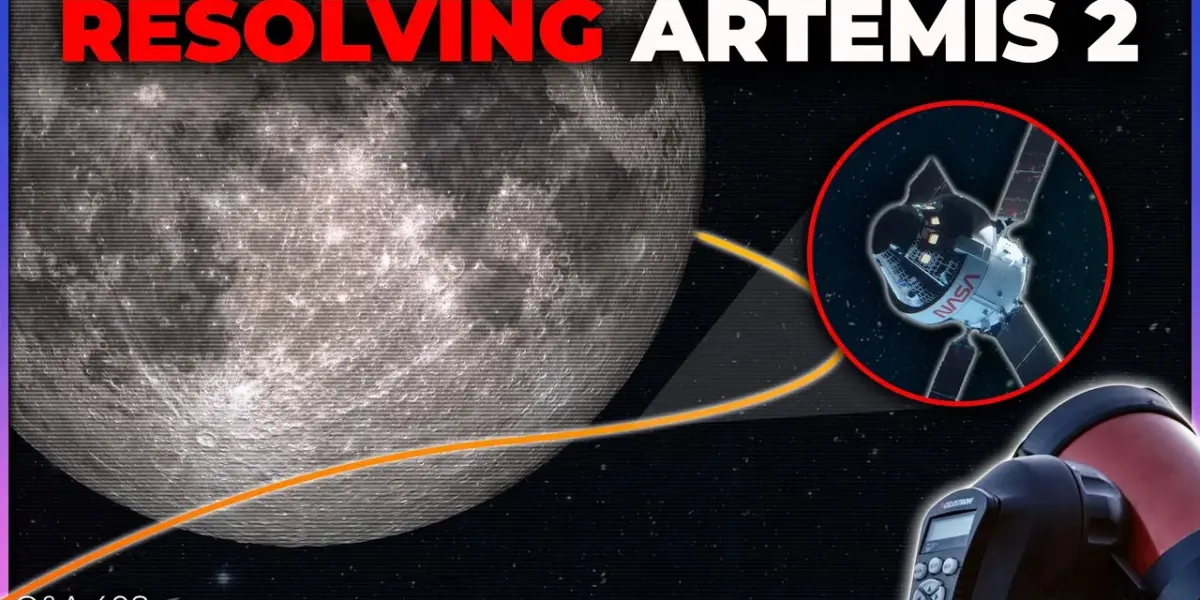
While you might dream of spotting the Artemis 2 mission with your own telescope, the reality is a bit more challenging. Even the world’s most powerful ground-based telescopes, like the 8.5-meter or 10-meter telescopes, can only resolve objects about 150 meters across on the Moon’s surface. The Orion capsule for Artemis 2 is significantly smaller than that, making it impossible to see with even the largest Earth-based instruments, let alone a smartphone telescope.
However, there are still opportunities to witness parts of the mission. You might be able to detect the Artemis 2 spacecraft when it’s still relatively close to Earth and on its journey towards the Moon, especially if you’re in the right location. A more spectacular viewing opportunity could arise during the Artemis 3 mission, when spacecraft perform docking maneuvers in Earth orbit. Observers might see two bright points of light, representing the two spacecraft, moving together in the sky until they dock. This would be a truly remarkable sight.
Looking further ahead, the asteroid Apophis will make a very close pass by Earth in 2029, coming within a few hundred thousand kilometers. This near-Earth object, estimated to be about 50 meters across, will be visible to the naked eye – no telescope required. It will appear as a star moving across the sky, a stark reminder of the celestial bodies that share our cosmic neighborhood.
Exploring the Concept of Orbital Cyclers
The idea of an ‘Aldrin cycler,’ proposed by Buzz Aldrin, suggests a large spacecraft that continuously travels between Earth and Mars on a set route. This vehicle would be equipped with all the necessities for a long journey, allowing astronauts to embark and disembark as it passes by. The cycler itself would require only minor course corrections, maintaining its regular cycle. This concept could make long-duration space travel more comfortable and efficient by providing a constant, well-supplied habitat in space.
Applying this to a Moon-Earth system, one could theoretically design a cycler that orbits between our planet and its natural satellite. Astronauts would launch to meet this cycler, travel to the Moon, and then return. While the Lunar Gateway, currently in a halo orbit around the Earth-Moon L1 Lagrange point, serves a similar purpose as a staging post, a dedicated cycler could act more like a ferry, continuously moving between the two bodies. Such a system would involve significant engineering challenges, including precise timing for rendezvous and ongoing maintenance.
The energy cost of docking with a cycler versus flying directly is an interesting question. While it might seem like you’d use similar amounts of fuel, the cycler’s value lies in its established infrastructure and mass. A smaller, faster craft could ferry passengers to the cycler, where they would then reside for the longer journey, avoiding the need to carry all life support and protection systems for the entire trip. This approach aims to optimize resources for sustained space exploration.
Establishing Navigation and Time on the Moon
As humanity’s presence on the Moon grows, the need for a dedicated lunar navigation system, akin to Earth’s GPS, becomes apparent. Initiatives like LunaNet, a collaboration involving NASA, the European Space Agency (ESA), and the Japan Aerospace Exploration Agency (JAXA), are working towards establishing a coordinated time system and positioning network on the Moon.
Accurate timekeeping on the Moon presents unique challenges. The Moon doesn’t adhere to Earth’s time zones, and its lower gravity affects the rate at which clocks tick. These relativistic effects, though small, would cause clocks on Earth and the Moon to drift apart over time. A lunar GPS would involve satellites in orbit around the Moon, transmitting positioning data to rovers and future lunar bases.
While not an immediate priority, as lunar infrastructure expands, dedicated navigation missions will become essential. Similar systems are planned for Mars, recognizing that future explorers will need reliable ways to navigate and keep time on other worlds. This development is crucial for enabling more complex and ambitious lunar operations.
The Fascinating Possibility of Moons Having Moons
The question of whether a moon can have its own moon, and even a moon with a moon, delves into the intriguing realm of celestial mechanics. While no natural examples of moons with moons (called ‘submoons’ or ‘moonmoons’) have been confirmed in our solar system, it is theoretically possible.
For a submoon to be stable, it would need to orbit its primary moon far enough away to avoid being pulled apart by the planet’s gravity. Neptune’s system is considered a potential candidate for such a scenario, where a large moon could potentially host its own smaller moon in a stable orbit. A moon with a moon with a moon would be a ‘subsubmoon,’ a hierarchical arrangement that, while theoretically possible, is not something astronomers widely expect to observe due to the complex gravitational interactions involved.
Regarding day-night cycles, a moon orbiting a gas giant would be tidally locked to the planet. However, its day-night cycle would match its orbital period around the planet. For instance, Earth’s Moon is tidally locked to us, taking about 29.5 days to complete one orbit and one rotation, thus experiencing one day-night cycle in that period. If a moon around a gas giant had a shorter orbital period, say a few Earth days, and was protected by the planet’s magnetosphere, it could have relatively short days and nights, potentially supporting habitable conditions.
White Dwarfs: The End of the Stellar Road
White dwarfs represent the final stage for stars like our Sun, the dense remnant core left after they have exhausted their nuclear fuel. The question arises whether a white dwarf can reignite fusion and become a star again.
In binary star systems, a white dwarf can accrete matter from its companion star. This material builds up on the white dwarf’s surface until it reaches a critical point, triggering a thermonuclear explosion known as a nova. These events can recur periodically, as seen in recurring novas that flash every few decades. However, this surface explosion doesn’t restart fusion in the white dwarf’s core.
The core of a white dwarf is essentially the star’s leftover core, composed of elements like carbon and oxygen for Sun-like stars. To restart fusion in this dense core, it would require an immense amount of additional fuel, roughly equivalent to two more stars’ worth of hydrogen. Such a massive accretion is highly unlikely. Instead, the material that accumulates on the surface is typically blown off in a nova event, or, in more extreme cases, can lead to a Type Ia supernova if the white dwarf reaches about 1.4 times the mass of the Sun. This explosive event obliterates the white dwarf, signifying that becoming a white dwarf is a one-way process for stars.
Source: Video from Titan, Watching Artemis 2, Moons with Moons with Moons | Q&A 408 (YouTube)

Related Articles

Europa’s Ocean: A New Twist on Habitability
New research suggests Europa's ocean may be less habitable than thought due to mineral transport challenges, while the detection of ammonia offers a counterpoint. Meanwhile, SpaceX plans a million satellites, Artemis 2 faces delays, and AI assists Mars rovers.


Cosmic Ray Mystery: Amaterasu Particle Stuns Scientists
Scientists are investigating the origins of the incredibly energetic Amaterasu cosmic ray and re-evaluating the timeline of the Late Heavy Bombardment. Meanwhile, new theories suggest Titan may have shaped Saturn's rings, and a distant brown dwarf reveals a colossal ring system.

Artemis 2: A New Toilet Takes On Deep Space
The Artemis 2 mission will feature the Universal Waste Management System (UWMS), the first toilet designed for deep space travel beyond the Moon. This advanced system represents a significant upgrade from the rudimentary 'Apollo bags' used by earlier lunar explorers, offering astronauts enhanced comfort and privacy.