The Rise of ‘ETF Slop’: High Fees and Complex Products
The ETF market is seeing an influx of complex, high-fee products, termed 'ETF slop.' These include thematic, buffer, covered call, and single stock ETFs, which often underperform and cater to investor biases rather than long-term goals. Analysts warn this trend risks undermining the low-cost, sensible investing principles ETFs were designed to champion.

The Proliferation of Complex ETFs Challenges Traditional Investing Principles
The landscape of exchange-traded funds (ETFs) is undergoing a significant transformation, moving beyond their original mandate of providing low-cost, broad-market exposure. In recent years, particularly in 2025, the US market saw a record-breaking launch of over 1,000 new ETFs, with the majority being actively managed. Canada mirrored this trend with over 300 new launches, also predominantly actively managed. This surge in product diversity, while seemingly offering more choice, is raising concerns among market analysts about the quality and investor benefit of these new offerings, a phenomenon being termed ‘ETF slop’.
From Low-Cost Indexing to High-Fee Complexity
ETFs revolutionized investing by offering a transparent, exchange-traded wrapper for investment strategies, most notably for index tracking. Low-cost index ETFs, with fees often below 0.1%, empowered investors to move away from expensive actively managed mutual funds that historically underperformed their benchmarks. However, the average management fee for US-listed ETFs launched in 2025 climbed to over 0.7%, with 166 new funds charging more than 1%. This shift signals a potential return to the higher fee structures that ETFs initially disrupted, potentially at the expense of investor outcomes.
“I think what we are seeing is best described as ETF slop. I’m Ben Felix, chief investment officer at PWL Capital, and I’m going to tell you why ETF SLOP is making it harder for investors to make good long-term decisions and bringing us right back to the dark ages of investing.”
Understanding ETF ‘Slop’: Thematic, Buffer, Covered Call, and Single Stock ETFs
The term ‘ETF slop’ refers to a large volume of complex, high-fee products that may not serve long-term investor interests. These products often appeal to specific investor biases, such as the desire for high income, protection against losses, or participation in trending themes. Four categories exemplify this trend:
1. Thematic ETFs
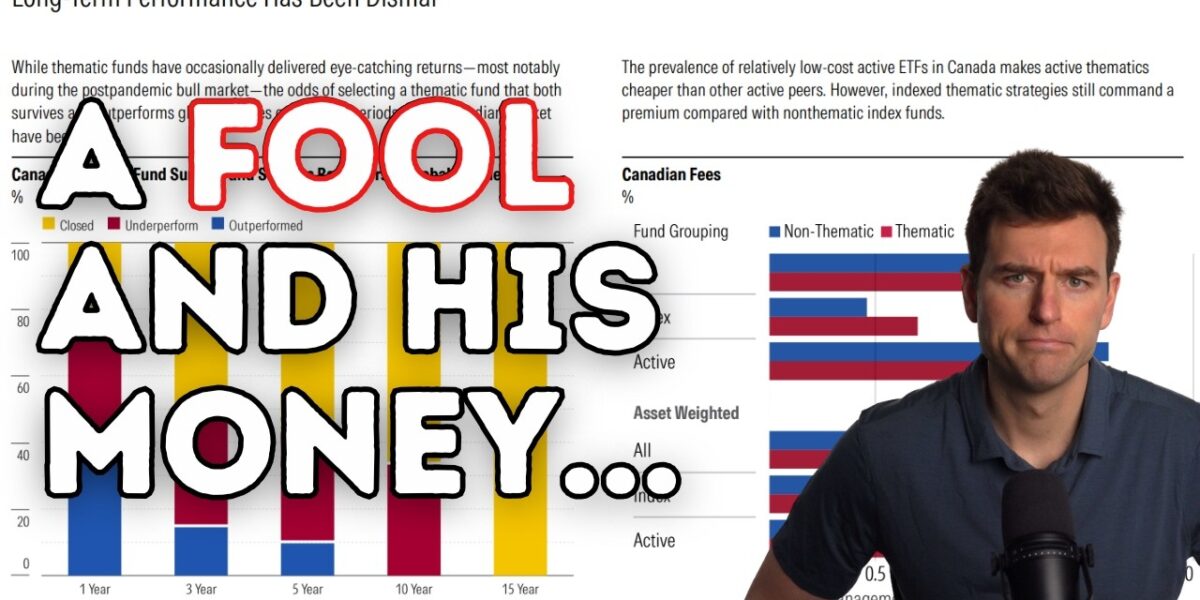
These ETFs focus on specific economic trends like Artificial Intelligence (AI), the metaverse, clean energy, or electric vehicles. While appealing to investors eager to capture the next big thing, research indicates significant underperformance. A 2021 academic study found that thematic ETFs underperform broad market benchmarks by an average of 6% annually in the five years following their launch. Morningstar data reveals that globally, only about 10% of thematic funds outperform over a 10-year horizon. In Canada, the situation is even starker, with 100% of listed thematic funds either closing or underperforming within 10 years, and all closing by the 15-year mark. High launch fees and investor optimism often inflate stock prices before the ETF launches, leading to subsequent underperformance as reality sets in.
2. Buffer ETFs
Designed to offer downside protection up to a certain level while capping upside potential, buffer ETFs appeal to investors’ aversion to losses. For example, one US equity buffer ETF offered capped upside of 8.1% and protection against the first 15% of market decline for a specific period. However, academic reviews suggest that the options used to structure these payoffs can be expensive, leading to higher fees (e.g., 0.73% expense ratio compared to 0.09% for the underlying asset). Furthermore, these funds often exhibit inconsistent downside protection outside their defined target periods. Studies indicate that simpler strategies, like combining equities with cash, often outperform buffer funds and even perform better during drawdowns. The conclusion is that these products may be engineered more for sales than for genuine investor benefit.
3. Covered Call ETFs
These ETFs sell call options on the stocks they hold, aiming to generate high distribution yields. While marketed heavily on their yield, they come with a significant trade-off: capped upside returns. Total returns from covered call strategies are expected to trail those of their underlying equities. Even when tested against alternative income strategies, such as combining dividend-paying index funds with periodic portfolio sales, covered call ETFs have been found to leave investors worse off. A simple combination of stocks and cash can often replicate the returns without imposing a hard cap on upside potential.
4. Single Stock ETFs
Considered by some analysts to be the most problematic form of ‘ETF slop’, single stock ETFs offer leveraged or income-generating strategies on individual stocks. They often feature high fees, complex structures, and are marketed to retail investors. Leveraged versions, aiming to amplify daily returns, often fall short of their targets due to high financing costs embedded in swap contracts, which are not explicitly stated in expense ratios. Research indicates that leveraged single stock ETFs, both long and inverse, significantly underperform simple leverage benchmarks. A 2025 paper simulating these funds found that a substantial percentage underperform even unleveraged market indices, with a non-trivial occurrence of total losses within a year.
Market Impact and Investor Considerations
The rise of these complex, high-fee ETFs poses a challenge to investors seeking sensible, long-term strategies. The sheer volume of new products can bury quality investments, making due diligence more difficult. The allure of high yields, thematic trends, or perceived downside protection can lead investors to products that ultimately detract from their long-term goals.
Financial industry veterans, like the late John Bogle, founder of Vanguard, cautioned against such developments. Bogle noted in 2015 that while the ETF structure itself is a marketing innovation, its use to entice investors into frequently traded, high-fee products could be detrimental. The current trend of launching numerous complex ETFs, often with high fees and questionable long-term benefits, appears to validate these concerns. Investors are advised to focus on simple, low-cost, broadly diversified investment strategies. As Bogle famously stated, “You get what you don’t pay for,” a principle that seems increasingly relevant in today’s evolving ETF market.
Source: The Rise of ETF Slop (YouTube)

Related Articles


Geopolitical Turmoil Bolsters Bitcoin Amidst ETF Inflows
Geopolitical tensions and strong Bitcoin ETF inflows are creating a resilient market. Analysts point to exhausted sellers and the potential for capital rotation into crypto, while regulatory clarity on the Clarity Act could unlock significant institutional investment.


401(k) Changes Poised to Reshape Retirement Savings
The SECURE Act 2.0 is introducing significant changes to 401(k) plans, including enhanced catch-up contributions and automatic enrollment features. These updates aim to boost retirement savings for millions of Americans. Employers will also have new options regarding Roth contributions.


Bitcoin Surges, Igniting Short Squeeze Potential
Bitcoin has experienced a significant price surge, liquidating numerous short positions and potentially signaling a shift in market momentum. This rally is occurring amidst increased institutional interest and crowded trades, raising the possibility of a substantial short squeeze.