The Great Cull: A Million Jobs Vanish as ‘Useless Class’ Emerges, Threatening Societal Stability
A profound shift is underway in the global labor market, with the 'useless class' – individuals deemed unemployable by the economic system – rapidly transitioning from a theoretical concept to a stark reality. Recent US data shows one million more job seekers than available jobs, fueling a 'Great Refusal' as workers become disillusioned with a broken system. This structural decoupling of profit from labor, driven by AI and automation, threatens societal stability, pushing millions towards economic precarity and sparking warnings of potential revolution or collapse if not addressed.

The Great Cull: A Million Jobs Vanish as ‘Useless Class’ Emerges, Threatening Societal Stability
In a stark assessment of the modern labor landscape, a profound shift is underway, one that threatens to redefine the very fabric of society and the economic contract. What historian Yuval Noah Harari once termed the ‘useless class’ – individuals deemed unemployable because the economic system no longer requires their labor – is no longer a theoretical prediction but a chilling reality. The implications extend far beyond individual hardship, pointing towards a potential societal unraveling if unaddressed.
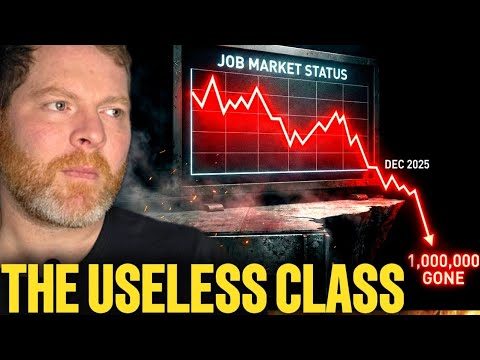
Recent data from the United States paints a grim picture: December saw a staggering one million more people actively seeking employment than there were jobs available. This marks a critical turning point, the first time in a decade that the balance of power has decisively shifted from the employee to the employer. This official figure, however, may only be the tip of the iceberg, failing to account for the countless individuals who have, out of prolonged frustration and systemic disillusionment, simply disengaged from the workforce altogether. This phenomenon, increasingly referred to as ‘The Great Refusal,’ signifies a deep-seated rejection of a system perceived as broken and exploitative.
From Prediction to Perilous Reality: The Rise of the ‘Useless Class’
Yuval Noah Harari, the acclaimed author of ‘Sapiens: A Brief History of Humankind’ and ‘Homo Deus: A Brief History of Tomorrow,’ introduced the concept of the ‘useless class’ not as a derogatory label, but as a socio-economic descriptor. His work often explores the profound challenges humanity faces in the age of artificial intelligence and advanced automation. Harari posited that as technology advances, it would not only displace manual labor but also increasingly sophisticated cognitive tasks, leaving a significant portion of the population without economic utility in the traditional sense.
For years, this idea resonated as a distant, dystopian forecast. However, the recent economic indicators suggest that this future has arrived with alarming speed. The December job data is a stark confirmation: for the first time in ten years, the supply of labor demonstrably outstrips demand by a million active job seekers. This isn’t just a cyclical downturn; it points to a structural problem where the economy is generating fewer opportunities for human labor than the available workforce requires. This imbalance indicates a fundamental shift in how value is created and distributed, leaving a growing segment of the population feeling, and indeed becoming, economically marginalized.
Beyond the official statistics, a hidden crisis looms. The transcript highlights that the official numbers do not account for those who have simply ‘checked out’ of the workforce. These are individuals who have endured prolonged unemployment, faced repeated rejections, and ultimately given up on participating in a system that has, as the speaker poignantly notes, ‘broken them.’ This segment of the population represents a silent crisis, their absence from official unemployment figures masking the true depth of the labor market’s dysfunction and the human cost of systemic failure.
The Dehumanizing Gauntlet of Modern Job Seeking
For those still actively seeking employment, the process itself has become a Kafkaesque ordeal. The sheer volume of competition is staggering: a typical corporate job posting on platforms like ZipRecruiter reportedly receives between 300 to 500 applications. This hyper-competition immediately reduces an applicant’s chances to lottery-ticket odds, a point driven home by the observation that one might have better odds of winning a scratch-off lottery ticket than securing many of these positions.
Adding layers of complexity and frustration, the job application process has been increasingly automated, often at the expense of human dignity. Artificial intelligence (AI) has become the primary gatekeeper, sifting through resumes long before a human eye ever has a chance to review them. Companies now rely heavily on Applicant Tracking Systems (ATS) that scan for specific keywords and phrases. If a resume lacks the exact keyword density or phrasing an algorithm is programmed to detect, it is often automatically deleted, rendering the applicant ‘invisible’ before their qualifications or potential can even be considered. This highly restrictive filtering mechanism inadvertently penalizes diverse experiences, unconventional career paths, and even slightly varied terminology, creating an impenetrable barrier for many qualified candidates.
Moreover, the transcript reveals the prevalence of ‘ghost jobs.’ These are job postings that appear legitimate but are not intended to result in actual hires. Companies post them for various reasons: to project an image of growth and expansion to Wall Street investors, to collect valuable applicant data for market research, or simply to maintain a talent pipeline for future, hypothetical needs. The existence of ghost jobs further exacerbates the desperation of job seekers, leading them through grueling, multi-round interview processes spanning months, only to be ‘ghosted’ – left without any response or explanation after significant investment of time and effort. This undignified and often belittling experience chips away at self-worth and fosters deep distrust in the system.
The ‘Great Refusal’: When the Social Contract Breaks Down
The disillusionment described above has coalesced into what is being termed ‘The Great Refusal.’ This is not, as the speaker emphasizes, a matter of laziness or a lack of incentive to work. Rather, it is a rational response to a fundamental breakdown in the social and economic contract that once governed the relationship between labor and capital. The ‘old deal’ promised that 40 hours of work a week would lead to a stable, dignified life: homeownership, a car, a family, and a future. The ‘new deal,’ however, offers a starkly different reality.
Under the contemporary paradigm, 40 hours of work a week often barely covers the rent for a single room in a shared apartment. The dream of homeownership or even affording a car remains elusive for many. The ultimate indignity, as highlighted in the transcript, is the increasing likelihood of being fired unceremoniously, often via a Zoom call, simply because an algorithm determined a marginal saving in quarterly earnings. This transactional, dehumanizing approach to labor, where individuals are seen as disposable units in a cost-optimization equation, fundamentally undermines the incentive to participate wholeheartedly in the system.
The core question posed by the transcript resonates deeply: ‘If 40 hours a week, working 40 hours a week still leaves you in poverty, the question is why work?’ This isn’t a call for idleness but an indictment of a system that fails to provide a meaningful return for labor. The erosion of real wages, coupled with soaring costs of living – particularly housing, healthcare, and education – has made the traditional path to economic security increasingly unattainable for a growing segment of the population, especially younger generations burdened by student debt and stagnant opportunities.
A Global Echo: The Crisis Beyond American Shores
While the immediate focus of the transcript is on the United States, it quickly expands to acknowledge the global nature of this crisis. Friends in Toronto, Sydney, and London are experiencing similar pressures: severe housing crises, escalating costs of living, and creeping youth unemployment. However, a critical distinction is drawn: these nations often possess a social safety net, including universal healthcare, which provides a buffer against the harshest impacts of economic precarity. The United States, with its often-fragile safety nets, leaves its citizens far more exposed to the consequences of job loss and economic instability.
Crucially, the transcript warns that the forces driving these changes are not confined by national borders. The same corporations and the same AI technologies that are replacing ‘mediocre white-collar employees’ in Chicago are destined to do the same in Melbourne and Manchester. This underscores the universal nature of technological displacement and the globalized race to optimize profits by reducing labor costs. The implications are clear: what begins as a crisis in one major economy will inevitably ripple outwards, impacting labor markets worldwide as corporations replicate successful cost-cutting strategies.
The Structural Decoupling of Profit from Labor
At the heart of this global phenomenon lies a profound economic shift: the structural decoupling of profit from labor. For the past century, the capitalist model largely relied on human labor as an indispensable component of wealth creation. Companies needed people to produce goods, provide services, and generate profits. While automation has always been a factor, it historically augmented human labor or displaced specific tasks, often leading to new job creation in other sectors.
Today, the narrative has fundamentally changed. Advanced automation, robotics, and sophisticated AI are enabling corporations to generate increasing profits with fewer human employees. This isn’t just about temporary layoffs during economic downturns; it’s about the permanent ‘deletion of the jobs themselves,’ the eradication of entire positions. Companies are realizing that they can achieve higher profit margins by minimizing their human workforce, viewing labor not as an asset to be invested in, but as a cost to be aggressively cut. This paradigm shift means that economic growth, as measured by corporate profits and stock market performance, can continue to flourish even as employment opportunities for a significant portion of the population dwindle.
This decoupling has far-reaching consequences for societal stability. Historically, a robust economy was synonymous with high employment and rising living standards for the working class. If profit can be generated without widespread employment, the traditional mechanisms for wealth distribution and social mobility break down. The result is a concentration of wealth at the top, while a growing segment of the population struggles to find a place in the economic system.
Societal Implications and the Dire Warning
The consequences of a growing ‘useless class’ are not merely economic; they are deeply societal. The transcript laments how society often looks upon the unemployed with ‘disgust,’ labeling them as lazy, failing to recognize that their predicament is often a symptom of systemic failure rather than individual moral failing. This societal judgment further isolates and dehumanizes those struggling, compounding their psychological burden.
The speaker articulates a genuine fear: that America is allowing millions to ‘fall through the cracks and rot.’ This is not just a humanitarian concern but a strategic one. When millions of military-aged individuals are left without jobs, purpose, a clear future, or a sense of ownership in their nation, the foundations of that nation are inherently weakened. This lack of economic utility and societal integration can breed profound resentment, despair, and instability.
The warning is stark and unambiguous: the consequences are not merely a recession, but a ‘revolution or a collapse.’ History is replete with examples of societies that fractured under the weight of extreme inequality, widespread unemployment, and a disenfranchised populace. When a significant portion of the population feels alienated from the economic and political system, the potential for social unrest and radical change dramatically increases. This is not a distant threat but a tangible risk, especially in societies where the social contract has been eroded and trust in institutions is at an all-time low.
Finding Value Beyond a Broken System
Despite the grim prognosis, the transcript offers a powerful message of resilience and self-worth. For those struggling with unemployment or long-term joblessness, the advice is clear: ‘Don’t let them tell you that you’re useless, that you’re broken.’ The problem, it asserts, lies not with the individual but with a ‘broken’ and ‘corrupted’ machine – the system itself.
The speaker, drawing from personal experience of returning to America with a pregnant wife, buying a house, and navigating the job market, emphasizes the tenacity required to survive. He acknowledges the difficulty but urges persistence: ‘If you haven’t found a job for a long time, keep at it. Eventually, you’re going to get one. Do what you have to.’ This includes embracing potentially unconventional paths: moving back in with family, downsizing, or accepting lateral moves into jobs one never imagined doing, even if it means less pay. These adaptations are presented not as failures, but as necessary steps for survival in a challenging landscape.
Crucially, the message transcends economic utility, affirming the inherent value of every human being. ‘None of these things devalue you as a human being or a person by any means. And you can’t let anyone think that it does.’ In a world increasingly defined by economic metrics, the reminder that personal worth is derived from community, family, friends, and intrinsic human dignity – rather than solely from market value – is a vital anchor. The economy, the speaker concludes, ‘never will’ love you, but your community and loved ones do.
The current global labor crisis is a multifaceted challenge, driven by technological advancement, economic restructuring, and a shifting social contract. While the immediate outlook appears daunting, understanding the systemic nature of the problem, fostering individual resilience, and nurturing community bonds may be crucial steps in navigating this transformative era and mitigating the risks of widespread societal instability. The conversation around the ‘useless class’ and ‘The Great Refusal’ is more than an economic debate; it is a critical examination of humanity’s future in an increasingly automated world.
Source: 1,000,000 Jobs Vanished The Great Cull (YouTube)

Related Articles

Germany’s Labor Market Paradox: Millions Unemployed, Yet Short of Workers
Germany is experiencing a complex labor market paradox, with millions unemployed while industries face critical skill shortages. Economic challenges and the rise of AI further complicate the situation, necessitating urgent solutions for skills alignment and workforce adaptation.


The System Fails Us: A Plea for Collective Action
A speaker voices profound disillusionment with the current societal system, arguing that ordinary people are treated as pawns by an indifferent elite. The message calls for unity beyond political divides to address systemic failures in providing basic needs and security.


A Divided Economy: Why Main Street Struggles While Wall Street Soars
Despite official narratives of economic strength and record stock market highs, many Americans are experiencing a deepening financial squeeze, driven by falling GDP, rising costs, and policies that disproportionately benefit corporations. This divergence highlights a 'two-economy' system where Wall Street's prosperity is increasingly disconnected from the struggles of Main Street, mirroring historical patterns of superficial growth preceding economic downturns.