Ted Cruz’s Bikini Photo Meltdown Exposes Political Hypocrisy
Senator Ted Cruz's complaint about doctored bikini photos, while seemingly trivial, exposes a concerning trend of using accusations like anti-Semitism to silence legitimate criticism. This tactic hinders open debate on critical foreign policy issues and protects governments from accountability.


Cruz’s Curious Complaint: Bikini Photos and the Weaponization of Accusations
In a recent public address, Senator Ted Cruz, while ostensibly discussing the grave issue of anti-Semitism, revealed a peculiar personal grievance: he claims to be “terrorized” by online hecklers who post doctored images of him in a bikini.
The senator’s statement, delivered during a speech on anti-Semitism, presented a stark dichotomy. On one hand, he decried the pervasive nature of anti-Semitic responses to his social media posts, stating, “I could tweet this morning, good morning, and hundreds of anti-semitic responses would immediately fill my social media.” On the other hand, he confessed to being deeply bothered by these doctored images, specifically mentioning “an image of myself in a bikini with a flag of Israel.” This juxtaposition immediately raises questions about the senator’s own emotional state and the strategic deployment of his complaint.
Cruz then invoked the playbook of former President Donald Trump, suggesting a stoic indifference as a form of strength: “There is a power to fearlessness. There is a power to speaking the truth and letting the idiots say what they will.” Yet, this assertion of fearlessness was immediately undercut by his own admission of being bothered. He attempted to reframe this as a sign of power, stating, “by not being bothered, you’re actually powerless and I’m more powerful.” The peculiar detail of admitting to having “saved to my hard drive” hundreds of these images, while simultaneously claiming they “totally don’t bother me at all,” paints a picture of someone either genuinely distressed or performing distress for a strategic purpose.
The Real Issue: Silencing Criticism Through Accusation
Beyond the personal drama of bikini photos, Cruz’s remarks highlight a broader, more troubling trend in political discourse: the weaponization of accusations, particularly the charge of anti-Semitism, to shut down legitimate criticism. The transcript points out the difficulty in having nuanced foreign policy conversations, especially concerning Israel, when any critique of the Israeli government is immediately labeled as anti-Semitic.
The analysis presented suggests that individuals like Cruz, who are not unintelligent, understand the distinction between criticizing a government and harboring animosity towards a people, culture, or religion. The transcript argues, “The people have nothing to do with it. The religion has absolutely nothing to do with it. It’s the actions of those in power in the government.” Therefore, it posits that criticizing government actions, even those leading to alleged war crimes, is not inherently anti-Semitic.
Historical Context: The Shifting Sands of Political Discourse
The tactic of equating criticism of a state with prejudice against an entire group is not new. Historically, such accusations have been used to stifle dissent and maintain political narratives. In the context of international relations, particularly concerning the Middle East, the line between legitimate critique and prejudiced attack has often been blurred. The discourse surrounding the Israeli-Palestinian conflict is a prime example, where strong opinions are frequently met with accusations of bias, making constructive dialogue exceedingly difficult.
The transcript draws a parallel to political criticism within the United States, asking if criticizing President Biden for his actions would imply anti-Catholic sentiment. The implication is clear: criticism is typically directed at specific policies or actions of an individual or government, not at their religious or ethnic identity. The senator’s apparent inability or unwillingness to apply this logic to foreign policy suggests a selective application of critical thinking.
Why This Matters: The Erosion of Open Debate
The senator’s public display and his rhetoric are significant because they contribute to an environment where open and honest debate is increasingly stifled. When legitimate criticism of government actions is met with accusations of deep-seated prejudice, it serves to protect those governments from accountability. The transcript suggests that this tactic is particularly effective when it involves governments that have significant geopolitical ties to the United States, implying that figures like Cruz are “beholden to monsters like Netanyahu” not out of genuine belief, but out of political obligation.
This approach prevents a mature discussion of complex issues. It allows governments to evade scrutiny for actions that may be harmful or violate international norms, simply by leveraging the powerful and emotionally charged label of anti-Semitism. The transcript argues that this is precisely why it is difficult to have productive foreign policy conversations, especially when those conversations involve the actions of governments supported by the U.S.
Implications, Trends, and Future Outlook
The trend of using labels to shut down discourse is likely to persist, fueled by the nature of social media and the polarization of political landscapes. The ease with which accusations can be amplified online means that the line between genuine concern and political maneuvering becomes increasingly blurred.
For the future, fostering a political environment that encourages critical thinking and allows for nuanced discussion is paramount. This requires a conscious effort from public figures to engage in good-faith arguments, to differentiate between critique and prejudice, and to resist the temptation to weaponize accusations for political gain. The public, in turn, must be discerning, recognizing when such tactics are being employed to deflect from substantive issues.
Ultimately, the incident with Senator Cruz and the bikini photos, while seemingly absurd, serves as a potent, if unintentional, illustration of a larger problem: the degradation of political dialogue, where personal grievances and strategic accusations overshadow the complex realities of governance and international relations.
Source: Ted Cruz Says He’s Being Terrorized By Bikini Photos (YouTube)

Related Articles
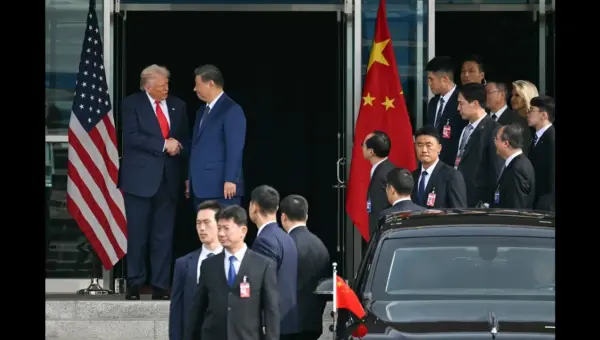
Trump’s “Walk Away” Tactic Signals Tougher Stance on China
Retired Air Force Brigadier General David Stillwell believes President Trump's strategy of being willing to walk away from negotiations puts pressure on China. This tactic, combined with US global actions and strengthened alliances, signals a more assertive American foreign policy.

Trump’s War Talk Stuns Financial Crowd
Donald Trump's recent speech in Miami focused on his foreign policy, particularly his critical views on NATO and his vision for international relations. He declared the U.S. would no longer defend NATO allies, questioned the value of existing alliances, and suggested renaming the Strait of Hormuz. The speech also touched on his personal views of success, his allies, and his perceived role as a global peacemaker.
Trump’s Warpath: New Threats Signal Imperial Ambitions
Recent statements from Donald Trump reveal a potential embrace of increased military action and interventionist foreign policy. This approach, characterized by critics as "imperialism 2.0," contrasts with his past promises of peace and has even drawn criticism from parts of his own base. The implications for U.S. global engagement and domestic priorities are significant.