Supreme Court Delivers Major Blow to Trump’s Tariff Policy, Igniting Fierce Backlash and Redefining Trade Authority
The Supreme Court delivered a major blow to Donald Trump's tariff policy, ruling it unconstitutional and affirming Congress's power over trade. Trump swiftly denounced the 6-3 decision, praising dissenting justices while vowing to pursue "more powerful alternatives" and accusing the court's majority of disloyalty. This sets the stage for significant political battles over trade policy and executive authority ahead of the 2024 election.

Supreme Court Delivers Major Blow to Trump’s Tariff Policy, Igniting Fierce Backlash and Redefining Trade Authority
In a landmark 6-3 decision, the U.S. Supreme Court has dealt a significant blow to former President Donald Trump’s signature economic policy, ruling that his unilaterally imposed tariffs are unconstitutional. The highly anticipated verdict, which found that the power to levy such tariffs rests with Congress, not the executive branch, immediately triggered an emergency press conference from Trump, where he vehemently denounced the ruling, praised dissenting justices, and vowed to pursue even more aggressive trade measures.
The Constitutional Showdown: Presidential vs. Congressional Power Over Trade
At the heart of the Supreme Court’s decision was a fundamental question of constitutional authority: who holds the power to impose tariffs on imported goods? For centuries, this power has traditionally been vested in the legislative branch, as explicitly outlined in Article I, Section 8 of the U.S. Constitution, which grants Congress the authority to “regulate Commerce with foreign Nations, and among the several States.”
Tariffs, essentially taxes on imported goods, serve various purposes, from protecting domestic industries to generating revenue or exerting diplomatic pressure. During his presidency, Donald Trump extensively utilized tariffs, particularly against China and European allies, as a cornerstone of his “America First” economic agenda. These tariffs, often imposed under the guise of national security concerns or to address perceived unfair trade practices, were intended to renegotiate trade deals, reduce trade deficits, and bring manufacturing jobs back to the United States. However, critics consistently argued that these actions overstepped presidential authority, bypassing Congress and operating as a unilateral executive tax on American consumers and businesses.
The legal challenge against Trump’s tariffs centered on whether existing statutes, such as the Trade Act of 1974 or the Trade Expansion Act of 1962, provided the President with the broad, discretionary power he claimed to impose tariffs without specific congressional approval. The Supreme Court’s 6-3 majority opinion, though not yet fully detailed in the public transcript, affirmed the long-standing principle that while Congress can delegate certain authorities to the executive, the power to impose widespread tariffs that fundamentally alter trade policy remains a legislative prerogative. This ruling underscores the delicate balance of powers designed to prevent any single branch from accumulating excessive authority, particularly in matters with significant economic and international implications.
A Conservative Court’s Divided Verdict and Trump’s Ire
The 6-3 split in the Supreme Court is particularly noteworthy, given its conservative majority, with six justices appointed by Republican presidents. The decision saw a coalition of justices, including some typically aligned with conservative judicial philosophy, ruling against the former president’s interpretation of executive power. The only dissenting votes came from Justices Clarence Thomas, Samuel Alito, and Brett Kavanaugh, all of whom were appointed by Republican presidents, with Thomas and Alito being long-standing conservative figures and Kavanaugh a Trump appointee. This alignment of the dissenting justices with Trump’s position was a point of immediate praise from the former President.
Trump wasted no time in expressing his profound displeasure, declaring the ruling “deeply disappointing” and stating he was “ashamed of certain members of the court” for what he perceived as a lack of “courage to do what’s right for our country.” He singled out Justices Thomas, Alito, and Kavanaugh for their “strength and wisdom and love of our country,” urging observers to read their dissenting opinions, which he claimed were unassailable. This immediate and public condemnation of a court, particularly one with a conservative majority, highlights Trump’s characteristic expectation of unwavering loyalty, even from institutions traditionally seen as impartial arbiters of law.
His rhetoric quickly escalated, accusing the majority justices—whom he broadly and inaccurately painted as “Democrats on the court”—of being “an automatic no,” a “disgrace to our nation,” and “unpatriotic and disloyal to our constitution.” He alleged that the court had been “swayed by foreign interests and a political movement that is far smaller than people would ever think,” reiterating his unsubstantiated claims of widespread election fraud in 2020, asserting he “won by millions of votes… in a landslide with all the cheating that went on.” Such an attack on the integrity and patriotism of Supreme Court justices, especially those appointed by his own party, marks a significant moment in the ongoing tension between political branches and the judiciary.
Immediate Aftermath and Republican Calculations
In the immediate aftermath of the ruling, political observers and commentators quickly anticipated the Republican response. Before Trump’s presser, the commentator noted that House Speaker Mike Johnson had already indicated an interest in seeking “some type of legislative workaround” to continue implementing the tariffs. This suggests a concerted effort within the Republican party to navigate the Supreme Court’s decision and potentially find alternative legal avenues to reinstate the policy.
However, the path forward for Republicans is fraught with political peril, especially in an election year. The commentator pointed out the immense unpopularity of these tariffs, describing them as “not just unconstitutional but unpopular tariffs so that they can reimplement a tax on American consumers.” The imposition of such a “working-class tax” that “raised the cost of everything” for an administration that campaigned on lowering prices presents a significant political liability. For many Republicans, the Supreme Court’s ruling could be seen as a “gift”—an opportunity to abandon a detrimental policy without appearing to capitulate to political pressure.
Yet, the gravitational pull of adherence to Trump’s agenda remains potent within the GOP. The commentator predicted that despite the policy’s unpopularity, many “supplicants and sycophants” in Congress, like Mike Johnson and John Thune, would prioritize “currying favor with Trump” over representing their constituents or states. This dynamic suggests that efforts to find legislative workarounds, however challenging or politically unwise, are likely to continue, driven by loyalty to Trump rather than a strategic assessment of economic or electoral consequences. The prospect of Republicans voluntarily reimposing a massive tax on Americans just months before an election, especially after being handed an “out” by the Supreme Court, was described as “next level crazy.”
Tariffs: An Economic Burden on American Consumers
The economic impact of Trump’s tariffs has been a central point of contention, with critics consistently arguing that they function as a direct tax on American consumers and businesses. The commentator highlighted this unequivocally, stating, “in effect, this is just a tax on Americans. Like, this is a Republican running on a massive tax hike that impacted working-class Americans. It’s a consumer tax. It’s a consumption tax.” This means that the increased costs of goods imported from overseas—which constitute a vast majority of consumer products, foods, clothing, and electronics—are ultimately borne by the American shopper.
The tariffs were observed to have “raised the cost of everything, on clothing, on food, on energy, electricity, electronics, toys,” over the past year. This directly contradicted the Trump administration’s stated goal of lowering costs for American families, a promise often made in contrast to the Biden administration’s economic policies. The commentator noted that even within the Republican party, there was little genuine desire for these tariffs due to their adverse economic effects, but loyalty to Trump superseded these concerns.
Beyond domestic consumer prices, the tariffs had significant repercussions for international trade relations. The commentator observed that trading partners had “abandoned the United States” and, in a concerning development, had “run into the arms of China to create deals outside of American influence.” This shift not only isolated the U.S. but also potentially strengthened rival economic blocs. Furthermore, the market’s reaction to the ruling was telling. The commentator noted that the stock market reacted “well to the fact that Trump himself, his own… tariff policy was struck down. So everything is in the green today.” This observation underscores a recurring pattern: “Every time one of his tariffs have been struck down at the courts, we have seen that the market reacts well to that. That is the only thing that pushes him as far as economics are concerned.” This positive market response to the curtailment of tariffs suggests that investors view such policies as detrimental to economic stability and growth.
Regarding broader economic indicators, the commentator mentioned stagnant job growth and persistent mid-2% inflation, despite Trump’s claims of economic prowess. These observations provided a stark contrast to the administration’s narrative, suggesting that the tariff policy had failed to deliver its promised economic benefits and instead contributed to inflationary pressures and hindered job creation.
The Enforcement Conundrum: A Test of Constitutional Norms
A critical question raised during the pre-press conference commentary concerned the enforcement of the Supreme Court’s decision, particularly if the executive branch were to defy it. The commentator acknowledged the inherent challenge: “Famously, as we’ve learned, there is no one to enforce the court’s decision. Technically, that would be the executive branch, which whose job is to enforce… and uphold the law. But… the executive branch obviously is the party in question here that would be going against the Supreme Court.”
This highlights a fundamental aspect of the American system of checks and balances: its reliance on the good faith and adherence of each branch to the constitutional framework. If the executive branch were to refuse to abide by a Supreme Court ruling, it would plunge the nation into a “constitutional crisis.” The commentator expressed hope that such a scenario would be avoided, predicting that the White House would ultimately adhere to the ruling, even if it meant Republicans in Congress would seek legislative workarounds to achieve similar policy goals. This reliance on adherence to judicial decisions, rather than direct enforcement mechanisms, underscores the fragility of constitutional norms when faced with a president unwilling to accept limitations on executive power. The question, in essence, becomes whether the nation remains “a nation of laws” or descends “further into autocracy.”
Trump’s Emergency Press Conference: Defiance and Redefinition
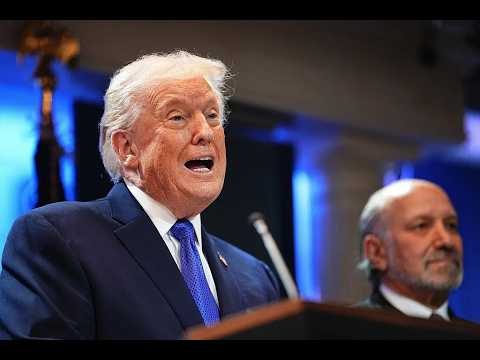
After a significant delay, Trump finally took the podium for his “emergency presser,” immediately launching into a defiant and characteristic speech. He began by praising the turnout, claiming, “That’s a new record. We set a record every time.” He then reiterated his “deep disappointment” and “shame” regarding the court’s majority, thanking the three dissenting justices by name. His tone was combative, asserting that “foreign countries that have been ripping us off for years are ecstatic. They’re so happy and they’re dancing in the streets, but they won’t be dancing for long. That I can assure you.”
Trump’s narrative quickly pivoted to a familiar theme: the alleged political motivations of his opponents. He claimed the “Democrats on the court are thrilled, but they will automatically vote no. They’re an automatic no. Just like in Congress, they’re an automatic no.” This conflation of judicial decisions with partisan political votes, especially within a conservative-leaning court, underscored his perception of the judiciary as another battleground in his political struggle. He branded these justices “a frankly disgrace to our nation… very unpatriotic and disloyal to our constitution,” suggesting they were “being fools and lap dogs for the rhinos and the radical left Democrats.” He further asserted that the court had been “swayed by foreign interests and a political movement that is far smaller than people would ever think.” These accusations, delivered with characteristic fervor, aimed to delegitimize the ruling and rally his base against perceived enemies within the government.
He framed the tariffs as more than just an economic tool, but a “symbol of economic national security.” Despite the ruling, he maintained a positive outlook on the nation’s economic state, claiming, “We’re doing so well as a country. We’ve never done so well.” This statement was immediately met with a commentator’s factual counterpoint, noting that fourth-quarter GDP was up just 1.4%, significantly lower than the 5-8% growth figures often boasted by some proponents.
Reimagining Presidential Power: “More Powerful Alternatives”
Perhaps the most striking aspect of Trump’s press conference was his assertion that the Supreme Court’s decision, far from limiting presidential power, had inadvertently expanded it. He claimed that “there are methods, practices, statutes, and authorities as recognized by the entire court in this terrible decision and also as recognized by Congress, which they refer to that are even stronger than the AIPA tariffs available to me as president of the United States.” He cited specific federal statutes, including the Trade Expansion Act of 1962 (Section 232), the Trade Act of 1974 (Sections 122, 2011, 301), and the Tariff Act of 1930 (Section 338), as providing these “more powerful” alternatives.
Trump’s interpretation of the ruling was that while he could not unilaterally charge a “fee” or a “dollar” under the specific AIPA framework, the court had affirmed his “unquestioned right to ban all sorts of things from coming into our country to destroy foreign countries.” He framed this as a right “much more powerful than many people ever thought we even had.” He elaborated on this perceived power, stating, “I am allowed to cut off any and all trade or business with that same country. In other words, I can destroy the trade. I can destroy the country. I’m even allowed to impose a foreign country destroying embargo. I can embargo. I can do anything I want. But I can’t charge $1 because that’s not what it says.” He found this distinction “ridiculous” but nonetheless declared, “It doesn’t matter because we have very powerful alternatives that have been approved by this decision.” In his view, the ruling had merely “overruled a particular use of AIPA tariffs and essentially it’s to use to get a fee,” while fully confirming “the ability to block, embargo, restrict, license, or impose any other condition on a foreign country’s ability to conduct trade with the United States under AIPA.” He concluded by claiming the decision “made a president’s ability to both regulate trade and impose tariffs more powerful and more crystal clear rather than less.”
He also made a curious claim of self-restraint, suggesting he was “very modest in my ask of other countries and businesses because I wanted to do and I very important. I wanted to be very well behaved because I wanted to do anything. I didn’t want to do anything that would affect the decision of the court because I understand the court. I understand how they are very easily swayed. I want to be a good boy.” This statement, delivered after years of aggressive trade actions, presented a stark contrast to his established approach.
Fact-Checking Trump’s Economic and Geopolitical Claims
During his address, Trump made several extraordinary claims regarding economic performance and geopolitical achievements, many of which warrant closer scrutiny. He boasted about the stock market, asserting, “Our stock market has just recently broken 50,000 on the Dow and simultaneously and even more amazingly broken 7,000 on the S&P.” While stock markets have seen significant growth over various periods, the Dow Jones Industrial Average has never reached 50,000, nor has the S&P 500 reached 7,000. These figures appear to be highly inflated and disconnected from actual market performance during any period of his presidency or immediately following it. The commentator noted this as a “Pam Bondi meme right now. the B the 50,000,” indicating a clear misrepresentation.
Beyond economics, Trump attributed significant geopolitical successes to his tariff policy, claiming, “Tariffs have likewise been used to end five of the eight wars that I settled… including India, Pakistan, big ones. Nuclear could have been nuclear.” He further stated that the Prime Minister of Pakistan had credited him with potentially saving “35 million lives” by stopping them from fighting. He also claimed that tariffs, used as a penalty against countries, had “reduced fentanyl coming into our country by 30%.” While tariffs can be a tool in diplomatic negotiations, directly attributing the end of wars, particularly large-scale international conflicts, and specific reductions in drug trafficking solely to tariffs is an unprecedented and largely unsubstantiated claim that stretches the typical understanding of their impact. His assertion that “all of those tariffs remain. They all remain. We’re still getting them and we will after the decision” directly contradicts the Supreme Court’s ruling that deemed them unconstitutional.
The Political Strategy: Loyalty, Ego, and the Election Cycle
Trump’s reaction to the Supreme Court ruling is deeply rooted in his political philosophy, which demands absolute loyalty and views any perceived concession as weakness. The commentator aptly described this dynamic: “He has planted his flag on the tariffs are the best thing to ever happen to the United States Hill. And because he’s done that and any backtracking would would kind of be viewed as capitulation and he views any capitulation as weakness, he’s just going to double, triple, quadruple down.” This ego-driven approach explains his fierce denunciation of the court, even a conservative one, for not giving him “100% complete total loyalty.”
The commentator further elaborated on the behavior of Republican allies, noting that figures like Mike Johnson and John Thune are motivated primarily by a desire to “curry favor with Trump.” Their goal is “not to represent their constituents… they are just there to show themselves up as doormats for this president.” This loyalty, born out of a fear of “a mean tweet or to get thrown under the bus,” explains the Republican eagerness to pursue legislative workarounds, even for a policy widely regarded as unpopular and economically detrimental. This dynamic underscores the profound influence Trump continues to wield over the GOP, shaping policy priorities and legislative strategies.
Trump also used the press conference to pivot to other political grievances, accusing Democrats of wanting to “pack the court” with “21 people.” This familiar attack, often deployed by Republicans, serves to energize his base and frame the political landscape as a battle against radical leftists attempting to undermine American institutions. His concluding remarks, asserting that the court’s decision would ironically lead to “no longer be any doubt and the income coming in and the protection of our companies and country will actually increase because of this decision,” encapsulated his defiance and his ability to reframe setbacks as victories.
Looking Ahead: Trade Policy, Presidential Authority, and the 2024 Election
The Supreme Court’s ruling on tariffs and Donald Trump’s fiery response set the stage for significant political and economic battles ahead. For the immediate future, the decision forces the executive branch to cease the unilateral imposition of these particular tariffs, though Trump has vowed to explore “more powerful alternatives” through other statutory authorities. This will likely lead to intense legislative efforts by Republicans to craft new trade policies that align with Trump’s protectionist agenda while adhering to constitutional constraints.
The ruling also reignites the enduring debate over the scope of presidential authority in foreign and economic policy. While presidents traditionally have significant leeway in conducting foreign affairs, the court has reaffirmed that trade, particularly the power to tax through tariffs, remains firmly within Congress’s domain. This could lead to a more assertive Congress in future trade negotiations and policy-making, potentially shifting the balance of power back towards the legislative branch.
Furthermore, the implications for the upcoming 2024 election are profound. The tariffs, as a “tax on American consumers,” were already a political vulnerability for Republicans. Now, with the Supreme Court’s ruling, the party faces a choice: abandon the unpopular policy or push for legislative workarounds that could be framed by opponents as a deliberate effort to raise costs for voters. Trump’s defiant stance, coupled with his attacks on the judiciary, will undoubtedly become a central theme in his campaign, appealing to his base while potentially alienating moderate voters concerned about constitutional norms and economic stability. The decision ensures that trade policy, executive power, and the role of the Supreme Court will remain front and center in the national political discourse.
Conclusion
The Supreme Court’s 6-3 decision striking down former President Donald Trump’s tariffs marks a pivotal moment in American constitutional law and trade policy. While affirming Congress’s primary role in regulating commerce, the ruling has ignited a fierce backlash from Trump, who has vowed to pursue even more aggressive trade measures. The ensuing political and economic debates will test the limits of executive power, challenge the unity of the Republican party, and undoubtedly cast a long shadow over the upcoming election, with profound implications for American consumers and the global economy.
Source: LIVE: Trump calls EMERGENCY PRESSER after Supreme Court LOSS (YouTube)

Related Articles
Trump: Iran Strikes Ahead of Schedule, Expects ‘Great Deal for World’
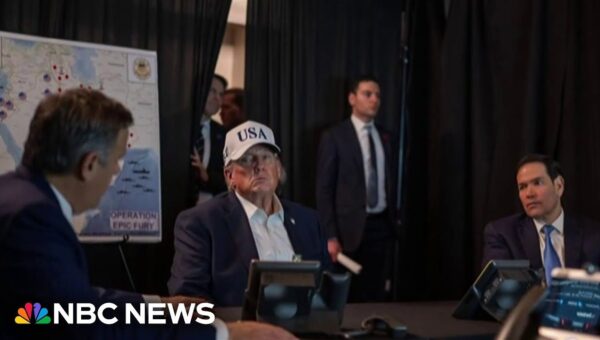
Three U.S. service members have been killed amid escalating conflict with Iran, President Trump confirmed. He stated that strikes are ahead of schedule, with senior Iranian leaders killed, and expressed optimism for a "great deal for the world" despite ongoing talks with Iranian officials.
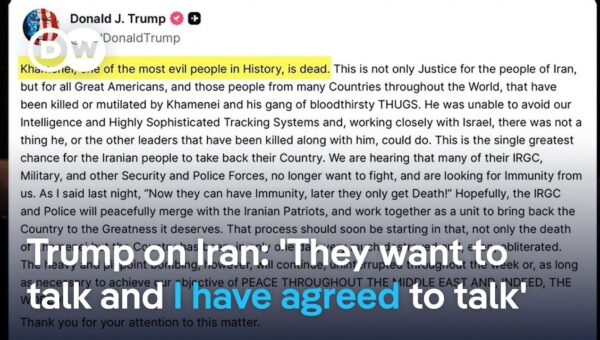
Trump Agrees to Talks with Iran After Major Strikes
President Donald Trump has agreed to talks with Iran's leadership following coordinated strikes that reportedly killed key figures, including the Supreme Leader. While Trump claims significant military successes, U.S. strategy remains unclear, and public opinion shows limited support for the actions amid rising American casualties.

Trump’s Putin Stance: US Strategy and Global Implications
Analysis suggests Donald Trump's approach to the Ukraine war involves pressuring Kyiv, but US involvement is crucial for resolution. China's influence and the 'MAGA' agenda's geopolitical implications are key factors.