Starship Booster Anomaly Reveals Design Secrets
An anomaly during testing of SpaceX's Super Heavy Booster 18 has revealed crucial details about its advanced COPV system and internal structure. Despite the loss, the incident provides invaluable data for refining Starship's design.

Starship Booster Anomaly Reveals Design Secrets
SpaceX’s relentless pursuit of rapid spaceflight development recently encountered a setback with an anomaly affecting Starship’s Super Heavy Booster 18. While the incident led to the unfortunate destruction of the booster, it has also provided invaluable insights into the advanced design of the next-generation rocket. The event, which occurred during ambient gas pressure testing at SpaceX’s Starbase facility, has prompted detailed analysis of the booster’s internal structure, particularly its Composite Overwrapped Pressure Vessels (COPVs).
Unpacking the Booster 18 Incident
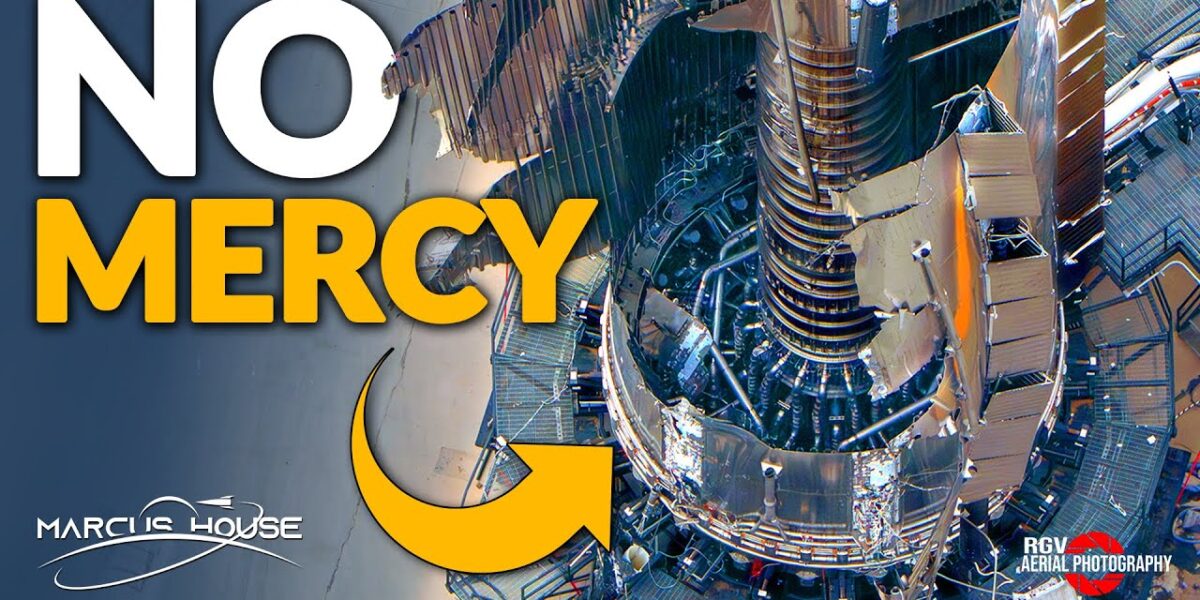
The anomaly with Booster 18, a Version 3 Super Heavy, resulted in a catastrophic failure of its liquid oxygen tank. Images captured by observers like Starbase Surfer and RGV Aerial Photography reveal that the eruption appears to have originated from one of the booster’s strakes. These strakes, aerodynamic fairings along the rocket’s body, conceal several COPVs – high-pressure tanks crucial for the rocket’s operation. The visual evidence suggests that the failure cascaded through multiple COPVs, with at least three significant ruptures visible on the tank wall. The opposite strake, which would normally house seven COPVs, shows signs of extensive damage.
This incident raises concerns about potential COPV-related issues, especially since a previous booster, Ship 36, experienced a similar failure attributed to a faulty COPV. SpaceX’s design for the Version 3 booster incorporates a complex network of plumbing and a new radial tank design to feed the 33 Raptor 3 engines. The damage sustained by Booster 18 also impacted the thrust simulator stand, with hydraulic fluid observed leaking from the structure. Despite the extensive damage, the booster’s inner transfer tube, a critical component for propellant flow, remarkably provided structural support to the remaining sections of the vehicle, a testament to its robust design.
Lessons Learned from Debris Analysis
The subsequent dismantling of Booster 18 has allowed for a closer examination of the failure’s aftermath. The debris field indicated that the breach originated near a strake, consistent with theories involving the COPVs housed within. The analysis of the fractured liquid oxygen tank revealed the intricate internal structure, including stringers for reinforcement and a large bellow designed to accommodate thermal expansion and contraction of cryogenic propellants. These components, along with external stiffeners, played a crucial role in maintaining the integrity of the transfer tube even after the primary tank wall was compromised.
A particularly interesting revelation from the wreckage is the presence of a vortex baffle at the top of the common dome. This component is essential for preventing the formation of dangerous vortices when propellant is drained, similar to water draining from a sink. Given the immense scale of the Starship tanks, such vortices could cause significant damage. The images also highlight the complexity of the propellant transfer system, with separate routing for liquid methane and liquid oxygen, and the stresses involved during propellant loading and re-entry.
What’s Next for Starship Development
Despite the setback, SpaceX remains undeterred. The company has indicated that the assembly of the next Version 3 Super Heavy booster is already underway, with plans to stack it in December. This rapid pace suggests that the anomaly with Booster 18 is not expected to significantly impact the overall timeline for Starship’s inaugural flight, tentatively targeted for the first quarter of 2026. This ambitious schedule underscores SpaceX’s iterative approach to development, where failures are seen as learning opportunities that accelerate progress.
The incident also highlights the ongoing infrastructure development at Starbase. Work continues on the orbital launch mount, with its removal and subsequent demolition of the pad’s foundation being a major undertaking. The construction of new facilities, such as the Gigabay with its specialized workstations and potential dedicated bridge cranes, signals the company’s commitment to scaling up production and streamlining the assembly process for future Starship and Super Heavy vehicles. The development of new transport and static fire stands for the Version 3 boosters further emphasizes the evolution of the Starship program.
Broader Context and Future Implications
The Starship program represents a paradigm shift in space exploration, aiming for full reusability and the capability to transport large payloads and significant numbers of people to Earth orbit, the Moon, and Mars. The lessons learned from Booster 18’s failure, though costly, are critical for refining the design and ensuring the safety and reliability of future Starship missions. The rapid progress in assembling new boosters and the continuous upgrades to launch and production facilities demonstrate SpaceX’s commitment to achieving these ambitious goals.
Beyond Starship, the week saw other significant developments in the space industry. Falcon 9 continued its busy launch cadence with multiple Starlink missions, including the debut of a new booster. Blue Origin announced progress on its Blue Ring space platform and revealed a mockup of its Blue Moon MK2 lunar lander, signaling continued efforts in the burgeoning commercial space sector. Meanwhile, a mishap at the Baikonur Cosmodrome following a Soyuz launch highlighted the challenges and complexities inherent in human spaceflight operations, emphasizing the importance of robust ground support systems.
The data gathered from the analysis of Booster 18’s failure will undoubtedly inform the design and testing of subsequent Super Heavy boosters. As SpaceX pushes the boundaries of rocket technology, each anomaly, while disappointing, contributes to a deeper understanding of the engineering challenges involved. The ultimate goal of Starship – to make humanity a multi-planetary species – relies on this continuous cycle of innovation, testing, and refinement.
Source: Starship’s Brutal Booster Failure Exposed New Secrets! (YouTube)

Related Articles


SpaceX Starship V3 Nears First Flight Amidst Major Artemis Shakeup
SpaceX eyes March for Starship V3's maiden flight as new testing reveals design improvements. Meanwhile, NASA's Artemis program faces delays and strategic shifts, with Artemis III repurposed as a LEO test mission.


Space Data Centers: A Leap for AI or Economic Hubris?
SpaceX's ambitious plans for orbital AI data centers raise profound questions about economic sustainability and the future of humanity. This article explores the potential benefits, immense challenges, and critical risks associated with this futuristic endeavor.

Starship V3: The Dawn of Reusable Spaceflight
SpaceX's Starship program enters a new phase with Version 3, focusing on full reusability, advanced Raptor 3 engines, and orbital refueling. Key milestones include mid-air rocket catches and the development of a Human Landing System for NASA's Artemis missions. This evolution promises a dramatic increase in launch cadence and unlocks ambitious deep-space exploration capabilities.