Starmer Knew ‘Quite A Lot’ About Mandelson’s Epstein Ties
New documents suggest Keir Starmer knew 'quite a lot' about Lord Mandelson's relationship with Jeffrey Epstein before appointing him ambassador, raising questions about his judgment. The Cabinet Office report details Mandelson's continued friendship and a stay at Epstein's apartment post-conviction, undermining Starmer's defense of being misled. The controversy resurfaces as Labour faces criticism amid shifting political polls.


Starmer Faces Scrutiny Over Mandelson Appointment Amid Epstein Revelations
London, UK – Questions are intensifying around Keir Starmer’s judgment following the initial release of documents pertaining to Lord Mandelson’s appointment as ambassador, specifically concerning his relationship with convicted pedophile Jeffrey Epstein. The first batch of these files, released after Prime Minister’s Questions, is expected to shed light on what the then-relevant authorities, including Starmer, knew about Mandelson’s ties to the disgraced American financier before the appointment was made.
Cabinet Office Report Highlights Extensive Knowledge
The central focus of the initial document release is the Cabinet Office’s due diligence report on Lord Mandelson. According to reports, this two-page document is described as a “Google cut and paste job” of publicly available information at the time. Crucially, it is understood to have detailed the continuation of Mandelson’s friendship with Epstein even after Epstein’s 2008 conviction for child sex offenses. The report allegedly includes details of Mandelson staying at Epstein’s New York apartment while the financier was serving his sentence, and references a JP Morgan report indicating a particularly close relationship between the two men.
“The key thing that everyone will be looking out for is what was called the Cabinet Office’s due diligence report into Lord Mandelson. And what that was essentially is what did Keir Starmer know about his friendship with Jeffrey Epstein, the pedophile American financier before he appointed him as ambassador and it turns out we think it is quite a lot.”
This information poses a significant challenge for Keir Starmer, raising fundamental questions about his decision-making process. The core issue is why he would appoint an individual to a high office when it was publicly known that the individual maintained a sustained friendship with a convicted pedophile, even after the conviction.
“Misled” Defense Under Threat
Starmer’s previous defense has centered on the claim that he was misled by Lord Mandelson regarding the nature and extent of his relationship with Epstein. However, the impending release of documents, particularly the mention of Mandelson staying at Epstein’s apartment, directly contradicts this narrative. The existence of such information in black and white, readily available at the time of the appointment, undermines the argument that Starmer was deceived.
The transcript highlights that even if Mandelson lied, the public knowledge of his continued association with Epstein, including the stay at the apartment, should have been a red flag. The argument presented is that the fact of staying at the flat is, in itself, indicative of a significant relationship, rendering the defense of being misled less tenable. The broader sustained friendship beyond 2008 is presented as more critical than the specific detail of the flat stay.
Questions Over Vetting Process
Further scrutiny is being directed at the vetting process undertaken for Lord Mandelson’s appointment. It is reported that the entirety of the vetting involved sending just three questions to Mandelson via Keir Starmer’s then-chief of staff, Morgan McSweeney. These questions reportedly focused on the New York flat and the closeness of the relationship. The assertion is that no further security checks were conducted, and the appointment was pushed through without adequate due diligence.
The situation is likened to a scene from the sitcom Blackadder, where a simplistic approach to identifying a spy is questioned. The timing of the document release, strategically placed after Prime Minister’s Questions, is also noted as a potentially cynical move to mitigate immediate political damage, though it is acknowledged that the documents will still pose difficult questions for Starmer regardless of the timing.
Broader Implications for Labour
This controversy has resurfaced at a time when Labour is already facing criticism. The transcript references a comment from a Labour MP suggesting that the party risks appearing as the “Pedo Protectors Party,” a phrase reportedly used by Keir Starmer in the Commons recently. This highlights a persistent problem of individuals with questionable associations being appointed to positions of power.
Focus Shifts to Defence and Geopolitics
While the Mandelson files are a significant domestic issue, the discussion also touches upon broader geopolitical and defence matters. The transcript explores the potential for Keir Starmer to leverage the ongoing international conflict, particularly the UK’s stance and public opinion, as a political talking point. There is an observation that the public may be uncomfortable with direct UK military involvement, suggesting a potential area where Starmer could find political advantage, especially if the Conservative government’s response is perceived as misjudged.
However, the conversation quickly pivots back to the state of the UK’s armed forces and long-term defence investment. Concerns are raised about the current government’s perceived lack of a clear strategy for defence, particularly in light of evolving technological demands like drones and advanced capabilities. The lack of a published defence investment plan is cited as a critical omission.
Polling Data Reveals Shifting Political Landscape
The transcript concludes with a discussion of recent polling data, which indicates a significant shift in the political landscape. A new YouGov poll is mentioned, showing Reform UK leading with 23%, followed by the Conservatives and the Greens at 19%, and Labour a distant fourth at 17%. This data suggests a challenging environment for the Labour party, with the rise of smaller parties like Reform UK and the Green Party potentially squeezing traditional political blocs.
The analysis suggests that if parties like the Greens can maintain their poll numbers over several months, they could be perceived as major players in British politics. The current polling landscape paints a picture of a fragmented and volatile electorate, with significant challenges for all major parties.
Source: Starmer Knew ‘Quite A Lot’ About Mandelson’s Relationship With Epstein | Steven Swinford (YouTube)

Related Articles


Mandelson Files Drop as Starmer Battles Sunak in Heated PMQs
Prime Minister's Questions became a focal point for political maneuvering as the first tranche of the Peter Mandelson files were released. Analysts Lara Spirit and Steve Baker unpacked the dynamics of the exchange between Keir Starmer and Rishi Sunak, discussing the potential implications of the historical documents on current politics.

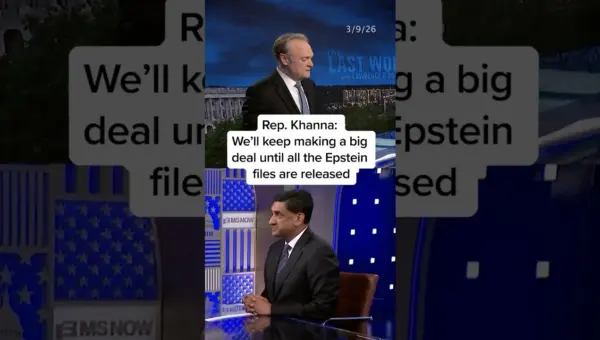
Khanna Vows Continued Fight for Epstein File Release
Representative Ro Khanna vows to 'keep making a big deal' until all sealed documents related to Jeffrey Epstein's case are released. The House Oversight Committee has voted to subpoena former Florida Attorney General Pam Bondi regarding her handling of the Epstein files, marking a significant step in the push for transparency.


New Mexico Probes Epstein’s Zorro Ranch for Criminal Activity
Investigators have searched Jeffrey Epstein's former Zorro Ranch in New Mexico as part of a renewed probe into allegations of criminal activity. The search follows the release of new documents and the establishment of a state Truth Commission examining potential legal gaps.