Spinning Wonders: Unraveling Gyroscopic Precision’s Mysteries
An experimental approach using analogies to linear momentum helps demystify the counterintuitive behavior of spinning objects known as gyroscopic precision. This phenomenon, where a spinning object reacts to force at a 90-degree angle, is crucial for understanding everything from frisbees to spacecraft.

Spinning Wonders: Unraveling Gyroscopic Precision’s Mysteries
The universe is replete with spinning objects, from planets and stars to the humble bicycle wheel and the sophisticated designs of disk golf. Yet, a seemingly simple phenomenon associated with these spinning bodies – gyroscopic precision – has long puzzled even those with advanced scientific training. This article delves into the captivating world of gyroscopic precision, demystifying its principles through an accessible, experimental approach that moves beyond rote memorization to genuine understanding.
The Puzzling Persistence of Spin
Gyroscopic precision is the counterintuitive tendency of a spinning object to resist changes in its orientation. When a force is applied to a spinning gyroscope, it doesn’t simply move in the direction of the applied force. Instead, it reacts by tilting or wobbling at an angle, typically 90 degrees away from the point of applied force. This phenomenon, while crucial for understanding everything from satellite stabilization to the flight dynamics of a frisbee, often remains an abstract concept, explained with complex equations or demonstrations that assume a deep prior knowledge of physics.
The challenge lies not just in observing gyroscopic precision, but in grasping its underlying ‘why.’ Many explanations, including those found in popular science videos, describe what happens but fail to bridge the gap to a fundamental comprehension. This is where a recent experimental approach seeks to shed new light, offering a step-by-step revelation of this complex physical behavior.
An Experimental Approach to Understanding
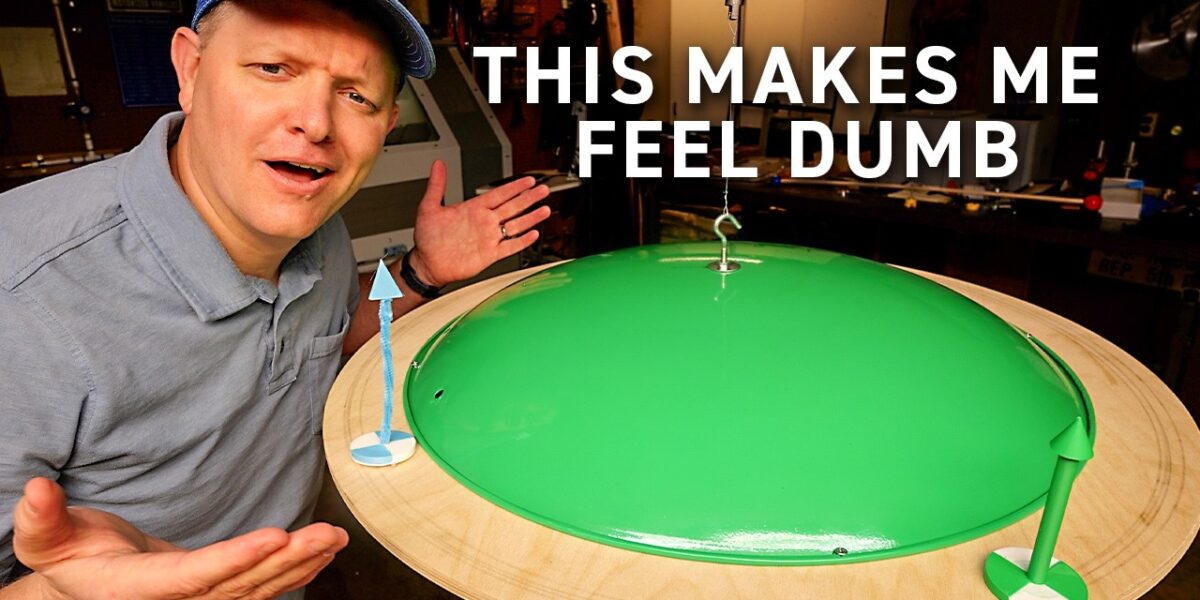
The core of this exploration involved a meticulously constructed experimental setup designed to isolate and observe gyroscopic precision in a controlled environment. A spinning disk, suspended by wires and free to move, served as the central subject. The experimenters aimed to apply forces to this disk and observe its reaction, paying close attention to the resulting motion.
Initially, the disk was tested without spin. When a downward force was applied, the disk predictably tipped in the direction of the force. This established a baseline, highlighting the difference that spin makes.
The experiment then introduced spin to the disk, significantly increasing its angular momentum. When a downward force was applied to the spinning disk, the expected result – a simple downward tilt – did not occur. Instead, the disk exhibited a complex wobble, a clear indication of gyroscopic precision at play. The applied downward force resulted in a tilt 90 degrees away, demonstrating the characteristic lag and angular displacement of gyroscopic precession.
To further probe this phenomenon, forces were applied both upwards and downwards at specific points on the spinning disk. In each instance, the disk’s reaction was not a direct response to the applied force but a motion occurring approximately 90 degrees out of phase. This consistent 90-degree displacement is the hallmark of gyroscopic precision, a direct consequence of the conservation of angular momentum.
Bridging the Gap with Linear Momentum
The breakthrough in understanding came from reframing the problem. Instead of solely focusing on the complex concepts of angular momentum and rotational dynamics, the experimenters turned to the more intuitive principles of linear momentum. This analogy, inspired by the behavior of colliding billiard balls, proved to be a powerful tool for demystifying gyroscopic precision.
Consider two pool balls. If one ball (with linear momentum in the X direction) collides with another stationary ball, the stationary ball will move. If, however, a second ball (with linear momentum in the Y direction) strikes the first ball as it is rolling, the resulting motion of the first ball is a combination of its original momentum and the momentum imparted by the second ball. The resultant motion is at an angle, representing the vector sum of the two momenta. The system conserves both X and Y momentum.
This concept was then applied to the spinning disk. The spinning disk, with mass distributed at a radius, can be conceptually broken down into numerous tiny elements, each possessing linear momentum. When an external force is applied, it’s akin to one of these elements being struck by another ‘force’ ball. The applied force, carrying its own momentum, interacts with the existing linear momentum of the spinning elements. The resulting motion of the disk is not a direct response to the applied force but a consequence of the vector addition of the applied momentum and the pre-existing momentum of the spinning mass elements.
From the perspective of the spinning disk, this interaction results in a torque that causes a change in its angular momentum. Because the disk already possesses significant angular momentum, the applied torque generates a precession, a slow rotation of the axis of spin. This is why pushing down on one side of the spinning disk causes it to tilt, or ‘precess,’ sideways, rather than simply moving downwards.
Implications and Future Directions
Understanding gyroscopic precision has profound implications across numerous scientific and engineering fields. It is fundamental to the stability of spinning tops, the navigation of spacecraft, the flight of drones, and the design of gyroscopes used in everything from smartphones to aircraft. The ability to explain this phenomenon using relatable analogies, such as the billiard ball collision, opens the door for broader scientific literacy.
The experimental setup, though simplified, provides a tangible model for exploring rotational dynamics. Future research could involve more precise measurements, varying the mass distribution and spin rates of the disk to observe more nuanced effects. Advanced simulations could further validate the linear momentum analogy, providing a deeper quantitative understanding.
For the disk golf enthusiast, this newfound clarity helps explain the subtle but critical role of spin in achieving stable flight. For the aspiring engineer or physicist, it offers a more intuitive pathway to grasping a fundamental concept in mechanics. The quest to understand gyroscopic precision, sparked by the simple act of observing how things fly, underscores the power of curiosity-driven exploration and the beauty of uncovering the hidden order within the seemingly chaotic motion of the universe.
Source: Why Do Spinning Things Do This? – Smarter Every Day 312 (YouTube)

Related Articles

Heisenberg’s 1925 Quantum Leap Still Puzzles
In 1925, Werner Heisenberg's groundbreaking work laid the foundation for quantum mechanics, a theory that revolutionized physics but whose fundamental implications remain a profound mystery 100 years later. This exploration delves into the birth of this strange new physics.

Mystery of the Rising Weight: A Physics Puzzle Solved
A surprising physics demonstration shows a weight rising after a connecting rope is cut. The counterintuitive outcome is explained by the stored energy and rapid contraction of springs in the system.


Quantum Mystery: Fields or Potentials?
The Bohm-Aharonov effect, demonstrated experimentally, suggests quantum particles are influenced by magnetic potentials even when magnetic fields are absent. This challenges classical physics' view of potentials as mere mathematical tools.