SpaceX’s Orbital Data Centers: A Million Satellites?
SpaceX is planning a massive constellation of up to one million satellites to serve as orbital data centers. These satellites will be deployed in various orbits, including sun-synchronous paths, to provide global computing power. The ambitious project raises questions about scale, visibility, and the future of space infrastructure.

SpaceX’s Orbital Data Centers: A Million Satellites?
SpaceX, the ambitious aerospace company led by Elon Musk, has recently unveiled plans that could fundamentally reshape our understanding of computing and space infrastructure. In a move that blurs the lines between artificial intelligence, data processing, and orbital mechanics, SpaceX has acquired X AI, a company that also owns the social media platform X (formerly Twitter). The stated goal: to build humanity’s compute in space by launching vast data centers into orbit.
A Mega-Constellation of Unprecedented Scale
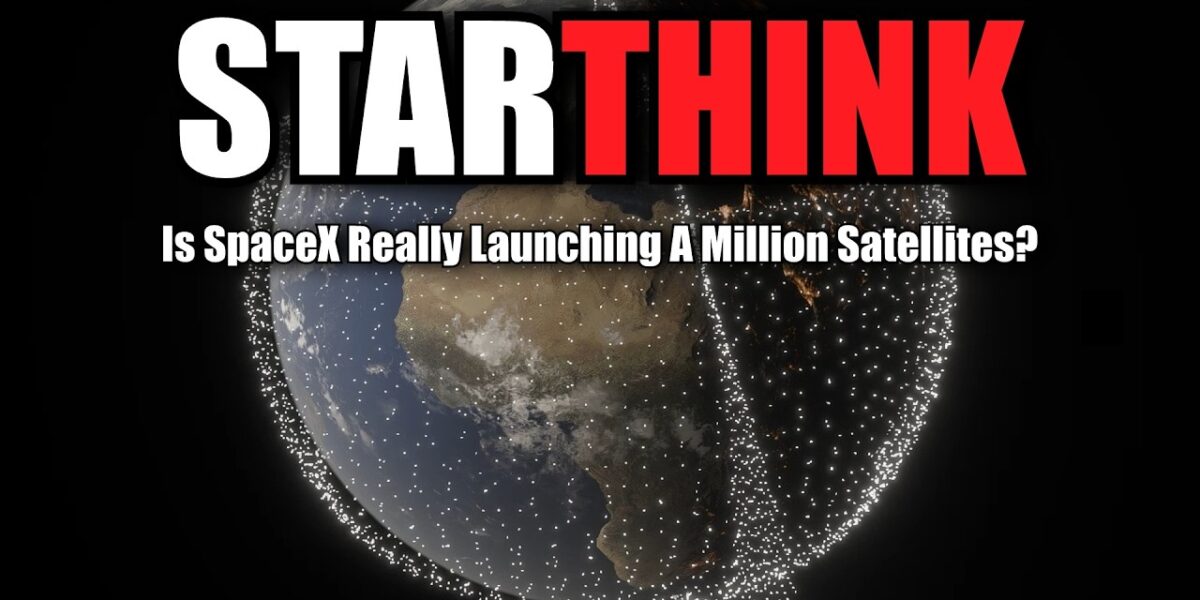
The sheer scale of this proposed endeavor is staggering. While SpaceX’s Starlink constellation already numbers in the thousands, a recent FCC filing suggests this new venture could involve as many as one million satellites. To visualize this, Scott Manley, a renowned space commentator, has utilized the physics simulator Universe Sandbox to model what such a constellation might look like. These simulated satellites, each weighing approximately 500 kg and consistent with Starlink V2 minis, are depicted in near-circular orbits between 500 and 2,000 km in altitude, with inclinations of 30 degrees and sun-synchronous orbits.
Orbital Mechanics and Strategic Placement
The orbital parameters outlined in the filing are crucial to understanding the operational strategy. Sun-synchronous orbits, which circle the Earth over the poles, are particularly important. Satellites in these orbits can remain in sunlight for extended periods, ideal for continuous operation and power generation. Manley likens these to ‘sun-synchronous halos’ due to their polar paths.
However, the plan also includes satellites in a 30-degree inclined shell. These orbits will experience periods of darkness as they pass into Earth’s shadow. The rationale here appears to be linked to demand. During daylight hours, when most of the planet’s population is active, there is a greater demand for computing services. This inclined band of satellites could potentially serve these daylight users, offering localized, high-demand computing power when and where it’s needed most.
The arrangement of these satellites into ‘walker shells’ is a well-established method for distributing satellites to maximize coverage. This systematic approach ensures a more uniform distribution across the designated orbital shells, a concept pioneered by systems engineer Paul Walker.
Visualizing the Invisible: Scale and Brightness Concerns
Visualizing a million satellites, each significantly smaller than the Earth, presents a challenge. While Universe Sandbox can simulate their orbits, actual visibility is complex. The reflectivity of the satellites, particularly their solar panels and bodies, could lead to occasional bright flares visible from Earth. SpaceX’s Starlink satellites have already drawn attention from astronomers due to their brightness. While SpaceX aims to mitigate this through careful orientation, the sheer number of satellites in this new constellation raises concerns about light pollution and its impact on astronomical observations. Realistic estimations of satellite size, such as the 50-meter span of proposed Starship V3 satellites, are difficult to grasp without comparison. On the ground, such an object would be roughly the size of a propellant storage tank near a launch site, but in the vastness of space, it becomes smaller than a single pixel, visible only under specific conditions of reflected sunlight.
Behind the Scenes: Simulating the Constellation
Creating the visualization in Universe Sandbox involved a degree of technical ingenuity. The game’s save files, formatted as zip archives containing JSON data, were manipulated. Python scripting was used to generate the complex arrangement of ‘walker shells’ and populate the simulation with thousands of satellite entities. To make these tiny objects visible in the simulation, Manley resorted to ‘cheating’ by increasing their thermal emission, effectively making them glow like miniature stars – a humorous nod to solving cooling problems by emitting light.
This simulation setup, along with Python scripts for generating orbital configurations, has been shared on platforms like the Universe Sandbox Workshop and Patreon, allowing enthusiasts to explore these concepts further.
The Future: Moon Over Mars, and the AI Question
While the orbital data center concept is ambitious, its timeline is uncertain, with Musk’s ‘Elon time’ suggesting it could be three years away, if not longer. Furthermore, the viability of such a project hinges on the continued growth and stability of the AI market, as well as the development of more efficient computing technologies.
Interestingly, a recent shift in focus has been announced by Musk: SpaceX is now prioritizing the development of a self-sustaining city on the Moon, with Mars development taking a backseat. This pivot aligns with a broader trend in the space industry, with companies like Blue Origin also re-emphasizing lunar missions. This focus on the Moon is likely influenced by discussions with NASA and governmental bodies, aiming to secure America’s lead in lunar exploration.
Broader Implications
The concept of vast orbital data centers raises profound questions about the future of computing, space utilization, and our relationship with the cosmos. It represents a bold vision for harnessing solar energy on an unprecedented scale and distributing computational power globally. However, it also necessitates careful consideration of orbital debris, light pollution, and the economic feasibility of such mega-projects. As humanity continues to push the boundaries of space exploration and technological innovation, the decisions made today will shape the future of our presence beyond Earth.
Source: What Would SpaceX's Space Datacenter Plans Look Like? (YouTube)

Related Articles


US Secretly Arm-Twists Iran with Starlink & Military Might
The US is reportedly covertly supplying Iran with thousands of Starlink terminals to aid protesters, while simultaneously deploying a significant military force to the Middle East. This dual strategy unfolds against a backdrop of stalled diplomacy and escalating regional tensions, raising questions about the path forward.


SpaceX Starship V3 Nears First Flight Amidst Major Artemis Shakeup
SpaceX eyes March for Starship V3's maiden flight as new testing reveals design improvements. Meanwhile, NASA's Artemis program faces delays and strategic shifts, with Artemis III repurposed as a LEO test mission.


Ukraine Offensive: Starlink Cutoff Cripples Russian Communications
Ukraine has launched a significant offensive, reclaiming territory by exploiting a critical communication failure among Russian troops. The cutoff of Starlink services to Russian forces, coupled with Ukraine's advanced electronic warfare capabilities, has left Russian units severely hampered and vulnerable. This development allows Ukrainian forces, despite being outnumbered, to systematically dismantle Russian positions.