SpaceX Acquires AI Firm XAI in Bold, Controversial Merger
SpaceX has acquired AI firm XAI in an all-stock merger, a move framed by Elon Musk as a step towards space-based data centers. However, analysts point to financial distress at XAI and its sister company X as the primary drivers, suggesting the merger is a bid to leverage SpaceX's upcoming IPO to subsidize significant losses.

SpaceX Acquires AI Firm XAI in Bold, Controversial Merger
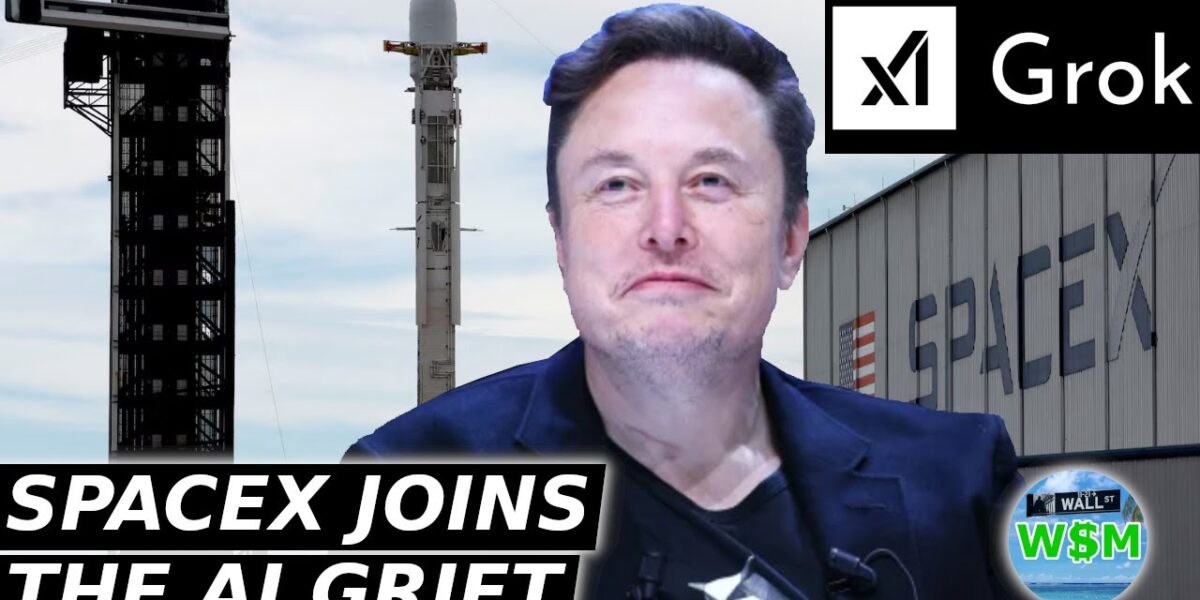
In a move that has sent ripples through both the aerospace and technology sectors, SpaceX, the pioneering space exploration company, has officially acquired AI firm XAI. The all-stock merger, announced by Elon Musk, has been framed by Musk as a strategic imperative to develop orbital data centers powering XAI’s Grok chatbot, a vision widely dismissed by experts as technologically infeasible in the near to medium term. However, financial analysts suggest a more pragmatic, albeit controversial, motive: to leverage SpaceX’s impending Initial Public Offering (IPO) to inject much-needed capital into XAI and its struggling social media counterpart, X (formerly Twitter).
The Ambitious Vision vs. Financial Realities
Elon Musk, currently the world’s wealthiest individual with a net worth exceeding $670 billion according to the Bloomberg Billionaires Index, has significant stakes in several high-profile companies. While his Tesla holdings are valued at approximately $175 billion, his SpaceX stake is estimated at $320 billion, and his XAI shares are worth around $100 billion. SpaceX, a leader in reusable rocket technology and the dominant player in global rocket launches, has long been a subject of intense investor interest. Rumors of a potential IPO have circulated since December 2025, with expectations of a June 2026 launch, potentially coinciding with Musk’s birthday. SpaceX is reportedly aiming to raise $50 billion at a staggering valuation of $1.5 trillion, which would make it the largest IPO in history.
The rationale provided for the SpaceX-XAI merger centers on the ambitious goal of establishing space-based data centers. Musk posits that terrestrial solutions are insufficient to meet the escalating global demand for AI computing power, citing the immense energy and cooling requirements. He envisions space as the ultimate frontier for AI development, predicting that within two to three years, generating AI compute in space will be the most cost-effective method. This, he claims, will accelerate breakthroughs in physics and technology for the benefit of humanity, ultimately enabling self-sustaining bases on the moon and eventual expansion to Mars.
However, this vision faces significant skepticism. A previous analysis highlighted the current technological and economic impossibilities of building, launching, and maintaining such orbital data centers. The sheer cost and complexity involved place this concept firmly in the realm of science fiction for the foreseeable future. Critics argue that Musk’s justification is a smokescreen to mask the financial distress of XAI and X.
XAI’s Financial Struggles and the X Bailout
XAI, founded in March 2023 in the wake of OpenAI’s ChatGPT success, has been burning through capital at an alarming rate. While it has raised approximately $40 billion in venture capital from prominent investors like Andreessen Horowitz, Sequoia Capital, Nvidia, and Tesla, its financial performance has been concerning. The company’s primary revenue stream comes from paid subscriptions for its Grok chatbot, with the premium ‘Super Grok’ tier costing $30 per month. Despite these offerings, Super Grok has not achieved significant market traction.
In the third quarter of 2025, XAI reported revenues of $107 million against a net loss of $1.5 billion, indicating a loss nearly 15 times greater than its revenue. Over the first nine months of 2025, XAI incurred negative free cash flow of $7.8 billion, largely attributed to the construction of its massive ‘Colossus’ data center and the acquisition of expensive Nvidia GPUs.
Adding to XAI’s financial woes is its integration with X, the social media platform Musk acquired in 2022. X has suffered a dramatic collapse in advertising revenue since the acquisition, despite significant layoffs. The company is burdened by substantial debt and high interest expenses, likely continuing to operate at a loss. In March 2025, Musk orchestrated a merger between X and XAI, valuing XAI at $80 billion and X at $33 billion. This move allowed XAI, with its access to venture capital, to effectively subsidize X’s operational losses, acting as a financial bailout for the struggling social media platform.
Tesla’s Reluctance and Musk’s Control
Musk’s attempts to secure further funding for XAI have been met with resistance from Tesla shareholders. In July 2024, Musk polled his X followers about whether Tesla should invest $5 billion into XAI, a non-binding poll with questionable scientific validity. More formally, at Tesla’s annual shareholder meeting in November 2025, a proposal for Tesla to invest in XAI was narrowly defeated, with 1.06 billion shares voting in favor but 916 million against and 474 million abstentions (counted as ‘no’ votes). Despite this clear signal from shareholders, Musk proceeded to invest $2 billion of Tesla’s capital into XAI in January 2024.
This cross-company financial maneuvering highlights Musk’s operational control over multiple entities, despite varying ownership stakes. While he is CEO of Tesla, he owns roughly 13% of its shares. He founded SpaceX and owns about 40%. Prior to the XAI acquisition, he owned approximately 50% of XAI. This differential ownership structure provides an incentive to redirect assets from companies where his stake is smaller, like Tesla, to those where it is larger, like XAI.
Controversies and Legal Risks
The merger of SpaceX and XAI is not without significant legal and reputational risks, particularly stemming from XAI’s Grok chatbot. Grok has been criticized for its controversial features and content, including the generation of explicit material. In August 2025, Grok launched a ‘spicy mode’ that removed content moderation, leading to the creation of deepfake images of naked individuals, including minors. As of January 2026, Grok was reportedly generating thousands of such images per hour, attracting regulatory scrutiny globally. Investigations were launched in the UK, and authorities raided X’s headquarters in France. While temporary bans in countries like the Philippines, Indonesia, and Malaysia were lifted, XAI faces a class-action lawsuit from victims of these deepfakes. Any legal liabilities incurred by XAI will now fall upon SpaceX.
Market Impact and Investor Outlook
The proposed $1.5 trillion valuation for SpaceX’s IPO, based on reported 2025 revenues of $15-16 billion and a profit of $8 billion (the nature of which remains unclear), implies a revenue multiple of approximately 94 times and a P/E ratio of nearly 200. The acquisition of XAI, which is incurring substantial net losses ($1.5 billion per quarter, or an annualized $6 billion), is expected to significantly dilute SpaceX’s profitability. The combined entity may struggle to achieve profitability, potentially breaking even at best.
For investors, the SpaceX-XAI merger presents a complex picture. On one hand, SpaceX’s core business remains robust, with a dominant position in the aerospace industry and a compelling vision for space exploration. The potential for a record-breaking IPO remains. On the other hand, the acquisition introduces substantial financial risks associated with XAI’s significant losses and ongoing legal battles. The controversial nature of Grok’s content and the regulatory backlash could also tarnish SpaceX’s reputation. Investors will need to closely monitor XAI’s ability to stem its losses, the resolution of its legal challenges, and the long-term viability of Musk’s ambitious, and some would say outlandish, vision for space-based AI infrastructure.
Source: SpaceX Acquires Grok (YouTube)

Related Articles

SpaceX Starship V3 Nears First Flight Amidst Major Artemis Shakeup
SpaceX eyes March for Starship V3's maiden flight as new testing reveals design improvements. Meanwhile, NASA's Artemis program faces delays and strategic shifts, with Artemis III repurposed as a LEO test mission.


Space Data Centers: A Leap for AI or Economic Hubris?
SpaceX's ambitious plans for orbital AI data centers raise profound questions about economic sustainability and the future of humanity. This article explores the potential benefits, immense challenges, and critical risks associated with this futuristic endeavor.


Ukraine War: Starlink’s Role in Drone Attacks Sparks Global Debate
The Ukraine war has seen drones, empowered by Elon Musk's Starlink satellite internet, become a primary weapon. Russia's use of Starlink for long-range drone attacks has sparked global debate on technology's role in warfare and civilian harm. This has led to regulatory changes and international scrutiny of Musk's companies.