Space Force Deploys Tech to Neutralize Iran Threats
The U.S. Space Force has reportedly used advanced space technology to neutralize Iranian missile threats during 'Operation Epic Fury,' highlighting space as a critical battlefield. NASA Administrator Jared Isaacman emphasized the strategic importance of space assets for observation and communication, while also detailing ambitious plans for lunar exploration and the development of nuclear propulsion.


US Leverages Space Assets in ‘Operation Epic Fury’ Against Iran
In a significant escalation of geopolitical tensions, the United States has reportedly utilized advanced space-based technology to counter Iranian aggression during what is being termed ‘Operation Epic Fury.’ This operation saw American forces employing sophisticated space assets to track and neutralize retaliatory missile launches, marking a new frontier in modern warfare where the battlefield extends beyond land, sea, and air into the vastness of outer space.
Space Force’s Role in Missile Defense
According to reports, the U.S. Space Force has deployed technology capable of detecting missile launches almost instantaneously. These systems can track missiles from their initial ascent, identifying the heat signatures they generate. Real-time data is then processed to calculate missile trajectories, allowing for swift and decisive countermeasures. This capability provides a critical advantage, enabling U.S. forces to respond effectively to threats originating from space.
“Space is the ultimate high ground… Satellites for observation, for communication, the capabilities that are identifying the rocket launches, communicating to our forces, give America an extreme edge in this conflict.”
Jared Isaacman, NASA Administrator
Protecting the Final Frontier: A National Security Imperative
The strategic importance of space as a national security domain has been a recurring theme. NASA Administrator Jared Isaacman emphasized that space is the “ultimate high ground” and highlighted the proactive measures taken, such as the establishment of the Space Force by President Trump during his first term. The Artemis program, aimed at peaceful civil exploration of the Moon, also underscores America’s commitment to leadership in space. Isaacman noted that satellites are crucial for observation and communication, providing U.S. forces with a significant advantage in conflicts.
The vulnerability of these space assets is a growing concern. Adversaries may seek to disable or destroy U.S. satellites to disrupt communications and intelligence gathering, effectively “shutting the lights off on Earth.” This threat is precisely why President Trump prioritized the creation of the Space Force, recognizing that space is no longer a secure domain and that adversaries possess capabilities to threaten U.S. assets. While the U.S. has assets in space that can counter these threats, the proximity of satellites in low Earth orbit makes them more vulnerable compared to those in geostationary orbit.
America’s Lunar Ambitions and Space Dominance
Isaacman detailed the Trump administration’s ambitious space policy, which focuses on maintaining American superiority in space. This includes not only civil and peaceful exploration but also a renewed focus on returning to the Moon and establishing a permanent presence. The Artemis program, with its Moon rocket, is central to this vision. The plan involves sending astronauts around the Moon and safely returning them to Earth, followed by annual missions to establish a lunar base by 2028. Future aspirations include testing technologies like nuclear propulsion for space travel, potentially enabling American astronauts to reach Mars.
“The Artemis program is a program that lives on beyond any one rocket,” Isaacman stated. “President Trump wants to make sure that we pick up where Apollo 17 left off. We’re not going back to the Moon to plant the flag, leave footsteps, but build an enduring presence on the Moon.” This enduring presence is seen as crucial for national security, economic value, and as a proving ground for technologies needed for future missions, including those to Mars.
The Growing Competition in Space
The narrative of space as a competitive arena is further amplified by the focus on China’s burgeoning space program. Reports suggest that China is rapidly developing its space capabilities, including a contested spaceport, a portfolio of rockets, landers, and satellite constellations. This long-term strategic investment by authoritarian space powers like China and Russia is seen as a direct challenge to U.S. dominance.
Isaacman emphasized that nations pursuing bold endeavors in space are often achieving their national security objectives. America’s return to the Moon and the establishment of a lunar base are intended to send a clear message to adversaries about U.S. capabilities. The race for technological supremacy in space is measured in months, not years, making rapid progress and sustained leadership critical.
Defending and Repairing Satellites
When questioned about the U.S. capability to defend or repair satellites, Isaacman indicated that demonstrations and missions are already underway. These include on-orbit boosting and refueling of satellites. The lunar strategy also involves collaboration with partners like SpaceX and Blue Origin for lunar landers, and potential on-orbit assembly, which could be a game-changer for the United States.
“I one hundred percent believe that our adversaries around the world understand how important the high ground of space is what our satellites are capable of doing,” Isaacman asserted, referring to observation and communication capabilities. “And they are doing everything they can to try and challenge it.” He reiterated that President Trump’s initiatives, including building larger constellations and focusing on cis-lunar space, are key to addressing these challenges.
Concerns Over Iran’s Nuclear Ambitions
The discussion also touched upon Iran’s nuclear program, with references to comments made by Senator Lindsey Graham. Graham expressed grave concern over Iran possessing enough highly enriched uranium to potentially create nuclear weapons, warning of the severe consequences for America and the region if Iran were to acquire nuclear capabilities. He stated that the fall of the Iranian regime would usher in a “new Middle East” and prevent threats to vital shipping lanes.
Isaacman concurred with the sentiment, stating unequivocally that a country chanting “Death to America” should never possess nuclear weapons. He elaborated on the dangers, noting that highly enriched uranium doesn’t just pose a threat for bomb-making but can also be used to create radiological hazards, rendering areas uninhabitable for extended periods. He stressed that such a capability must never be allowed.
Nuclear Propulsion: A Game Changer for Space Exploration
The conversation highlighted the critical role of nuclear propulsion in future space endeavors. Isaacman explained that while chemical rockets are effective for one-way journeys, nuclear propulsion offers the capability for efficient round trips, enabling the movement of large masses and the establishment of an “interplanetary railroad.” This technology could allow astronauts on Mars to manufacture propellant for their return journey, fundamentally changing the scope and feasibility of deep space exploration.
“Nuclear power is important for peaceful space exploration,” Isaacman clarified. “It’s a game-changer for the United States moving in that direction for sure.”
The Emerging Space Race with China and Russia
Concerns were raised about potential complicity between China and Russia in assisting Iran by using their space assets to identify U.S. targets. While Isaacman could not delve into classified intelligence matters, he noted that Russia and China have publicly announced collaborations on lunar nuclear power projects. This underscores the strategic importance of U.S. initiatives like the Artemis Accords and executive orders aimed at ensuring American leadership in space.
“Space is already the ultimate high ground; it is a battlefield,” Isaacman declared. He credited President Trump with understanding the importance of space, leading to the creation of the Space Force and the Artemis Accords. The focus on American superiority in space, he argued, is crucial for national security.
The Role of Private Industry in Space Dominance
The vital contribution of private companies like SpaceX and Blue Origin to America’s space capabilities was also emphasized. Isaacman noted that the U.S. currently possesses the healthiest and most competitive launch industry in its history. The reusable rocket technology developed by companies like SpaceX is crucial for maintaining an edge in orbital launches, especially when competing with China. These capabilities directly support the deployment of observation and communication satellites, which are making a difference in current conflicts.
Regarding China’s potential to establish the first permanent base on the Moon, Isaacman expressed a strong belief that the U.S. is in a race against China, with success measured in months. He warned that if the U.S. falters, China could establish a base at critical locations like the lunar South Pole, a goal they have openly stated. This underscores the urgency for the U.S. to accelerate its lunar ambitions and maintain its leadership.
NASA’s Dual Role: Science and National Security
Isaacman concluded by affirming NASA’s dual role as an agency dedicated to science and discovery, as well as a component of America’s strategic deterrent. He highlighted NASA’s ongoing scientific missions, such as the James Webb Space Telescope and Mars rovers, emphasizing that knowledge gained from space exploration has immense power. Simultaneously, he recognized NASA’s national security mission, drawing a parallel to the 1969 Apollo 11 mission, which sent a powerful message to the world about America’s capabilities. He expressed confidence that under President Trump’s leadership, these achievements will be replicated in the years ahead.
Looking Ahead: The Future of Space Warfare and Exploration
The integration of space-based technology into military operations signifies a profound shift in global security dynamics. As nations continue to develop and deploy advanced space capabilities, the potential for conflict in this domain will likely increase. The race for lunar dominance and the development of technologies like nuclear propulsion will shape the future of both space exploration and geopolitical power. The coming years will be critical in determining whether international cooperation or competition will define humanity’s future in space.
Source: SPACE WAR: Trump UNLEASHES 'space technology' on Iran (YouTube)

Related Articles

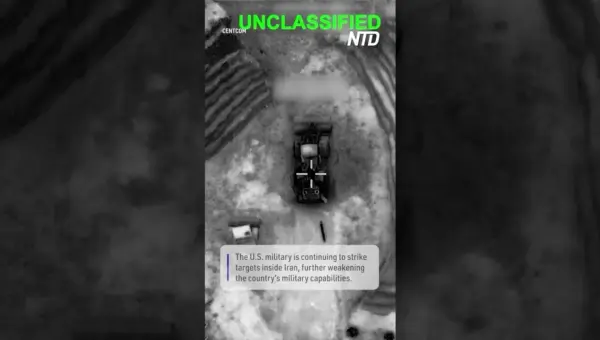
US Strikes Cripple Iran’s Military Might, CENTCOM Reports
U.S. Central Command reports ongoing strikes inside Iran are significantly weakening its military power. This direct action aims to reshape regional security dynamics, but carries risks of escalation. The long-term impact depends on Iran's response and ability to adapt.


Iran Targets US With Cyberattacks, Escalating Digital Warfare
Iran is increasingly using cyberattacks to challenge the U.S., as seen in a recent hack of the FBI director's account. Experts say this is a strategic shift due to Iran's limitations in conventional warfare. The U.S. needs to strengthen its digital defenses, focusing on encryption and cloud computing, rather than solely relying on traditional security measures.


Iran Hacks FBI Chief, Exposing U.S. Cyber Vulnerabilities
A recent hack of FBI Director Kash Patel's personal email by an Iran-linked group highlights Iran's growing cyber threat to the U.S. Experts explain how simple security oversights are exploited, emphasizing the need for basic defenses like two-factor authentication to protect against propaganda and potential infrastructure attacks.