Small Homes, Big Returns: How to Quit Your Job
A former math teacher built a 19-unit rental portfolio by focusing on small, affordable properties under $100,000. Crystal Still's strategy leverages out-of-state investing and a dual-income approach to achieve financial freedom.

Small Homes, Big Returns: How to Quit Your Job
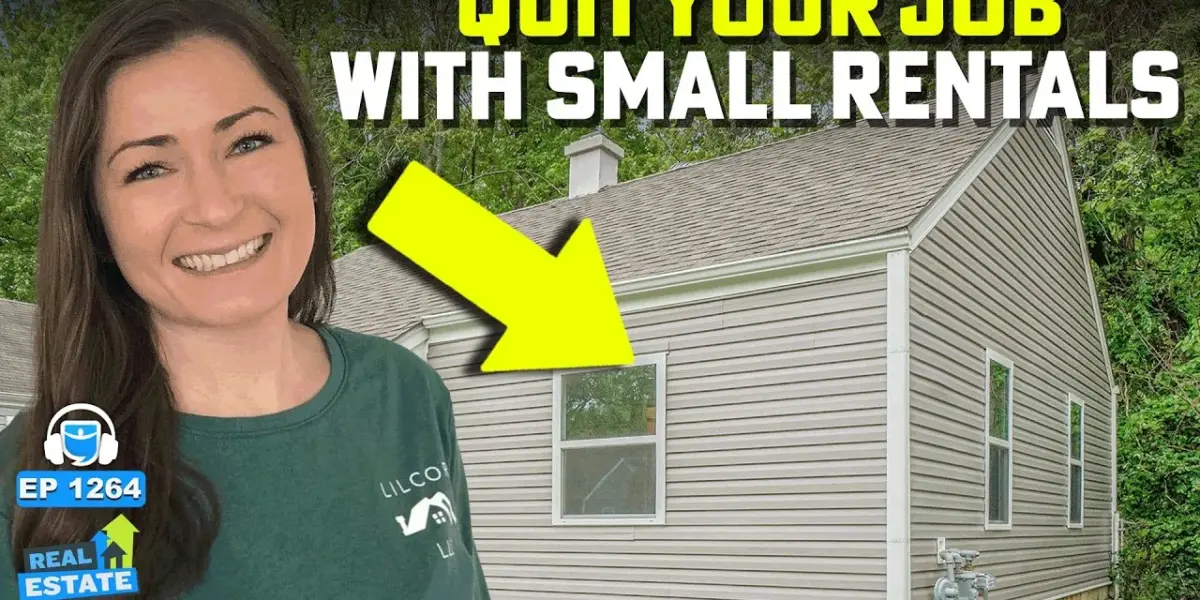
Crystal Still, a former high school math teacher, found a way to leave her job and spend more time with her young daughters. She achieved this not by climbing the corporate ladder, but by investing in small rental properties. These aren’t million-dollar mansions; they are modest homes, often around 800 square feet, purchased for under $100,000. This strategy allowed her to build a portfolio that generates enough income to replace her teaching salary.
From Teacher to Investor
Still’s journey into real estate began after the birth of her second daughter. The cost of childcare and the desire for more family time pushed her to explore alternative income streams. Inspired by books like “Rich Dad Poor Dad” and countless real estate podcasts, she and her husband, Alex, decided to dive into property investing.
Finding suitable properties in their high-cost Chicago suburban area proved difficult. So, they looked out of state. Their first investment was in Kansas City, Missouri, purchased for $52,000. Despite a rocky start with a tenant moving out right after closing, Still persevered. By the time she acquired her third rental property, she felt confident enough to leave her teaching job.
The Power of Small, Affordable Rentals
Still’s strategy centers on acquiring properties in the sub-$100,000 range. These smaller homes, often needing light to moderate renovations, can still command solid rental income. For instance, her first Kansas City property, bought for $52,000, was rented for $800 per month. After minor updates like a new roof and kitchen floor, the property continued to generate cash flow.
A key part of her success is the financing approach. For the $52,000 property, she used a delayed financing strategy. After purchasing it with cash, she was able to refinance it, pulling out most of her investment while leaving about $13,000 in the deal. The property appraised for around $75,000, allowing her to recoup a significant portion of her initial outlay.
Navigating Out-of-State Investing
Investing out of state requires building trust and systems. Still and her husband found their first out-of-state agent through networking on platforms like BiggerPockets. They even visited Kansas City to get a feel for the market and meet their agent in person—a step they highly recommend for any out-of-state investor.
Her second deal involved a different approach: a foreclosure auction in Kansas City. They partnered with an individual who specialized in identifying and bidding on auction properties. Still’s team provided their maximum bid, and the partner handled the bidding and initial renovations. This property, a small 850-square-foot house, was purchased for just $21,800. The renovation cost around $40,000, bringing the total investment to roughly $61,800. The property was later rented for $925 per month, and after a cash-out refinance, they had only $13,000 left in the deal.
To vet their partner, Still and her husband asked for references and spoke with other investors the partner had worked with. They also valued the clear communication and regular updates provided by the partner’s team, including video walkthroughs of the renovation progress.
Shifting Closer to Home
While out-of-state investing forced Still to build systems that could run without her constant presence, the COVID-19 pandemic led to a shift. Foreclosure auctions dried up, prompting her to re-evaluate her strategy. She decided to invest closer to her home in Illinois.
She found a real estate agent in Rock County, Wisconsin, just over the Illinois border. Her first property in this new area was a small, 600-square-foot single-family home purchased for $57,000. The home was already renovated and rented for $725 per month. This deal was financed with a conventional mortgage, requiring a 25% down payment.
The Two-Income Strategy
Still emphasizes the importance of her husband’s stable W2 income. While she transitioned to full-time real estate investing, his engineering salary covers their household bills. This arrangement allows them to reinvest all the cash flow from their rental properties back into the business, accelerating their growth without the pressure of needing rental income to cover immediate living expenses.
This strategy is crucial. Relying on rental income too soon can force investors to make less strategic decisions, potentially impacting long-term profitability. Having a W2 job not only provides financial stability but also enhances a borrower’s ability to secure financing from banks, which often favor stable employment history.
Scaling to 19 Units
Today, Crystal Still manages a portfolio of 19 rental units. The majority are long-term rentals, including a four-unit and a two-unit building in Wisconsin. She has also begun investing in markets like Machznney Park, Illinois, north of Rockford.
To find local deals, she experimented with direct mail marketing. Sending out a small batch of 82 postcards yielded two deals from investors, a remarkably high success rate. She also works with a small local bank that provides a line of credit for renovations and offers financing upon completion. This partnership allows her to be creative with financing, supporting her growth.
While the sub-$100,000 price point is still her target, the market has changed. Properties now cost closer to $100,000 to $110,000, with renovations adding another $40,000. Yet, rents have also risen, allowing for strong returns. For example, a property that cost $110,000 plus $40,000 in renovations appraised for $187,000. After a cash-out refinance, leaving only $11,000 in equity, the property now rents for $1,825 per month.
Still’s story highlights that financial freedom through real estate doesn’t always require large, expensive properties. Small, affordable rentals, combined with smart financing and a strategic approach, can pave the way for significant wealth building and lifestyle changes.
Source: The Small, $100K Rental Properties That Helped Me Quit My Job (YouTube)

Related Articles


Stagflation Fears Grip Housing Market
Stagflation fears are rising as a troubling economic scenario reminiscent of the 1970s looms. This means higher prices coupled with job losses, potentially impacting the housing market significantly. Investors and buyers should prepare for challenges ahead.


Buy Low, Sell High: Counter-Cyclical Real Estate Strategy
Discover the counter-cyclical real estate strategy: buying properties when others are selling at steep discounts. Learn how to identify opportunities in down markets and achieve long-term gains by going against the crowd.

Real Estate Offers Hedge Against Stagflation
Stagflation, characterized by high inflation and unemployment, presents economic challenges. However, real estate investments can act as a powerful hedge against these conditions. Understanding key terms like cash flow and cap rates is vital for navigating the market.