Shoe Print Unmasks Killer in Brutal Highway Murder
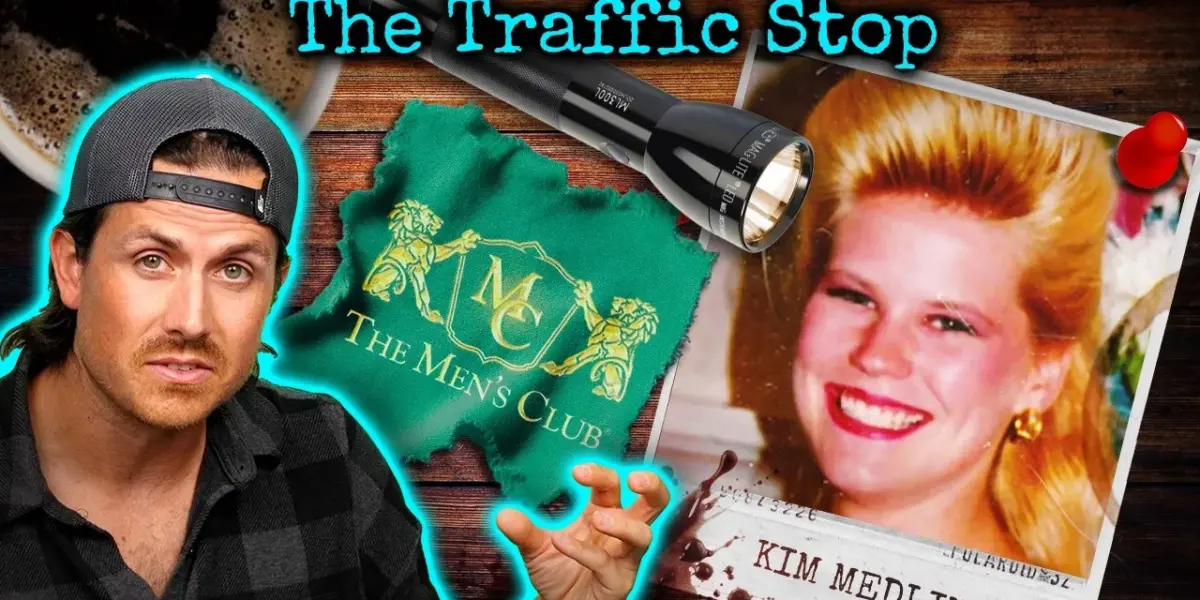
A chilling discovery on a secluded North Carolina road led investigators down a path of obsession and brutal violence. A single shoe print on a victim's sweatshirt became the key to unlocking the truth behind Kim Medlin's murder.

Shoe Print Unmasks Killer in Brutal Highway Murder
In the quiet pre-dawn hours of March 29, 1997, a routine police patrol on the outskirts of Monroe, North Carolina, took a chilling turn. A police captain spotted a Jeep idling on the highway shoulder, its headlights on. Growing suspicious, he approached the vehicle. The driver’s side window was down, but the car was empty. Then, a cell phone on the passenger seat began to ring.
A Night Off Turns Deadly
Earlier that evening, 26-year-old waitress Kim Medlin had finished her shift at a local topless bar. Kim worked there a few nights a week to support her passions: her horses and decorating her new home. She and her husband, Bridger, had recently built their dream house and a barn on a 7-acre property outside Monroe.
Kim left the bar around 2:00 a.m., looking forward to a long weekend of unpacking and settling into her new home. She drove her red Jeep down Old Charlotte Highway, a secluded road that had recently begun to make her nervous. A couple of weeks prior, she had experienced a frightening road rage incident on this very route. A car had aggressively tailgated and honked at her. Fearing it was a disgruntled customer, she had pulled over at a convenience store with a police car present. An officer had promised to look for the aggressor and even put out a bulletin to watch for Kim’s car.
To calm her nerves on this particular night, Kim called her husband, Bridger. He was on his way home from a DJ gig but told her he was almost there. They spoke briefly, and he said he would call her back once he was inside. About 15 minutes later, Kim’s phone rang again. It was Bridger. She told him she was about 20 minutes from home. He wished her goodnight, and they hung up. Kim placed her phone on the passenger seat. As she turned her attention back to the road, blinding headlights appeared in her rearview mirror.
A Husband’s Growing Fear
Around 4:00 a.m., Bridger Medlin woke up. Kim should have been home nearly an hour ago. He checked the house, but Kim was not there. Her Jeep was also missing from the driveway. He called Kim’s cell phone. A man’s voice answered – a police officer. Bridger learned that the officer, Captain David Simpson, had found Kim’s Jeep idling on the side of the road with her phone ringing inside. There was no one in the vehicle.
The Investigation Begins
Assistant Chief Bobby Hulk of the Monroe Public Safety Department arrived at the scene. He recognized Captain Simpson and learned that Simpson had encountered Kim two weeks earlier during the road rage incident. Hulk, who knew Bridger, examined the Jeep. Kim’s wallet was on the passenger seat, but her driver’s license was missing. This suggested she may have been pulled over, but officers on duty confirmed no one had made any traffic stops that night. This raised the possibility of a “blue light bandit” – someone impersonating a police officer.
Bridger arrived at the scene, frantic. He insisted on getting into Kim’s Jeep to test its engine, despite Hulk’s instructions to stay back. This action, though disruptive, confirmed the Jeep was operational.
A police dog was brought in to track Kim’s scent. The trail led officers about 100 yards down the road to a driveway and then to a small house. The dog stopped at the garage. The homeowner, Nathan Hargett, reported being woken around 3:45 a.m. by a strange car with Texas plates loitering near his garage. He mentioned a blonde woman in the back seat. A search of his house and garage yielded no sign of Kim.
A Troubling Connection and a Grim Discovery
The investigation shifted to finding the car with Texas plates. A dispatcher recalled a call about a car in a ditch near where Kim’s Jeep was found, around 2:00 a.m. The responding officer, rookie Josh Griffin, stated his shift was over, and he had simply called a tow truck. This car was unlikely to be the one Hargett saw later.
Hulk revisited the road rage incident report. The driver of the harassing vehicle was identified as Eric Williams, accompanied by George Connell. They claimed Kim had been flashing her lights at them. The officers let them go, deeming it a misunderstanding. However, the fact that Kim disappeared on the same road, at the same time of night, on the same day of the week as the road rage incident struck Hulk as too coincidental.
The next evening, March 30th, police received a call about a body found in the woods off Westwood Industrial Drive, a secluded area known as “Lover’s Lane.” It was Kim Medlin. She was wearing only shorts, a bra, and a sweatshirt pulled over her head. Her face and neck were severely beaten, with cuts and bruises. Her jewelry was still on, indicating robbery was not the motive.
The Crucial Clue: A Shoe Print
As the forensics team examined Kim’s sweatshirt, Hulk noticed a distinct shoe print on the fabric. He ordered the sweatshirt sent to the crime lab for analysis. The location of the body suggested the killer was local. The lack of a struggle at the Jeep indicated Kim likely knew and trusted her attacker.
Husband Under Suspicion, Then Cleared
Hulk interviewed Kim’s husband, Bridger. Bridger’s initial alibi of arriving home around 2:30 a.m. and going straight to bed was contradicted by a report of his truck being seen in town at that time. Bridger became enraged at the accusation, pointing to the lack of struggle and missing license as evidence of a traffic stop gone wrong. He insisted Kim would never have gotten out of her car for a stranger, especially after the recent road rage incident. Security footage later showed Bridger’s truck in town at 4:00 a.m., after Kim’s Jeep had already been found by police, seemingly clearing his alibi discrepancy.
The “Blue Light Bandit” Theory Gains Traction
The investigation explored the “blue light bandit” theory. A witness reported seeing Kim’s Jeep pass, followed by another car making a sharp turn and speeding after her. This car had lights on its roof and reflective tape, resembling a police vehicle. While no Monroe officers were on duty or made stops, this sighting supported the idea of an impersonator.
Hulk learned of another “blue light bandit” case in a nearby town where the suspect had not been caught. This individual was a potential match.
Forensics Solves the Case
The breakthrough came from the crime lab. The analysis of the shoe print on Kim’s sweatshirt provided the key. Based on this evidence and witness accounts, police reconstructed the events.
The killer, who had been targeting women on Old Charlotte Highway, had become obsessed with Kim. Seeing her Jeep, they made a U-turn and pursued her, flashing their lights. Kim, likely believing it was a legitimate stop, pulled over and rolled down her window. The killer, posing as an officer, took her license and ordered her out of the car. Kim complied, and the killer handcuffed her and placed her in the back of their vehicle.
The killer then drove to a secluded dead-end road. Realizing Kim was fiddling with the unlocked rear door, the killer attempted to lock it. Before they could, Kim escaped, jumping from the moving car. The killer stopped, got out, and brutally attacked Kim. They smashed her head with a flashlight, stomped on her, broke her neck, and then used the flashlight to strangle her.
The shoe print analysis matched a specific type of athletic shoe. This, combined with other evidence, led investigators to a suspect. While the transcript does not name the killer, the shoe print was the critical piece of evidence that cracked the case open, revealing the horrifying truth of Kim Medlin’s final moments and bringing her killer to justice.
Source: Shoe print cracked her murder investigation wide open (YouTube)

Related Articles

From Wells to Caves: Terrifying Trapped Survival Stories Revealed
Real-life survival stories reveal the terrifying ordeals of people trapped in extreme situations, from deep wells and flooded caves to underwater accidents and mine collapses. These accounts highlight incredible bravery and the fight for life against impossible odds.


Unsolved Mysteries: 30 Disappearances That Still Haunt Us
Explore 30 of the most chilling and baffling disappearances throughout history. From Amelia Earhart to D.B. Cooper, these unsolved cases continue to haunt us, leaving behind a legacy of unanswered questions and enduring mysteries.


DNA Clues Emerge in Cold Case: Saliva Samples Hold Key
Seventy days into the Nancy Guthrie case, fears of it going cold are rising. A mixed DNA sample is the only lead, but it requires advanced analysis. Expert CeCe Moore believes saliva DNA from the perpetrator, potentially left while holding a flashlight, is a key to solving the mystery. New technologies could help investigators overcome these challenges.