Senator Vance’s Uncomfortable Humor Attempt Ignites Debate on Political Rhetoric and Polarization
Senator J.D. Vance's recent attempt at a joke targeting Congresswoman Alexandria Ocasio-Cortez has sparked widespread discussion, with many observers finding the humor notably awkward and lacking a clear punchline. The incident highlights the precarious nature of political humor, underscoring the importance of brevity, wit, and audience awareness in an era of heightened political polarization and media scrutiny. It serves as a cautionary tale on the challenges public figures face in crafting effective and well-received communication.

Senator Vance’s Uncomfortable Humor Attempt Ignites Debate on Political Rhetoric and Polarization
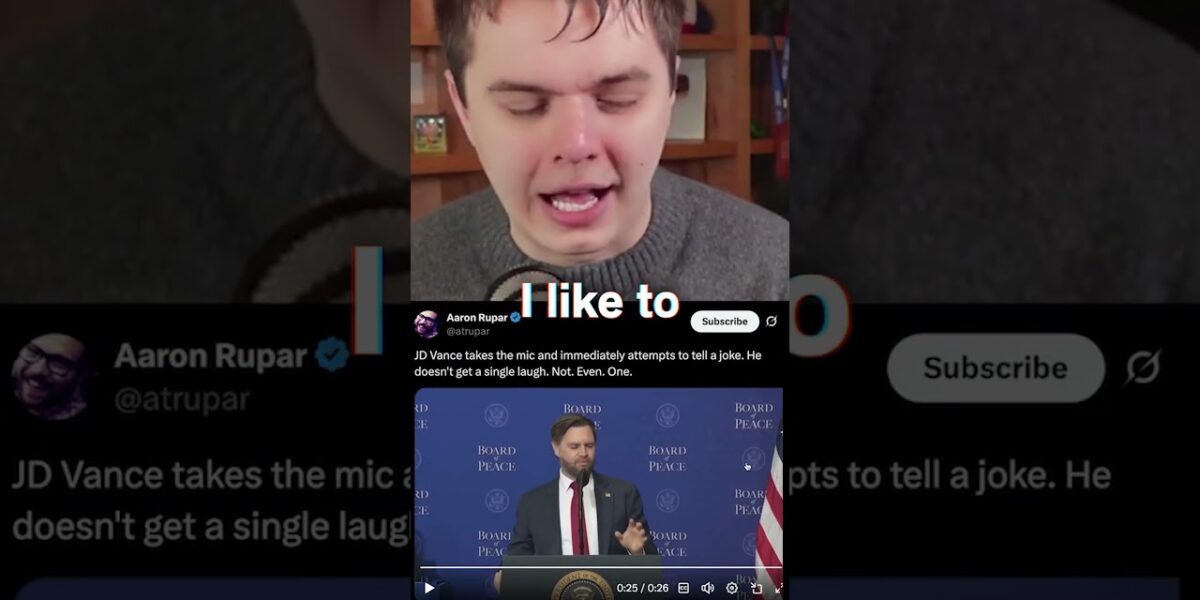
In the often-contentious arena of American politics, where words are weapons and humor can be a double-edged sword, an recent incident involving Senator J.D. Vance has sparked widespread discussion regarding the efficacy and pitfalls of political comedy. A brief but widely circulated clip captured Senator Vance attempting to deliver a joke aimed at Congresswoman Alexandria Ocasio-Cortez, an endeavor that many observers, including the original commentator of the video, found to be notably awkward, protracted, and ultimately lacking a discernible punchline. The episode, described by some as “uncomfortable,” has not only drawn attention to Senator Vance’s rhetorical style but also reignited broader conversations about political communication, the role of humor in partisan discourse, and the ever-present scrutiny faced by public figures.
The Incident: A Joke That Missed Its Mark
The moment in question occurred during a public address where Senator Vance, seemingly addressing former President Donald Trump, began a statement by thanking him for his leadership and kind words. What followed was an attempt at humor that quickly veered into an uncertain territory. Vance stated, “I knew exactly what I wanted to say, but then after the president said that I was so smart and that I didn’t want to repeat our congresswoman who froze for 20 seconds over in Munich, now I’m tempted, sir, just to freeze for 20 seconds and just stare at the cameras and maybe they’ll say nice things about me like they do about Congresswoman Cortez.” The delivery was reportedly met with a less-than-enthusiastic reception, with the video commentator suggesting even Trump might have been perplexed.
The immediate reaction captured in the transcript highlights the perceived failure of the joke. The commentator noted, “This is perhaps the most uncomfortable JD Vance clip I have ever seen. To be honest, I don’t even quite understand the full joke he was trying to make. I think he was just trying to tear down AOC without actually having a punchline.” This assessment underscores a critical flaw in rhetorical design: a joke, by its very nature, requires a clear setup and a definitive punchline to elicit its intended effect. When these elements are muddled or absent, the attempt often falls flat, leaving the audience confused rather than amused.
Deconstructing the Failed Humor: Brevity, Wit, and Political Intent
The commentator’s reference to Shakespeare’s adage, “brevity is the soul of wit,” serves as a poignant critique of Senator Vance’s delivery. Wit, particularly in the realm of political discourse, often thrives on conciseness, cleverness, and an unexpected twist. A joke that is “way too drawn out” and lacks a clear “punchline,” as described, violates these fundamental principles. Instead of a sharp, incisive jab, the attempt came across as a meandering statement that struggled to find its comedic footing.
Beyond the structural issues, the intent behind the joke also warrants examination. The commentator surmised that Vance “was just trying to tear down AOC without actually having a punchline.” This suggests that the primary motivation might have been less about genuine humor and more about a partisan attack, thinly veiled as a jest. In an era of heightened political polarization, such attempts at humor, especially when perceived as mean-spirited or poorly executed, often serve to reinforce existing divides rather than bridge them. When humor is deployed as a weapon without the precision and wit required to land effectively, it risks alienating audiences and simply appearing awkward.
The Vance-Ocasio-Cortez Dynamic: A Microcosm of Political Rivalry
The target of Senator Vance’s humor, Congresswoman Alexandria Ocasio-Cortez, is a prominent figure on the progressive left, known for her outspokenness and significant social media presence. She frequently serves as a lightning rod for conservative criticism, just as Senator Vance, a staunch conservative and ally of former President Trump, is often a target for the left. This established political dynamic provides crucial context for understanding the incident.
The reference to Ocasio-Cortez “freezing for 20 seconds over in Munich” alludes to an incident that, while not explicitly detailed in the transcript, likely refers to a moment where Ocasio-Cortez faced scrutiny or criticism for a perceived hesitation or silence during a public appearance or interview. Such moments are often amplified and weaponized in the partisan media landscape, becoming shorthand for broader criticisms of a politician’s competence or ideology. Vance’s attempt to leverage this perceived vulnerability, even if through a clumsy joke, highlights the tit-for-tat nature of modern political sparring.
The broader implications of this specific rivalry underscore a fundamental aspect of contemporary politics: the personalization of ideological conflict. Rather than solely debating policy, politicians often engage in direct attacks on each other’s character, intelligence, or public performance. Humor, when used in this context, can either humanize or dehumanize, depending on its execution and the audience’s perception. In Vance’s case, the attempt was perceived as an ill-conceived effort to diminish a political opponent, which can often backfire, drawing more attention to the attacker’s misstep than the target’s perceived flaw.
The Role of Humor in Political Communication: A High-Stakes Game
Humor has long been an integral, albeit risky, component of political communication. From the satirical cartoons of the 18th century to late-night comedy shows of today, politicians and their actions have been subjects of jest. Effective political humor can disarm opponents, connect with voters on a personal level, simplify complex issues, and even highlight hypocrisies. Think of figures like Ronald Reagan, whose self-deprecating wit often endeared him to the public, or Barack Obama, whose sharp timing could lighten serious moments.
However, the line between effective humor and a public relations disaster is exceedingly fine. What one audience finds amusing, another might find offensive, tone-deaf, or simply unfunny. This is particularly true in a diverse and politically fractured society. Jokes about sensitive topics, or those perceived as punching down, can quickly erode public trust and generate negative headlines. For public figures, whose every word is scrutinized and amplified across traditional and social media, the stakes are exceptionally high.
Senator Vance’s incident serves as a cautionary tale. It illustrates that merely having the intention to be humorous, or to make a point through humor, is insufficient. The execution must be precise, the timing impeccable, and the understanding of the audience paramount. When these elements are absent, the politician risks not only failing to achieve the desired comedic effect but also appearing out of touch, awkward, or even mean-spirited, thereby damaging their public image and rhetorical credibility.
Audience and Perception: Performing for the Base
The commentator’s observation that “JD Vance looks directly at him and is trying to make a joke for Trump” offers a critical insight into the intended audience and the dynamics at play. Many politicians, especially those aligned with a particular faction, tailor their rhetoric and humor to appeal to their base or to specific influential figures within their party. Former President Trump himself is known for a distinctive, often provocative, style of humor that resonates strongly with his supporters, often at the expense of his critics. This creates an environment where politicians might feel compelled to emulate or cater to such styles.
However, what plays well to a specific base might not translate to a broader audience. Jokes intended for an “in-group” can often sound alienating or confusing to those outside of it. Furthermore, attempting to perform humor for a specific individual, especially one as prominent as a former president, can add an extra layer of pressure, potentially leading to a stilted or unnatural delivery. The perceived lack of genuine amusement, even from the implied target audience, suggests that the attempt failed to resonate even within its intended sphere.
In the age of viral clips and instant social media analysis, a politician’s every utterance is subject to widespread dissemination and interpretation, often stripped of its original context. A joke that falls flat in one setting can become a symbol of awkwardness or insensitivity when viewed by millions online, leading to a cascade of commentary, memes, and further scrutiny. This constant surveillance demands a higher level of rhetorical precision and self-awareness from public figures.
Rhetorical Effectiveness and the Art of Public Speaking
Effective public speaking, particularly in politics, is an art form that requires a mastery of various rhetorical devices, including humor. Beyond the content of a speech, the delivery—pacing, tone, body language, and timing—plays a crucial role in how a message is received. Senator Vance’s attempt, as described, suffered not only from a weak premise but also from an apparent lack of a sharp, concise delivery, which is essential for humor to land.
Rhetorical theory emphasizes the importance of kairos, or the opportune moment, for speaking. A joke, especially one with a political edge, must be timely and relevant to the context. It also requires an understanding of pathos (emotional appeal) and ethos (credibility). A joke that fails to evoke the intended emotion (laughter) and potentially undermines the speaker’s credibility (by appearing awkward or ill-conceived) fails on multiple rhetorical fronts.
The incident underscores the importance of speechwriters and communication strategists in crafting effective political messaging. While extemporaneous remarks can sometimes lend authenticity, they also carry significant risks. For public figures whose words carry weight and are subject to intense scrutiny, the careful crafting and rehearsing of remarks, especially those involving humor, is often critical to avoid missteps that can quickly overshadow their intended message.
Broader Implications for Political Discourse
This seemingly minor incident, when viewed through a broader lens, offers insights into the current state of political discourse. The tendency to rely on divisive humor, the personalization of political attacks, and the constant pressure to perform for specific audiences contribute to an environment where genuine dialogue and substantive debate can be overshadowed by performative rhetoric and gaffes.
Such episodes also highlight the challenges faced by politicians in navigating a media landscape that prioritizes viral moments and controversy. The quest for a memorable soundbite or a moment that resonates with the base can sometimes lead to miscalculations, where the desire to be edgy or witty overrides the need for clarity, conciseness, and universal appeal. In the long run, consistent misfires in communication can erode a politician’s credibility and make it harder for them to convey serious policy positions effectively.
Conclusion: The Enduring Challenge of Political Wit
Senator J.D. Vance’s awkward joke attempt, aimed at Congresswoman Alexandria Ocasio-Cortez, serves as a vivid reminder of the delicate and often perilous nature of humor in politics. While humor can be a powerful tool for connection and persuasion, its misuse can lead to confusion, discomfort, and a diminished public image. The incident underscores the timeless principles of effective rhetoric – brevity, wit, and a keen understanding of one’s audience – while also highlighting the unique pressures and pitfalls of political communication in a highly polarized and hyper-scrutinized era.
As politicians continue to grapple with the demands of public speaking and the ever-present glare of the media, the challenge remains to craft messages that are not only impactful but also authentically connect with a diverse electorate, avoiding the kind of rhetorical missteps that can quickly become the subject of widespread critique and debate.
Source: Vice President Attempts to Tell a Joke #politics #fyp #new (YouTube)

Related Articles
Vance’s Silence on Iran Strikes Signals GOP Foreign Policy Divide
Vice President JD Vance's uncharacteristic silence following US strikes against Iran has sparked debate about a growing rift within the Republican party over foreign intervention. His past anti-interventionist statements contrast sharply with President Trump's recent actions, highlighting a potential ideological divide within the MAGA movement.
Polls Expose Trump’s Disapproval Ratings Amidst Economic Debate
New polling data reveals significant disapproval ratings for Donald Trump, with figures from Fox News and other major outlets showing him underwater. Despite claims of a booming economy, polls suggest a challenging path forward, particularly with independent voters.


Rubio’s Rising Star: Vance’s 2028 Prospects Dim?
Senator Marco Rubio's standing in the 2028 Republican presidential race appears to be rising, with prediction markets showing a significant spike in his favor. Meanwhile, Senator JD Vance's odds have reportedly declined amid ambiguous endorsements from Donald Trump. Rubio's recent high-profile speeches, including one in Munich, have drawn attention and fueled speculation about his future political trajectory.