Sam Altman’s AI Energy Analogy Sparks Global Backlash
Sam Altman, CEO of OpenAI, has faced widespread criticism for comparing the energy cost of training AI models to raising a human. The statement has drawn accusations of a dehumanizing worldview and intensified public concerns about AI's energy consumption and societal impact.

Sam Altman’s AI Energy Analogy Sparks Global Backlash
Sam Altman, CEO of OpenAI, has ignited a firestorm of controversy following a recent statement where he compared the energy required to train an AI model to the energy and time it takes to raise a human child.
The comment, made during an interview discussing AI development in India, quickly went viral for all the wrong reasons, drawing widespread criticism and accusations of a dehumanizing worldview. The clip garnered millions of views, overwhelmingly negative, and has been labeled some of the worst public relations for the AI industry in recent memory.
The Controversial Statement
In the interview, while discussing the significant energy demands of training AI models, Altman stated, “People talk about how much energy it takes to train an AI model, but it also takes a lot of energy to train a human. It takes like 20 years of life on all the food you eat during that time before you get smart.”
This analogy, intended to contextualize the energy requirements of AI, was widely interpreted as equating human life and development to a mere energy cost, sparking outrage across social media platforms and beyond.
Public Reaction and Accusations
The backlash was swift and intense. Many users expressed dismay, with comments ranging from labeling Altman a “traitor to the human race” to more extreme, albeit non-violent, sentiments like “Shoot that guy.” The sheer volume of support for such sentiments, even if hyperbolic, highlighted a deep-seated public apprehension towards AI and its perceived impact on humanity.
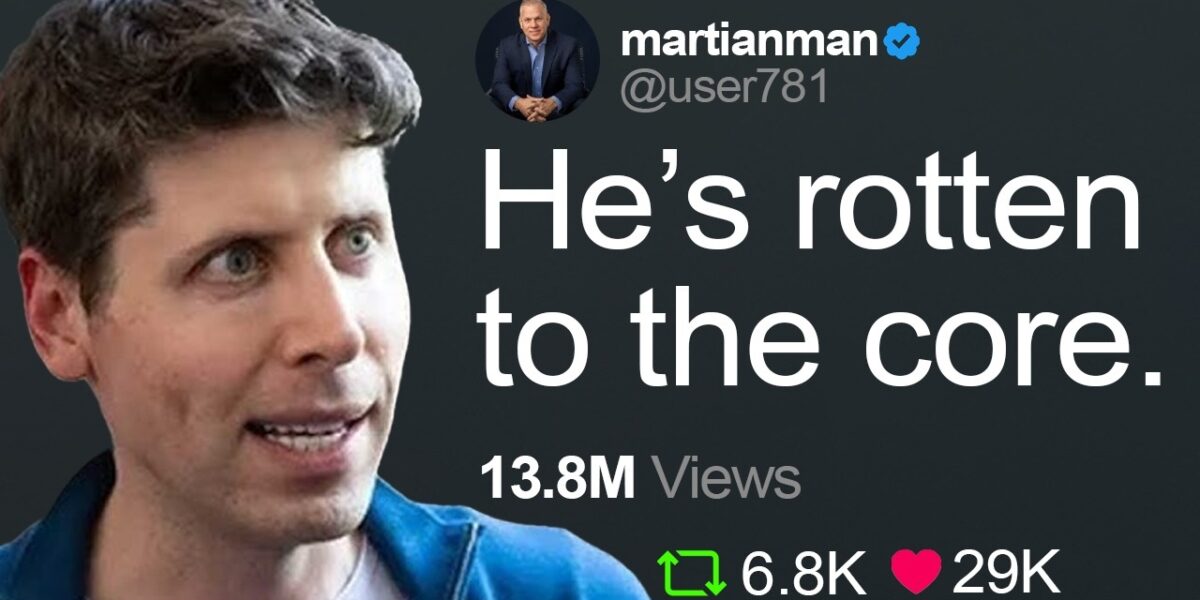
One particularly influential response came from David Fairchild, whose post garnered significant attention. Fairchild argued that Altman’s statement wasn’t just about energy use but revealed a troubling underlying anthropology: “He’s smuggling in a whole anthropology where humans are basically inefficient meat computers that you have to pour food and years into before they become useful.” Fairchild posited that this perspective could lead to viewing AI as superior to humans, especially if human development is framed as a “bug in the system” or a costly “biological training run.”
This sentiment resonated with many, who felt that Altman’s framing dismissed the intrinsic value of human life and development, reducing it to a quantifiable energy expenditure. Critics argued that such a worldview is “dystopian” and fundamentally “rotten,” as it fails to recognize that humans, not computational processes, are the point of existence.
Further fueling the controversy, the statement has been linked to a growing public distrust of AI leaders and the technology itself. Many believe that AI companies, particularly those at the forefront like OpenAI, are failing to communicate the value and integration of AI in a way that resonates positively with the general public. Instead of being perceived as an inspirational advancement, like the space race, AI is increasingly framed as a threat, leading to fears of job displacement and societal disruption.
Data Center Opposition and Energy Concerns
Altman’s remarks also touched upon a burgeoning real-world issue: the immense energy consumption of AI data centers and the resulting strain on local resources. Communities across the United States have been increasingly vocal in their opposition to new data center developments, citing concerns over water scarcity, soaring electricity costs, and air pollution.
The transcript highlights a significant increase in data center project cancellations, with 25 projects halted in 2025 alone, up from just two in 2023. This trend underscores the growing tension between the rapid expansion of AI infrastructure and local community concerns. Even political figures like former President Trump have voiced concerns about the impact of data centers on energy bills.
The financial implications are also substantial, with reports of billions in planned AI data center development being derailed by community pushback. This growing opposition suggests that the energy cost of AI is not just a theoretical concern but a tangible challenge with significant economic and social consequences.
The “Sociopath” Accusation and Altman’s Reputation
The intensity of the backlash has led some to question Altman’s character, with the term “sociopath” appearing frequently in discussions. While the video’s narrator explicitly states they are not diagnosing Altman, they point to a history of alleged behavior that has contributed to a negative public perception.
Citing an article by Emil P. Torres, the transcript mentions accusations of “menacious, manipulative and abusive behavior” from former OpenAI employees. Reports suggest senior staff described Altman as “psychologically abusive” and “highly toxic,” with accusations of pitting employees against each other and a lack of candor in communications. These past controversies, including his temporary ousting from OpenAI, have seemingly contributed to a narrative that frames him as out of touch and potentially lacking in integrity.
The Math Behind the Controversy
Beyond the qualitative outrage, a quantitative analysis has further undermined Altman’s analogy. A breakdown of the energy costs reveals a stark disparity:
- Human Training: Approximately 17 megawatt-hours (MWh) of food energy over 20 years.
- GPT-4 Training: Estimated 50,000 to 60,000 MWh of electricity.
This calculation suggests that training a model like GPT-4 requires roughly 3,000 times more energy than raising a human to adulthood. Furthermore, as newer, more powerful AI models are developed, their energy requirements are expected to increase, exacerbating the issue. The rapid obsolescence of hardware, driven by continuous chip development, also contributes to energy inefficiencies and economic waste.
Altman’s request for 10 gigawatts (GW) of power for future projects, equivalent to the total consumption of New York City, highlights the scale of energy demand. With national energy grids already facing potential shortfalls, the logistical and environmental challenges of powering future AI development are immense.
The core issue, as highlighted by critics, is not necessarily the energy consumption itself, but the framing and the lack of transparency regarding who bears the cost and the environmental impact. Altman’s analogy, while perhaps intended to be nuanced in its full context, was perceived as fundamentally flawed and dismissive of human value.
Why This Matters
Sam Altman’s controversial statement underscores a critical juncture in the public perception of artificial intelligence. The analogy, regardless of its original intent or full context, tapped into existing anxieties about AI’s societal impact, its energy footprint, and the perceived disconnect between AI developers and the broader public.
Public Trust and Adoption: For AI to be successfully integrated into society, public trust is paramount. Statements that dehumanize or devalue human life risk alienating the very population AI is intended to serve. This public relations misstep could hinder the adoption of beneficial AI technologies and fuel calls for heavy-handed regulation.
Environmental Responsibility: The energy demands of AI are a significant environmental concern. The backlash highlights the need for greater transparency and accountability from AI companies regarding their energy consumption and sustainability practices. The opposition to data centers is a clear indicator that communities are increasingly unwilling to bear the environmental burden of unchecked AI growth.
Ethical AI Development: The conversation has reignited debates about the ethical underpinnings of AI development. Critics argue that AI leaders must prioritize human values and well-being, framing AI as a tool to augment human capabilities rather than a replacement or a superior form of intelligence. As one AI optimist stated, the true techno-optimist position is not that AI is cheaper than humans, but that the combination of human and artificial intelligence is more powerful.
Altman’s role as the CEO of OpenAI, a leading AI organization, means his words carry immense weight. The incident serves as a stark reminder that even as AI technology advances at an unprecedented pace, effective and empathetic communication with the public is crucial for its responsible development and acceptance.
Source: Sam Altman Sparks OUTRAGE With Controversial AI Comment (YouTube)

Related Articles


AI’s Ethical Divide: Trump’s Ban Sparks Fierce Debate
The Trump administration's blacklisting of AI firm Anthropic over its refusal to allow autonomous weapons and mass surveillance has ignited a fierce debate. The move highlights deep ethical divides in AI development and raises concerns about future government-tech partnerships.


OpenAI Faces Existential Threats: Ads, Competition, and Financial Woes
OpenAI faces mounting challenges, including the introduction of ads into ChatGPT, diminishing returns from scaling AI models, intense competition from rivals like Google, and significant financial pressures. These factors raise questions about the company's long-term sustainability and its future in the rapidly evolving AI landscape.


OpenAI’s Pentagon Deal Sparks Controversy and Trust Crisis
OpenAI's new agreement with the Department of War to deploy its models on classified networks has ignited controversy. Critics accuse the company of compromising on safety principles accepted by rival Anthropic, potentially eroding trust and setting a dangerous precedent for AI ethics in government contracts.