Russia Clings to Fading Deal Spirit, Analyst Reveals
Political analyst Michael Shelman debunks Russia's 'spirit of Anchorage' narrative, calling it a manufactured reality. He discusses the internal Kremlin dynamics, the role of state-controlled media, and the potential for Russian Federation's collapse, drawing parallels to the Soviet Union's dissolution. The conversation also highlights the integrated Russian-Iranian military industry.

Russia’s Anchorage Summit “Spirit” Questioned Amidst Shifting Geopolitics
In a recent broadcast, political analyst Michael Shelman discussed the persistent Russian rhetoric surrounding the “spirit of Anchorage,” a supposed starting point for peace talks concerning Ukraine. Shelman, speaking with host Natalya, argued that this narrative, repeatedly invoked by Russian officials like Foreign Minister Sergey Lavrov, is a manufactured reality rather than a reflection of actual diplomatic progress. The 2018 Anchorage summit between then-President Trump and President Putin, intended as a significant bilateral meeting, reportedly collapsed mid-event, leaving no concrete agreements or joint press conferences.
The Anchorage Summit: A Disputed Reality
Shelman detailed the events of the Anchorage summit, highlighting the substantial Russian delegation, including economic and investment officials, who arrived with high expectations. The plan included a joint press conference and a working lunch to discuss economic and investment matters. However, the meeting was abruptly cut short. According to Shelman, instead of a joint press conference, President Putin delivered an eight-minute speech, followed by a three-minute address from President Trump, after which Trump departed. The planned lunch and subsequent discussions never materialized.
“The meeting was as I said, like exploded at the middle of this,” Shelman stated, emphasizing the lack of tangible outcomes. He further noted that while Russian officials, particularly the Foreign Ministry, subsequently presented a narrative of agreements and compromises, these claims were never corroborated by the American side. “President Trump never mentioned this meeting in the future,” Shelman observed, suggesting that Trump was aware of the meeting’s lack of substance.
Lavrov’s Narrative and Internal Kremlin Dynamics
The persistence of the “spirit of Anchorage” narrative, even as Lavrov himself acknowledges it is “fading away,” is seen by Shelman as a strategic attempt by Moscow to confuse the international community. “They are trying to confuse the world that listen Washington has promised something to us in Anchorage and they are not giving that to us. That’s why we are going to sabotage the peace agreement,” he posited.
Beyond international messaging, Shelman suggested that these narratives also serve an internal purpose within the Kremlin. He theorized that Lavrov, who was responsible for the Anchorage meeting, might be presenting this invented reality not only to external audiences but also to President Putin himself, potentially to manage perceptions of his own responsibilities and past diplomatic efforts. “This is also part of inter-Kremlin discussion,” Shelman remarked.
State-Controlled Media and Information Warfare
The discussion also touched upon the role of media in shaping narratives, particularly concerning the large contingent of Russian journalists who accompanied Putin to Anchorage. Shelman contrasted this with the Western media landscape, where state-owned news outlets are largely prohibited by law. He pointed out that while outlets like the BBC are society-owned, the United States has zero state-owned news organizations.
Conversely, Shelman asserted that in Russia, “90% of news outlets they all state-owned formally formally state-owned or unformally state-owned.” He explained that this ownership structure means that journalists traveling with officials are often acting on behalf of the Russian state, rather than as independent reporters. “The Russian state pays for this visit, and they come as a part of their work for Russian Federation, not for they don’t work for news, they don’t work for public, they work for Russian government the facto,” he elaborated.
The Fading Debate on Russian Decolonization
The conversation shifted to the topic of Russia’s decolonization, a subject that was once prominent in political and academic circles but has since receded from public discourse. Shelman attributed this fading interest to a shift in expectations regarding the outcome of the war in Ukraine. “In 2022, 2023, they believed in the coming victory of this war and after the victory, you should to reorganize Russian Federation like it was with Nazi Germany… and with Japan,” he explained. The perceived lack of a “global and total victory” has dampened enthusiasm for such post-war restructuring.
However, Shelman noted an interesting development: the decolonization concept has become an official policy within the European Union. He referenced the Parliamentary Assembly of the Council of Europe, where Russia was previously a member. Now, Russian opposition leaders, including Garry Kasparov and Maria Alyokhina of Pussy Riot, along with representatives of various ethnic minorities within Russia, are engaging with the EU. “This direct dialogue between European Union and different nations who were colonized by Russian Federation is not by Russian Empire. I believe this is the first step for decolonization of Russian Empire,” Shelman stated.
Potential Collapse of the Russian Federation
The possibility of the Russian Federation collapsing, mirroring the dissolution of the Soviet Union, was explored. Shelman believes this is a “most predictable scenario,” citing the desire for independence among numerous ethnic groups within Russia, such as the Yakuts and Mordovians. He highlighted the economic potential of regions like Yakutia, suggesting that independent states could be stable and prosperous, possessing significant natural resources.
Shelman recalled instances in the 1990s when regions like Chechnya and Tatarstan sought independence. While Tatarstan proclaimed independence in 1991, it remains part of the Russian Federation. Shelman suggested that such aspirations could resurface, particularly if the central Russian state weakens. He drew parallels to the collapse of the British Empire after World War II, when many nations gained independence as the empire weakened.
Ukraine’s Role and Western Caution
Regarding Ukraine’s capacity to influence Russia’s fragmentation, Shelman stated that Ukrainian soldiers on the front lines are the primary contributors. He emphasized that the processes of self-determination within Russia are internal matters for those nations.
The analyst also addressed Western governments’ caution regarding a potential Russian collapse. He likened the situation to the dissolution of the Soviet Union, where the U.S. initially urged Ukraine not to declare independence. Shelman argued that while external influence is possible, a nation’s desire for independence, once ignited, is difficult to suppress. He recounted his personal experience witnessing Lithuania’s declaration of independence in 1990-1991, a move initially unrecognized by most of the world but ultimately successful.
Integrated Russian-Iranian Military Industry
The discussion concluded with an examination of the increasingly integrated military industries of Russia and Iran, particularly in light of a Russian drone incident in Dubai. Shelman asserted that Iran possesses more advanced missile and drone technology than Russia, and that Russia relies heavily on Iranian expertise and production. “Iran sells drones to Russian Federation, not vice versa,” he clarified.
This integration, Shelman believes, presents a critical vulnerability for Russia. He suggested that strikes against Iranian weapons manufacturing facilities also impact Russia’s capabilities. Furthermore, the Caspian Sea provides a logistical advantage for Iran to supply Russia, bypassing naval blockades. Shelman also briefly mentioned a Russian propagandist who reportedly disappeared after suggesting Ukrainian drones were more effective, framing it as another instance of internal Russian media inconsistencies.
Source: 😱Russia clings to deal! Lavrov shocked with a statement on war! Solovyov exploded on air (YouTube)

Related Articles
Putin’s Kremlin Fears US Strikes Amidst Iran Crisis
Moscow is gripped by fear as US strikes on Iran escalate, with Kremlin insiders reportedly believing Russia could be the next target. The ongoing conflict in Ukraine is increasingly being blamed internally for Russia's weakened global standing and strategic vulnerabilities.
Russia’s Shrinking Leverage Sparks Moscow Panic
Russia's influence is rapidly diminishing as Europe sheds its dependence on Russian gas, leaving Moscow increasingly desperate. Ukraine's successful strikes within Russia and the global challenges in exporting Russian energy highlight the Kremlin's weakening position. Internal economic strain and potential for domestic unrest further expose Russia's vulnerabilities.
Russia Faces Internal Revolt Risk Amid Ukraine War Strain
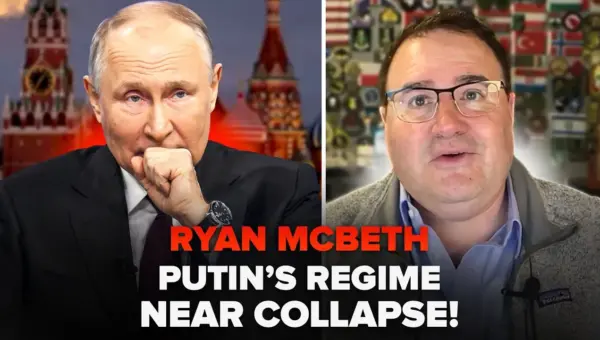
US Army veteran and analyst Ryan Mugbat warns that Russia's protracted war in Ukraine could trigger internal rebellion due to economic strain and returning, disgruntled veterans. He details how military corruption and battlefield realities might lead to widespread unrest against Putin's regime. The analysis also covers evolving warfare tactics and geopolitical shifts.