Rockets: Space’s Powerful Guns Explained
Rockets, much like guns, operate on the principle of action and reaction, expelling mass to generate thrust. This fundamental physics allows for space travel and continues to drive exploration.

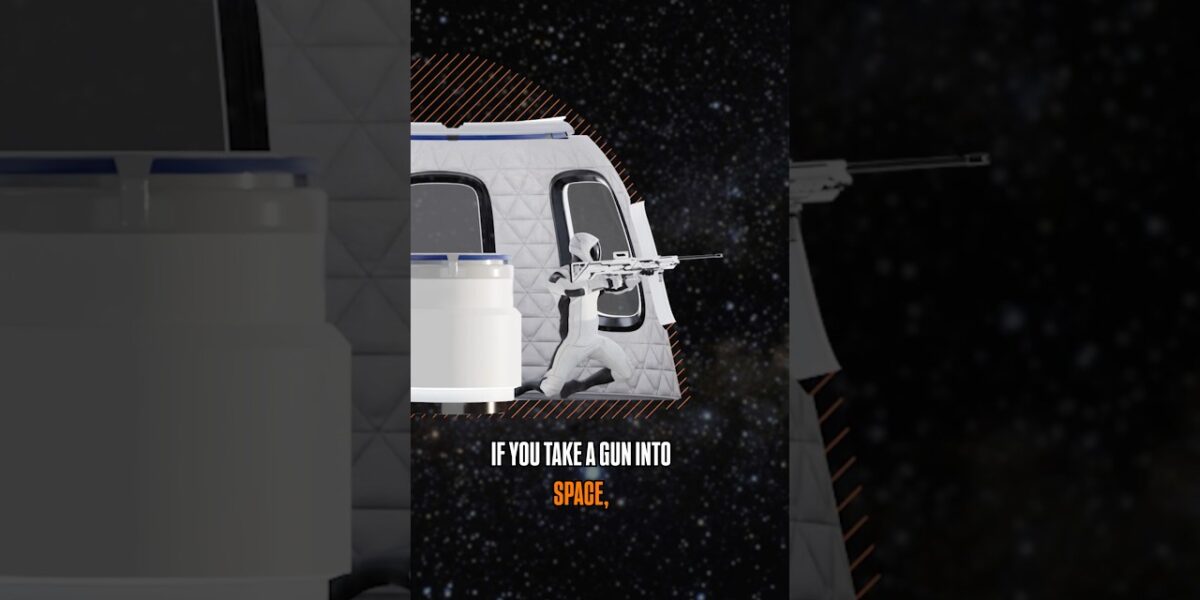
Rockets: Space’s Powerful Guns Explained
The fundamental principle behind rocket propulsion, often described as Newton’s Third Law of Motion, is elegantly simple yet profoundly powerful: for every action, there is an equal and opposite reaction. While this law governs everything from a child on a swing to the vast movements of celestial bodies, it finds one of its most dramatic and indispensable applications in the realm of space exploration. At their core, rockets are not so different from the firearms we use on Earth; they are, in essence, incredibly potent guns designed to operate in the vacuum of space.
The Physics of Recoil in Space
Imagine firing a bullet from a rifle. The explosive force propels the bullet forward, and simultaneously, the rifle kicks backward into your shoulder – that’s recoil. This recoil isn’t caused by the bullet hitting the air; it’s the direct consequence of the rapid expulsion of mass. Now, consider this principle in the context of space. If you were to fire a gun in the vacuum of space, it would still produce recoil. The absence of air resistance doesn’t negate the fundamental physics of momentum. The same applies to rockets. They expel mass – hot gases generated by burning propellant – at extremely high velocities. This expulsion is the action, and the resulting forward thrust that propels the rocket is the equal and opposite reaction.
The A-10 Warthog Analogy
A striking terrestrial analogy for this powerful expulsion of mass comes from the world of aviation: the A-10 Thunderbolt II, affectionately known as the “Warthog.” This rugged ground-attack aircraft is famous for its massive 30mm GAU-8 Avenger Gatling gun. This weapon fires depleted uranium rounds at an astonishing rate of up to 4,000 rounds per minute. The sheer volume and velocity of ammunition expelled by the GAU-8 are so immense that they generate a significant amount of thrust – comparable to one of the Warthog’s own jet engines.
Pilots of the A-10 must be mindful of this immense power. If they were to fire the Gatling gun continuously for an extended period, the thrust generated by the gun could actually slow the aircraft down. More critically, it can alter the aircraft’s handling characteristics, affecting its stability and maneuverability. This demonstrates how the expulsion of mass, even in an atmospheric environment, can produce a powerful reactive force. Rockets operate on this same principle, but without the moderating effects of air, their thrust is even more pronounced and directly usable for propulsion.
How Rockets Work: A Controlled Explosion
A rocket engine is essentially a sophisticated, controlled explosion. It consists of a combustion chamber where fuel and an oxidizer are mixed and ignited. This rapid combustion creates a massive amount of hot, high-pressure gas. This gas is then directed through a nozzle, typically a de Laval nozzle, which is shaped to accelerate the gas to supersonic speeds as it expands and exits the engine. The faster the exhaust gases are expelled, and the greater the mass of those gases, the greater the thrust produced. This thrust is what overcomes gravity and atmospheric drag, allowing rockets to achieve orbit and travel into deep space.
Historical Context: From Fireworks to Interstellar Travel
The concept of reaction propulsion dates back centuries. The earliest known reaction engines were documented in China around the 2nd century AD, utilizing gunpowder to propel fireworks and primitive rockets. These early devices were largely for entertainment and signaling. It wasn’t until the early 20th century that scientists like Robert Goddard in the United States and Konstantin Tsiolkovsky in Russia began to rigorously study and develop the theoretical and practical aspects of rocketry for spaceflight. Goddard, often hailed as the father of modern rocketry, launched the world’s first liquid-fueled rocket in 1926, a pivotal moment that laid the groundwork for future space endeavors.
The Cold War era saw a dramatic acceleration in rocket technology, driven by competition between the United States and the Soviet Union. The V-2 rocket developed by Germany during World War II, though a weapon of war, provided crucial insights into ballistic missile technology that both superpowers would build upon. Missions like Sputnik (1957), Yuri Gagarin’s flight (1961), and the Apollo program (culminating in the Moon landing in 1969) all relied on increasingly powerful and sophisticated rocket systems. Each mission pushed the boundaries of what was thought possible, demonstrating the ever-growing capability of reaction engines to transport humans and payloads beyond Earth’s atmosphere.
The Future of Rocketry and Our Cosmic Journey
Today, rocket science continues to evolve at an unprecedented pace. Companies like SpaceX, Blue Origin, and Rocket Lab are developing reusable rocket technology, significantly reducing the cost of access to space. This reusability is a direct nod to efficiency and the fundamental principle of getting the most out of every expulsion of mass. The development of more powerful and efficient engines, such as those utilizing advanced fuels or even concepts like nuclear thermal propulsion, promises to open up new frontiers.
Understanding rockets as powerful expulsion engines is key to our continued exploration of the cosmos. They are the workhorses that enable us to launch satellites that power our global communication and navigation systems, send probes to study distant planets and stars, and will eventually be the vehicles that carry humans to Mars and beyond. The seemingly simple act of expelling mass at high speed is, in reality, the most effective method we have for breaking free from Earth’s gravitational pull and venturing into the vast unknown. As we continue to push the boundaries of space exploration, the principles of rocket propulsion, rooted in the fundamental laws of physics, will remain our most crucial enabler.
Source: Rockets are just guns, recoil is essentially how they work in the vacuum of space #rocketscience (YouTube)

Related Articles
NASA’s Asteroid Mission: From Mars Dream to Lunar Gateway
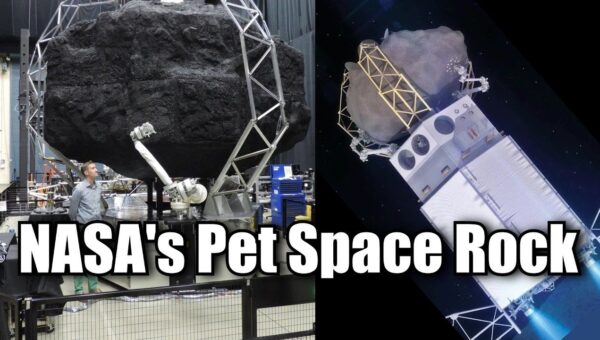
NASA's ambitious Asteroid Redirect Mission (ARM), designed as a stepping stone to Mars, aimed to capture a small asteroid boulder and tow it to lunar orbit for astronaut testing. Though cancelled, its advanced propulsion and robotic technologies live on in NASA's Lunar Gateway and future deep space exploration plans.
NASA’s Evolving SLS Rocket Hints at New Upper Stage
NASA's Artemis program may be adopting a new upper stage for its Space Launch System (SLS) rocket, potentially utilizing the commercially available Centaur V. An updated infographic reveals design changes and hints at evolving mission strategies, including advanced lunar lander operations.


SpaceX Starship V3 Nears First Flight Amidst Major Artemis Shakeup
SpaceX eyes March for Starship V3's maiden flight as new testing reveals design improvements. Meanwhile, NASA's Artemis program faces delays and strategic shifts, with Artemis III repurposed as a LEO test mission.