Quantum Eraser Mystery Solved: No Time Travel!
The delayed-choice quantum eraser experiment, long thought to suggest future events influencing the past, is demystified. New analysis and accessible demonstrations reveal that the effect arises not from time travel, but from the way we process information from entangled particles.

Quantum Eraser Mystery Solved: No Time Travel!
The universe’s quantum realm continues to defy our everyday intuitions, presenting phenomena that seem to bend the very fabric of reality. Among the most perplexing is the delayed-choice quantum eraser experiment, which has long fueled speculation about whether future events can retroactively influence the past. However, recent analyses and accessible demonstrations are now shedding light on this intricate puzzle, revealing that the apparent paradoxes arise not from time travel, but from a misunderstanding of quantum entanglement and information processing.
The Heart of Quantum Mechanics: The Double-Slit Experiment
At the core of this debate lies the venerable double-slit experiment, a cornerstone of quantum mechanics. As physicist Richard Feynman famously stated, it contains the ‘only mystery’ of quantum theory. In its simplest form, the experiment involves firing individual particles, such as photons, at a barrier with two narrow slits. According to classical physics, we would expect two distinct piles of particles to form on a screen behind the slits, corresponding to each particle passing through one slit or the other. Instead, the particles, behaving like waves, interfere with themselves, creating a characteristic interference pattern of alternating bright and dark fringes on the screen. This demonstrates superposition – the ability of a quantum particle to exist in multiple states or take multiple paths simultaneously until it is measured.
Introducing the ‘Which-Way’ Measurement
The mystery deepens when scientists attempt to determine which slit each particle actually traversed. By placing detectors at the slits to ‘mark’ the path, the interference pattern vanishes, and we observe the expected two-pile distribution of particles. This ‘which-way’ measurement collapses the particle’s wave function, forcing it to ‘choose’ a single path. The act of gaining information about the particle’s path destroys its wave-like interference behavior.
The Delayed-Choice Quantum Eraser: A Temporal Twist
The true bewilderment arises with the delayed-choice quantum eraser experiment, famously demonstrated by Yoon-Ho Kim, Robert Yu, and colleagues in 1999. In this setup, the decision to measure or ‘erase’ the which-way information is made *after* the particle has already passed through the slits and its initial state has been recorded. The experiment typically involves a process where a photon passing through the slits is duplicated into an entangled pair. One photon (let’s call it Photon A) travels to a detector screen, while its entangled twin (Photon B) is sent on a path where its which-way information can either be preserved or deliberately scrambled (erased).
The baffling result is that if Photon B’s which-way information is preserved, Photon A on the screen exhibits a particle-like, single-slit pattern. Conversely, if Photon B’s which-way information is erased, Photon A on the screen displays the wave-like double-slit interference pattern. This suggests that a choice made in the future (erasing or preserving information from Photon B) appears to influence the past behavior of Photon A.
Demystifying the Paradox: A Homemade Approach
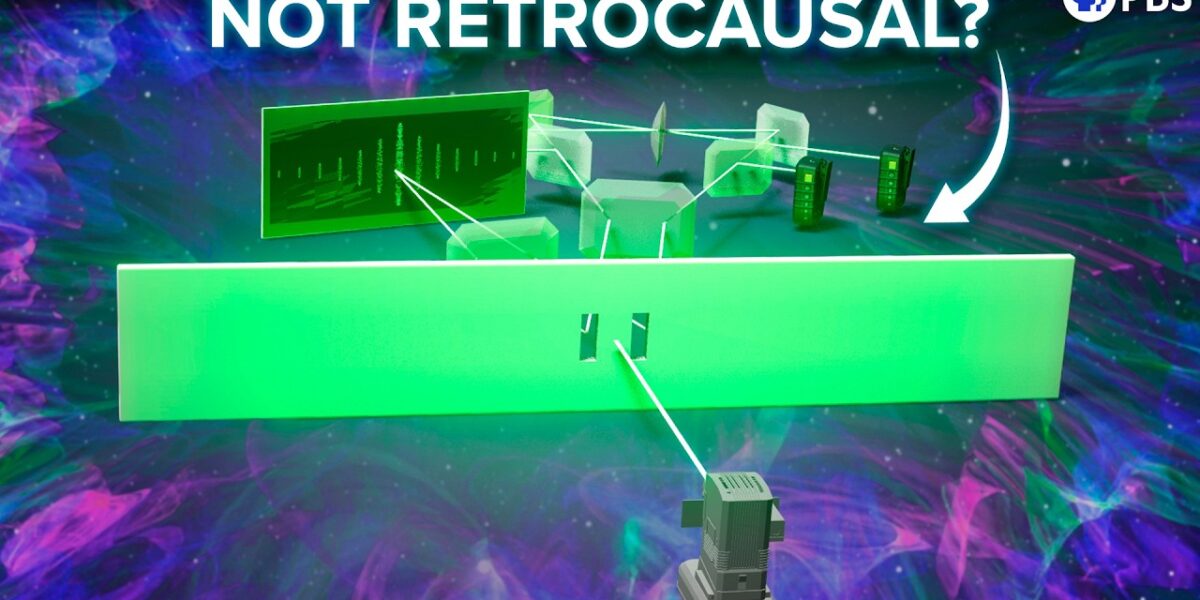
This apparent retrocausal influence has led to much debate. However, a more nuanced understanding, supported by accessible experimental setups, reveals that the phenomenon is not about information traveling backward in time. One such demonstration, adapted from the principles of the original experiment, uses polarization filters and a calcite crystal to mimic the crucial aspects of entanglement and information erasure without the need for expensive equipment like BBO crystals.
In this simplified setup, a laser beam is shone through a double slit. Filters placed in front of each slit impart distinct polarizations to the light passing through them: horizontal polarization for slit 1 and vertical for slit 2. This polarization acts as the ‘which-way’ marker. A calcite crystal, when oriented correctly, can then split the light based on its polarization. If the calcite is positioned to distinguish between horizontal and vertical polarization, it effectively ‘measures’ which slit the light came from, leading to a single-slit pattern on the detector. This is analogous to preserving the which-way information.
However, by rotating the calcite crystal to a different angle (approximately 45 degrees), its behavior changes. Instead of separating light based on distinct polarizations, it splits both horizontally and vertically polarized light into two beams, labeled ‘plus’ and ‘minus’. This new orientation effectively ‘scrambles’ or ‘erases’ the polarization information. When this ‘erasing’ calcite is used, the light on the detector screen, when analyzed appropriately, reconstructs the double-slit interference pattern.
The Crucial Role of Data Sorting
The key to resolving the paradox lies in understanding how the data from both ‘Photon A’ (the light reaching the main screen) and ‘Photon B’ (the light processed by the calcite) is ultimately analyzed. In the original experiment, and in the analogy, the main screen (where Photon A lands) initially shows a seemingly featureless distribution of dots, regardless of what happens to Photon B. It is only *after* Photon B’s information has been processed – either measured or erased – that the data can be sorted. If Photon B’s information was preserved, the corresponding dots on Photon A’s screen are identified as belonging to a single-slit distribution. If Photon B’s information was erased, the corresponding dots on Photon A’s screen can be sorted into two groups, which, when superimposed, form the double-slit interference pattern.
Crucially, the light detected on the screen by ‘Alice’ (observing Photon A) never instantaneously changes its pattern. She always observes a distribution that, when viewed in isolation, resembles a single-slit pattern. The double-slit interference pattern only emerges when the data is retrospectively sorted based on the results from ‘Bob’s’ side (processing Photon B), which can occur much later. The ‘erasure’ doesn’t change what has already happened; it merely enables a specific way of later analyzing the already recorded data.
Causality Re-examined
The delayed-choice quantum eraser experiment highlights the non-local correlations inherent in quantum entanglement. While it appears that a future choice influences the past, a more accurate interpretation is that the entangled particles are inextricably linked. The measurement performed on one particle influences the *possible* outcomes for the other, and vice-versa. The apparent causality can be viewed from either direction: Photon A’s position could be seen as influencing Photon B’s outcome, or Photon B’s measurement could be seen as determining how Photon A’s data is later interpreted. The symmetry of the situation, especially when considering different reference frames, makes assigning a definitive causal direction problematic, suggesting that the correlation exists outside of our conventional understanding of cause and effect in spacetime.
What Comes Next?
Understanding experiments like the delayed-choice quantum eraser is vital for advancing quantum computing, quantum cryptography, and our fundamental understanding of reality. By demystifying these seemingly paradoxical phenomena, scientists can build more robust quantum technologies and continue to probe the deepest mysteries of the universe. The revelation that no actual retrocausal influence is at play, but rather a sophisticated interplay of entanglement and information processing, allows us to move forward with a clearer, albeit still wondrous, picture of quantum mechanics.
Source: We Were WRONG About the Quantum Eraser! ft. @LookingGlassUniverse (YouTube)

Related Articles
Heisenberg’s 1925 Quantum Leap Still Puzzles
In 1925, Werner Heisenberg's groundbreaking work laid the foundation for quantum mechanics, a theory that revolutionized physics but whose fundamental implications remain a profound mystery 100 years later. This exploration delves into the birth of this strange new physics.


Dirac’s Equation: The Accidental Discovery of Antimatter
In 1928, Paul Dirac's relativistic electron equation unexpectedly predicted the existence of antimatter. Initially met with skepticism, the discovery of the positron in 1932 confirmed this groundbreaking concept, revolutionizing our understanding of the universe.

Quantum Entanglement Defies Speed of Light Limit
Einstein's critique of quantum mechanics led to the EPR paradox, suggesting faster-than-light correlations. Bell's theorem and subsequent experiments confirmed this apparent non-locality, challenging our understanding of reality.