Physics Breakthrough Simulates Water With Unprecedented Realism
A groundbreaking physics simulation technique achieves unprecedented realism in modeling water and air interactions, overcoming long-standing 'clipping' issues. Utilizing the Lattice Boltzmann Method and two-way coupling, the approach is not only visually superior but also significantly faster than previous methods.

Physics Breakthrough Simulates Water With Unprecedented Realism
In a significant leap forward for computer graphics and physics simulation, researchers have developed a novel technique that overcomes a long-standing challenge: accurately simulating the complex interactions between liquids and air. Unlike previous methods that often resorted to simplifications or approximations, this new approach, detailed in a recent research paper, achieves remarkably realistic fluid dynamics, particularly in scenarios involving water and air. The breakthrough lies in its ability to handle the vast density differences between these two mediums without computational instability or visual artifacts.
The Clipping Problem and Previous Limitations
For years, simulating how objects interact with water has been a persistent hurdle in computer graphics. A common issue, often referred to as ‘clipping,’ occurs when objects or fluid particles incorrectly pass through each other, breaking the illusion of physical reality. This is particularly problematic when dealing with the stark contrast in densities between water (heavy) and air (light). Traditional simulation methods often struggle to maintain stability when faced with these extreme differences. This can lead to computational ‘blow-ups’ or necessitate the use of ‘cheats’ that compromise realism, such as ignoring certain interactions.
The video highlights a common scenario: a propeller moving through water. While many simulations can render the resulting turbulence, they often fail to accurately depict the air’s behavior, especially when it interacts with the water’s movement. This can result in a disconnect where the air doesn’t behave as expected, leading to unrealistic visual outcomes.
A New Paradigm: Two-Way Coupling and the Lattice Boltzmann Method
The newly presented technique tackles these limitations head-on by employing a sophisticated approach known as ‘two-way coupling.’ This means that not only does the water affect the object (or air), but the object (or air) also influences the water’s movement in return. This creates a dynamic, interconnected system where forces are exchanged realistically.
At the core of this innovation is the Lattice Boltzmann Method (LBM). Unlike older methods that might broadcast instructions to a large group of particles (like a megaphone), LBM operates more granularly, providing specific instructions to individual particles. The method operates in two distinct steps:
- Particle Movement: Particles are allowed to move freely for a set period.
- Interaction: Following the movement phase, particles interact with each other and their environment.
This separation of movement and interaction phases is crucial. It mirrors a principle of efficient work and even life advice: dedicating specific time blocks for individual tasks and then separate, focused time for collaboration or interaction. This prevents the chaos that can arise from trying to do both simultaneously.
Furthermore, the technique incorporates a ‘hybrid moving bounce-back’ mechanism. This sophisticated rule set dictates how particles should react upon collision. It ensures that when particles collide, they rebound with the correct amount of energy and momentum transfer, effectively teaching them ‘etiquette’ for their interactions. This is what enables the robust two-way coupling.
Impressive Visuals and Real-World Comparisons
The results showcased are visually stunning and demonstrate the technique’s capabilities across a range of scenarios. These include:
- Intricate bubble formations and swirling water patterns.
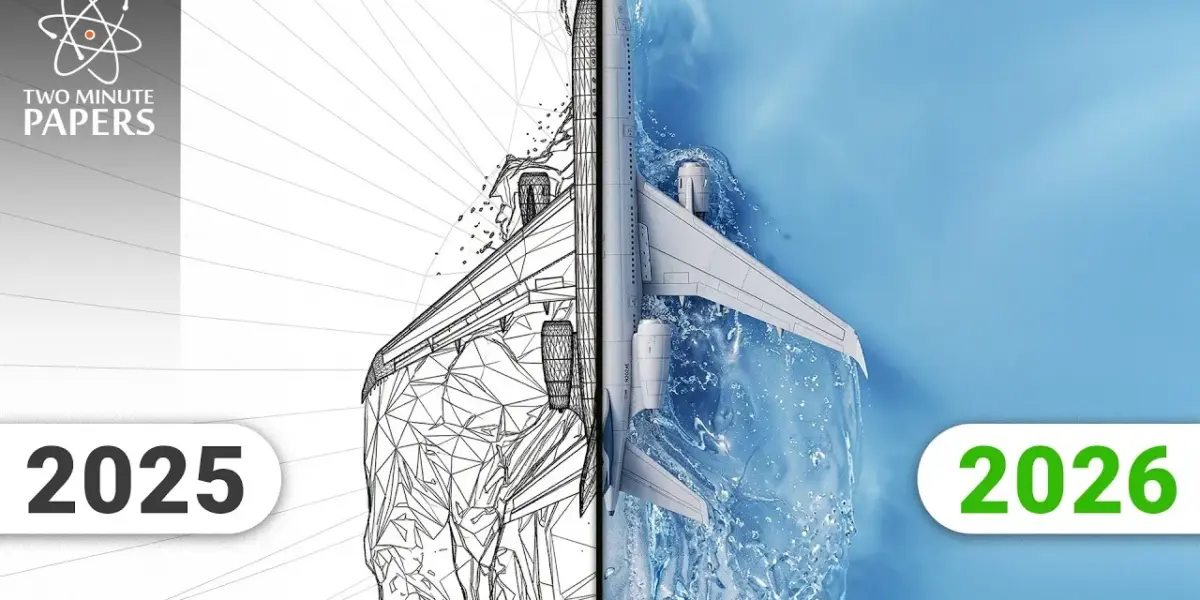
- The realistic splash of an airplane ditching into water, with water reaching the ceiling of its container.
- The formation of air bubbles in front of a car windshield as it moves through water, with air particles naturally being displaced.
- The complex flow patterns in the wake of a moving object.
- Simulations of objects skipping across water, such as stones or coins, which require the accurate simulation of the air layer beneath them.
Perhaps the most compelling demonstration is a side-by-side comparison with reality, simulating a key slicing through water. The simulation accurately captures three distinct phases:
- The Breach: The key cutting through the water’s surface without clipping, forcing the water to part realistically.
- The Veil: The formation of a long, trailing pocket of air behind the key, resembling a ‘bridal veil’ of bubbles.
- The End of the Wedding: The subsequent instability of the air veil as water pressure crushes it, turning it into a cloud of bubbles.
This rigorous comparison to real-world physics validates the accuracy and fidelity of the new simulation method.
Performance and Efficiency Gains
Beyond visual fidelity, the new method also offers significant performance advantages. While some advanced simulations can take considerably longer to compute than older, less accurate methods (sometimes up to 10x longer), this new technique is reportedly up to 4x faster than previous methods while achieving superior results. This speed improvement makes it far more practical for use in real-time applications, game development, and complex scientific modeling.
Why This Matters
The implications of this breakthrough are far-reaching:
- Enhanced Realism in Entertainment: Video games, movies, and virtual reality experiences can achieve unprecedented levels of visual fidelity, making virtual worlds feel more tangible and immersive.
- Scientific Research: Accurate fluid dynamics simulations are critical in fields like meteorology, oceanography, aerospace engineering, and medical research (e.g., blood flow). This new method could accelerate discoveries and improve predictive models.
- Engineering and Design: Engineers can more accurately simulate how designs interact with liquids, leading to better performance in everything from vehicle aerodynamics to the design of marine vessels.
- Education and Outreach: Complex physics phenomena can be visualized and understood more easily, making science more accessible.
The researchers’ ability to not only match but exceed the performance of previous techniques while delivering vastly superior visual results marks a significant milestone. The paper’s authors, and the presenter of the video, emphasize the importance of such fundamental research, which often goes unnoticed but forms the bedrock of technological advancement. The beauty and complexity of natural phenomena, like water flowing in a stream, serve as constant inspiration and the ultimate benchmark for these simulations.
Source: Most People Miss What Makes This Impossible (YouTube)

Related Articles

Physics Simulation Leaps Forward: 45x Faster, Real-Time Rendering
A new physics simulation technique drastically accelerates complex animations, achieving up to 45x speed improvements and enabling real-time rendering for hair, cloth, and structural dynamics. The open-source method bypasses traditional bottlenecks, offering unprecedented realism and efficiency for games, film, and scientific applications.

AI Breakthrough: Hyper-Realistic Clothing Simulation Achieved
A new physics-inspired technique revolutionizes digital clothing simulation, delivering hyper-realistic results with unprecedented speed and efficiency. By intelligently allocating detail and predicting material behavior, it overcomes the long-standing compromise between visual fidelity and computational cost.
New CPU Algorithm Outpaces GPUs in Physics Simulation
A new physics simulation algorithm leverages CPU power through domain decomposition, achieving speeds up to 66x faster than previous methods and even outperforming GPUs. This breakthrough promises more realistic animations and advanced scientific modeling.