Phoebe: Saturn’s Backwards Moon Holds Solar System Secrets
Saturn's moon Phoebe, discovered in 1899, orbits backward, a clear sign it formed elsewhere. Data from the Cassini mission reveals it's a captured planetary embryo from the outer solar system, responsible for Saturn's largest ring and the unique appearance of Iapetus.

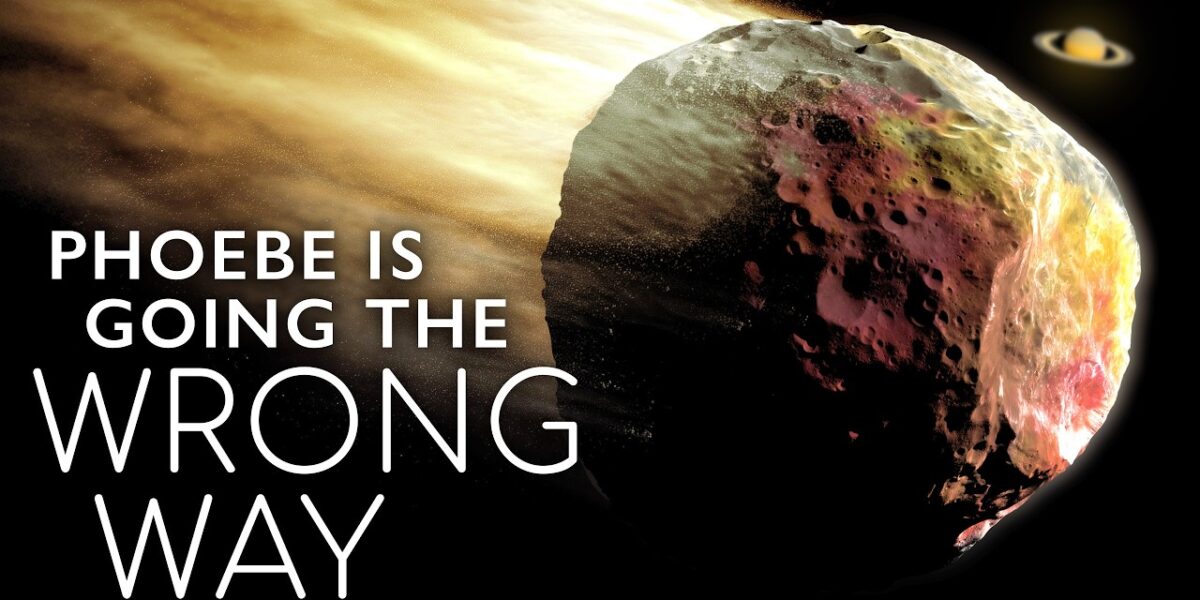
Saturn’s Backward Moon, Phoebe, Reveals Ancient Solar System History
Saturn, the jewel of our solar system, is famed for its majestic rings and a retinue of moons dancing in predictable orbits. Yet, far from the planet’s glittering display, a peculiar object named Phoebe defies the cosmic ballet. This dark, battered moon, millions of kilometers from Saturn, travels in a direction opposite to almost everything else in the solar system – a retrograde orbit that has puzzled astronomers for over a century. Phoebe is not just an anomaly; it’s a time capsule, offering profound insights into the chaotic early days of our solar system when giant planets migrated and the cosmos was a far more turbulent place.
A Discovery Forged in Light
The story of Phoebe’s discovery is a testament to the evolution of astronomical observation. For millennia, humanity’s view of the cosmos was limited by the naked eye. The invention of the telescope in the early 17th century expanded this view, but it was the “dry plate” photographic revolution of the 19th century that truly transformed astronomy. By allowing camera shutters to remain open for hours, astronomers could capture faint light from distant objects, revealing celestial bodies previously unimaginable.
In 1898, a team from the Harvard College Observatory, working with the 24-inch Bruce Telescope in Arequipa, Peru, embarked on a deep photographic survey of the southern sky. The meticulous process involved shipping glass plates back to Cambridge, Massachusetts, where human “computers” painstakingly examined them with magnifying loupes for new celestial objects. In August 1899, William Henry Pickering, examining plates taken earlier that month, spotted a faint speck – magnitude 15.5, roughly 4,000 times fainter than the limit of human vision. Crucially, this speck moved. As Pickering tracked its path over several nights, he observed it moving with Saturn but distinctly differently from the planet’s known moons. On March 18, 1899, the discovery of Phoebe was announced. It marked a historic milestone: the first natural satellite discovered not through direct visual observation, but via an image captured on a photographic plate.
The Anomaly of a Retrograde Orbit
As astronomers continued to observe Phoebe in the early 20th century, its unusual behavior became apparent. The solar system, formed from a single spinning disk of gas and dust, generally adheres to a principle: planets and their moons orbit and spin in the same direction, known as a prograde orbit (counter-clockwise when viewed from above the Sun’s north pole). Phoebe, however, orbits Saturn clockwise – a retrograde orbit. This deviation from the norm is a powerful indicator that Phoebe did not form in its current location. Had it coalesced from the primordial material around Saturn, the drag from the surrounding gas would have inevitably forced it into a prograde path. A retrograde orbit is a clear sign that Phoebe is an immigrant, an object formed elsewhere that was later captured by Saturn’s immense gravitational pull.
A Distant, Battered Wanderer
Phoebe’s orbital distance is staggering. It circles Saturn at an average distance of nearly 13 million kilometers, almost four times farther out than the moon Iapetus and a quarter of the distance from the Sun to Mercury. A single orbit takes approximately 550 Earth days, or about 18 months. So far from Saturn, the planet’s iconic rings would be invisible from Phoebe’s surface; only the bright glare of Saturn itself would be discernible in the night sky. This immense distance meant that Phoebe remained largely unstudied for nearly a century. Even the Voyager 2 probe, which flew through the Saturnian system in 1981, could only capture a distant image of the moon as a dark, irregular shape.
Cassini’s Close Encounter
The turning point in our understanding of Phoebe came with the Cassini-Huygens mission. When mission planners were charting Cassini’s trajectory to enter orbit around Saturn, they identified a unique opportunity. To brake and enter orbit, Cassini had to approach Saturn from the outside. This trajectory allowed for a brief flyby of Phoebe just 19 days before the spacecraft’s critical engine burn for orbital insertion on June 11, 2004. It was a singular chance; once Cassini committed to its inner orbit, it would never have the fuel to return to Phoebe or match its retrograde velocity.
During this brief encounter, Phoebe transformed from a mere point of light into a complex world in Cassini’s cameras. The relative speed of the flyby was an astonishing 5.8 kilometers per second. The data and images returned by Cassini revolutionized our perception of this enigmatic moon. It revealed a roughly spherical body, about 213 kilometers in diameter, but heavily scarred and battered. With an albedo of just 10%, Phoebe is as dark as asphalt, absorbing most of the sunlight that strikes it.
A World of Ice, Rock, and Ancient Materials
Cassini’s high-resolution imaging mapped Phoebe’s surface in unprecedented detail, showing extensive cratering and variations in brightness. Spectrometers analyzed its composition, detecting water ice, carbon dioxide, iron-bearing minerals, and signatures consistent with primitive carbonaceous materials found in meteorites – materials expected from the outer solar system. The most prominent feature is the Jason crater, a colossal impact basin spanning 101 kilometers, nearly half the moon’s diameter. The fact that Phoebe survived such a massive impact indicates it is a solid, cohesive body, not a loose aggregate of rubble.
The surface also displays dramatic landslides, where the dark surface material has slumped away from crater walls, revealing brighter material beneath. These features, combined with its density, paint a picture of Phoebe as an ice-rich body coated in a thin veneer of dark dust. Cassini’s measurements of Phoebe’s gravitational pull allowed scientists to calculate its density at approximately 1.63 grams per cubic centimeter. This is significantly denser than Saturn’s regular, icy moons (around 1.0 g/cm³), suggesting Phoebe is composed of 53-67% rock. This density is comparable to dwarf planets like Pluto and Neptune’s moon Triton, leading scientists to classify Phoebe as a “planetary embryo” – a world that began to differentiate into a rocky core and icy mantle but had its development halted.
The presence of trapped carbon dioxide, detected by Cassini’s spectrometers, further supports its outer solar system origin. Unlike the inner moons, where volatile compounds like CO2 would have long since boiled away, its preservation on Phoebe points to formation in the frigid depths of the outer solar system, far beyond Neptune. It is a survivor from the Kuiper Belt, a region of icy bodies beyond Neptune.
The Phoebe Ring: A Hidden Cosmic Structure
Phoebe’s story doesn’t end with its capture. For billions of years, it has been bombarded by micrometeoroids. Each impact ejects small amounts of its dark surface material into space. Due to Phoebe’s weak gravity, this dust easily escapes and enters a retrograde orbit around Saturn. Over eons, this dust has accumulated to form a vast, previously undetected structure: the Phoebe Ring. Discovered in 2009 by the Spitzer Space Telescope, this ring is enormous, spanning from 6 to 16 million kilometers from Saturn. It’s so large that roughly one billion Earths could fit within its volume, and if visible from Earth, it would appear as wide as two full moons.
The Phoebe Ring is tilted at 27 degrees relative to Saturn’s main ring plane, perfectly matching Phoebe’s orbital inclination and sharing its retrograde motion. Its composition, inferred from infrared signatures, matches the dark, primitive material of Phoebe’s surface. This confirmed that micrometeoroid impacts on Phoebe are the source of this colossal, diffuse dust halo.
Solving the Mystery of Iapetus
The discovery of the Phoebe Ring also shed light on one of astronomy’s oldest puzzles: the peculiar two-toned appearance of Saturn’s moon Iapetus. Discovered by Giovanni Cassini in 1671, Iapetus has one hemisphere as bright as snow and the other as dark as coal. The explanation is now clear. While Phoebe orbits retrograde, Iapetus orbits prograde. As the dark dust from the Phoebe Ring spirals inward towards Saturn, it collides with the leading face of Iapetus, effectively spray-painting its neighbor from millions of kilometers away. Phoebe is the cosmic artist responsible for Iapetus’s starkly contrasting hemispheres.
A Relic of Planetary Migration
But how did a moon born in the deep outer solar system end up orbiting Saturn? The prevailing theory, the Nice Model, posits that about 4 billion years ago, the giant planets – Jupiter, Saturn, Uranus, and Neptune – underwent a period of violent migration. This gravitational upheaval scattered countless icy bodies from the primordial Kuiper Belt, flinging some into interstellar space, others into the Sun, and a fortunate few, like Triton and Phoebe, into the gravitational grasp of the giant planets, becoming their moons.
Phoebe, therefore, is more than just a moon; it is a relic. It represents a preserved building block of the outer solar system, a testament to a period of immense cosmic upheaval. It offers a tangible link to the early solar system’s formation and the dynamic processes that shaped it. While much has been learned, questions remain about Phoebe’s internal structure and its precise origin within the Kuiper Belt or scattered disk. This dark intruder continues its lonely, backward journey around Saturn, a primordial messenger holding vital clues to the solar system’s turbulent youth and a constant reminder that planetary systems are ever-evolving, dynamic realms.
Source: We Finally Know Why Phoebe Orbits Backwards (YouTube)

Related Articles


White Dwarf Dyson Spheres: A Tiny Star’s Big Energy Solution
Astronomers are exploring the possibility of building Dyson spheres around compact white dwarf stars, which offer a long-lasting and stable energy source. Meanwhile, the Vera Rubin Observatory promises near real-time astronomical discovery, and new data challenges models of supermassive black hole formation in the early universe.


NASA’s Asteroid Mission: From Mars Dream to Lunar Gateway
NASA's ambitious Asteroid Redirect Mission (ARM), designed as a stepping stone to Mars, aimed to capture a small asteroid boulder and tow it to lunar orbit for astronaut testing. Though cancelled, its advanced propulsion and robotic technologies live on in NASA's Lunar Gateway and future deep space exploration plans.

NASA’s Evolving SLS Rocket Hints at New Upper Stage
NASA's Artemis program may be adopting a new upper stage for its Space Launch System (SLS) rocket, potentially utilizing the commercially available Centaur V. An updated infographic reveals design changes and hints at evolving mission strategies, including advanced lunar lander operations.