Pentagon Battles Press: Court Weighs Access Rights
A federal judge is hearing arguments in a dispute between the Pentagon and the New York Times over journalist access. The case centers on whether the Pentagon is complying with a court order to restore press credentials and access after a policy restricted reporters seeking classified information.


Pentagon Battles Press: Court Weighs Access Rights
A federal judge is currently listening to arguments in a significant court case. It’s a dispute pitting the Pentagon against major news organizations, specifically the New York Times. The core issue is about how much access journalists should have to military information and what constitutional rights protect their work.
District Judge Paul Friedman is considering a request from the New York Times. They want the court to force the War Department, which is the Pentagon, to follow an earlier ruling. That ruling had ordered the Pentagon to give journalists back their access. This legal fight started because of a policy put in place under former Defense Secretary Pete Hage. This policy warned reporters that they could lose their press credentials. This would happen if they tried to get classified information from sources who weren’t supposed to share it.
Back in March, the court agreed with parts of the New York Times’ argument. It found that some aspects of the Pentagon’s policy went against the First Amendment’s protection for news gathering. The court also said it violated due process rights. Because of this, the judge ordered that press credentials be given back to the reporters. However, the New York Times claims the Pentagon has not truly followed this order. They point to a new policy that still seems to limit access and adds more rules for journalists.
The Pentagon, on the other hand, disagrees with this assessment. They state that they have made changes to address the court’s earlier concerns. The government’s argument often centers on national security. They need to control the flow of sensitive information to protect troops and operations. This is a delicate balance. Journalists need information to inform the public and hold powerful institutions accountable. The Pentagon needs to protect secrets that could harm national security if revealed.
Historical Context of Press-Military Relations
The relationship between the press and the military has always been complex. During wartime, this tension often grows. For example, during World War II, the government had a strong censorship system. This was to prevent information from reaching the enemy. However, reporters still found ways to cover the war, often with embedded journalists. This practice, where reporters travel and live with military units, became more common in later conflicts like Vietnam and Iraq.
The Vietnam War, in particular, is often cited as a time when the press had significant freedom. This freedom allowed for critical reporting that shaped public opinion. In contrast, the first Gulf War saw more control over media access. This was a deliberate effort by the military to manage the narrative. The current case echoes these historical debates about control versus transparency.
Why This Matters
This court case is more than just a dispute over press badges. It touches on fundamental principles of a free society. The ability of journalists to access information and report on government activities is crucial for democracy. Without this access, the public might not know what their government is doing, especially in matters of national defense. This can lead to a lack of accountability.
The First Amendment protects the freedom of the press. This means the government generally cannot stop the press from publishing information or punish them for it. However, this right isn’t absolute. There are ongoing debates about how these rights apply when national security is at stake. This case helps define those boundaries. It shows how the courts interpret these vital protections in the digital age, where information can spread so quickly.
Implications and Future Outlook
If the court sides with the New York Times, it could set a strong precedent. It would reinforce the idea that the Pentagon cannot arbitrarily restrict press access. This might encourage other news organizations to challenge similar policies. It could lead to more transparency from the military.
Conversely, if the Pentagon’s arguments prevail, it could signal a shift. It might mean that national security concerns can justify tighter controls on journalists. This could make it harder for reporters to do their jobs effectively. It could also lead to a future where military actions are less scrutinized by the public.
The outcome of this case will likely influence how the Pentagon and other government agencies interact with the press moving forward. It will shape the ongoing discussion about the balance between security and the public’s right to know. As technology changes how news is gathered and shared, these legal battles become even more important in defining the role of a free press.
Source: Pentagon, New York Times in Court Over Press Access (YouTube)

Related Articles

Hegseth Undermines Trump’s War Plans Daily
Pete Hegseth, Trump's Secretary of Defense, is reportedly undermining the former president's stated war plans with Iran. Conflicting timelines, shifting objectives, and ethical questions surrounding financial dealings create significant uncertainty. This situation highlights the challenges of clear communication and strategic consistency in national security.

Pentagon Updates Operation Epic Fury: Troops Focused on Mission Success
Pentagon officials provided an update on Operation Epic Fury, highlighting the strong morale and mission focus of U.S. troops. The operation aims to counter Iran's military threats, with a particular emphasis on preventing it from acquiring nuclear weapons. Officials detailed successful strikes against Iran's missile capabilities and industrial base, while also acknowledging the crucial role of the American defense workforce.
US Troops Show Unwavering Resolve in Fight Against Iran
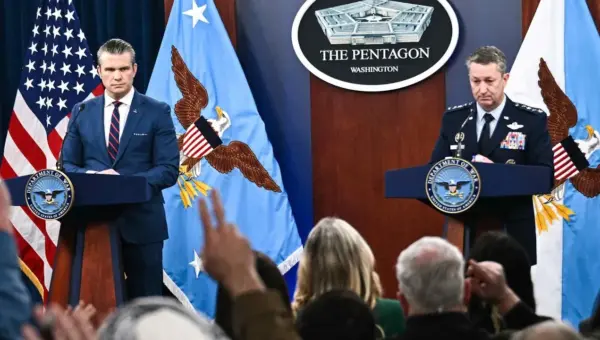
U.S. troops on Operation Epic Fury exhibit remarkable unity, competence, and urgency in their mission against Iran. Facing challenges with innovation and determination, they prioritize finishing the fight for future generations. The operations aim to degrade Iran's military capabilities and prevent nuclear proliferation, signaling a decisive period ahead.