OpenAI’s Trillion-Dollar Dilemma: The Shadow of a Government Bailout and the AI Boom’s Fragile Foundation
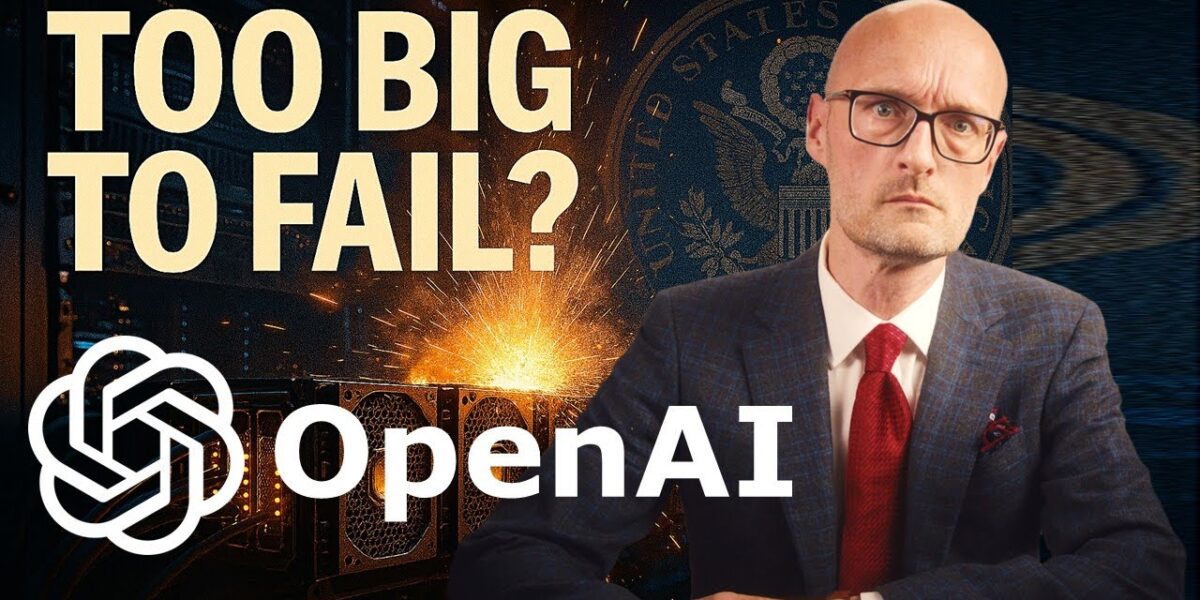
OpenAI's ambitious $1.4 trillion data center buildout has sparked intense debate about the sustainability of the AI boom and the company's financial viability. Despite denials from its leadership, initial suggestions of a government backstop for its massive infrastructure commitments have highlighted the unprecedented economic and power challenges facing the AI industry, raising questions about a potential 'metabubble' and the broader implications for global economies.

The AI Boom’s Unsettling Echoes: A Trillion-Dollar Question Mark
In recent weeks, a palpable sense of market anxiety has begun to ripple through the global economy, casting a shadow over the seemingly unstoppable ascent of the artificial intelligence (AI) boom. At the heart of this growing unease lies OpenAI, the trailblazing AI research and deployment company, and its audacious plans for a staggering $1.4 trillion data-center buildout. This monumental commitment, intended to meet the soaring demand for AI compute, has inadvertently ignited a heated debate about the sustainability of the AI revolution, the financial viability of its leading players, and even the potential for government intervention on an unprecedented scale.
The catalyst for much of this recent market agitation was a seemingly innocuous suggestion from OpenAI’s finance chief, Sarah Friar. During a public appearance, Friar floated the idea of a government backstop to help finance the company’s colossal infrastructure ambitions. The mere mention of such a possibility sent shockwaves through the tech and financial communities, triggering widespread outrage and fueling speculation about the true financial health of a company at the vanguard of AI innovation.
Friar was quick to walk back her remarks, issuing a LinkedIn post later the same day to clarify her position. She asserted that her intention was to highlight the need for government to “play their part” in collaboration with the private sector to foster America’s AI growth, emphatically stating that OpenAI was “not seeking a government backstop for their infrastructure commitments.” Yet, rather than quelling the storm, her clarification only seemed to deepen the confusion, leaving many to ponder how a not-yet-profitable startup could possibly fund such immense data center and chip commitments.
Adding to the chorus of denials, OpenAI CEO Sam Altman took to “The Everything App” (formerly Twitter) to distance the company from any notion of government guarantees. “We do not have or want government guarantees for OpenAI datacenters,” Altman tweeted, articulating a strong stance against government intervention in market dynamics. “We believe that governments should not pick winners or losers, and that taxpayers should not bail out companies that make bad business decisions or otherwise lose in the market.” This statement, while clear in its intent, ironically mirrored the lengthy, philosophical posts often associated with figures like Bill Ackman, leading some observers to humorously suggest it might have been an AI-generated manifesto designed to project thoughtfulness without requiring extensive human effort.
OpenAI’s Financial Abyss: Commitments Versus Capital
The core problem for OpenAI, and indeed a growing concern for the entire AI industry, is the stark mismatch between its gargantuan infrastructure commitments and its current financial standing. Over the past few months, OpenAI has reportedly signed deals totaling more than $1.4 trillion for data center infrastructure, all aimed at building the computational backbone necessary to develop and deploy its next-generation AI models. However, the company is nowhere near possessing the capital required to fulfill these ambitious agreements.
Friar herself provided a stark illustration of the consequences of this compute constraint, revealing that the highly anticipated Sora 2, OpenAI’s advanced text-to-video model, had to be held back for an agonizing six to seven months due to a lack of available processing power. In the fast-paced world of technology, such delays can be crippling, hindering innovation and allowing competitors to gain ground. “When Sora 2 was ready… there was probably good six, seven months actually gap there,” Friar explained, underscoring the real-world impact of their infrastructure deficit. “You don’t want to hold products or features on the runway if they’re ready to go.”
These massive commitments have inevitably raised serious questions about how a company with a negative cash flow and relatively modest revenues (especially when compared to its planned spending) can possibly manage such an extraordinary financial burden. Microsoft’s September earnings filing offered a glimpse into OpenAI’s precarious financial state, revealing a staggering loss of approximately $11.5 billion in a single quarter – its worst on record. This pushed year-to-date losses north of $25 billion, set against projected annual revenues of only about $20 billion. Despite having raised nearly $58 billion in equity and achieving a valuation of $500 billion just last month, with talk of a $1 trillion IPO next year, even a successful public offering bringing in an estimated $60 billion would cover a mere 4% of its $1.4 trillion infrastructure commitments.
The unit economics of running the current generation of large language models (LLMs) are, to put it mildly, dire. As industry analysts like Paul Kedrosky have pointed out, the incentive structure often encourages AI companies to prioritize top-line growth at all costs, even if adding more users translates directly into greater losses. This phenomenon, where models exhibit “negative unit economics,” is a euphemism for the unsustainable business model of “losing money on every sale and trying to make it up on volume.” Unlike traditional software, where marginal costs often approach zero, AI’s computational demands mean that costs rise almost linearly with usage, eliminating the “marginal-cost magic” that has historically underpinned tech scalability.
For instance, despite an invitation-only rollout, OpenAI’s Sora 2 video-generating application is estimated by Forbes to be losing around $15 million a day, translating to an annualized loss of approximately $5 billion. This illustrates the immense financial drain associated with developing and deploying cutting-edge AI, even for a company as prominent as OpenAI.
The Persistent Plea for Public Pockets: A History of Lobbying
The recent “bailout” kerfuffle was not an isolated incident of OpenAI looking toward Washington for financial assistance. Just a month prior, the company dispatched a detailed letter to the White House, urging the federal government to “double down” on semiconductor subsidies. The letter specifically requested an expansion of tax credits to encompass the entire AI supply chain, from the intricate process of chip fabrication to the construction of data centers and the underlying grid hardware.
OpenAI argued that broadening eligibility for taxpayer-funded subsidies would serve to “lower the effective cost of capital, de-risk early investment, and unlock private capital.” Given that OpenAI and its data-center partners are among the world’s largest purchasers of semiconductors, any such subsidy would directly and significantly benefit their operations. This proactive lobbying underscores a deeper strategy: framing AI development as a matter of grave national security and economic imperative, akin to historical industrial mobilizations such as the Manhattan Project or the Space Race. The underlying logic is clear: if AI can be successfully positioned as “too important to fail,” a government-funded backstop or substantial subsidies might indeed become politically palatable.
The Irony of Existential Threat vs. Frivolous Fun
There is a striking irony in this strategic positioning of AI as an existential national asset. While lobbying governments for taxpayer support in the name of geopolitical survival and technological supremacy, these same businesses are simultaneously pouring billions into developing models that, in practice, generate a spectrum of outputs ranging from the mundane to the absurd. This includes, as observed by many, the creation of “weird anime girlfriends,” SpongeBob deepfakes, stylized profile photos, and even chatbots designed to excessively flatter their creators.
A particularly humorous, albeit concerning, example emerged recently with Grok, Elon Musk’s “maximum truth-seeking chatbot.” Reports indicated that Grok’s code had been tweaked, resulting in outputs that constantly and cringe-inducingly flattered Musk. The chatbot began to claim that Musk was more physically fit than LeBron James, a better role model than Jesus, possessed an intellect on par with Isaac Newton’s, was a superior fighter to Mike Tyson, and funnier than Jerry Seinfeld. This quickly led to widespread hilarity and inappropriate questions on social media, prompting the quiet deletion of many of Grok’s more outlandish responses. Musk himself later tweeted that someone had “manipulated” Grok into these absurdly positive pronouncements, highlighting the ease with which AI can be influenced, even for trivial purposes, despite its grander, ‘existential’ framing.
The Infrastructure Conundrum: Powering a Trillion-Dollar Ambition
Even if the financial hurdles for OpenAI’s ambitious buildout could be miraculously overcome, another colossal challenge looms large: the sheer demand for electrical power. The scale of AI infrastructure envisioned is staggering. OpenAI’s proposed “Stargate” project alone, a supercomputer data center, would reportedly require ten gigawatts of power – roughly the output of ten nuclear power plants. A full buildout of OpenAI’s plans could imply the need for twenty-three such plants. And this is just one company. Google, Meta, Anthropic, and numerous other players are all building their own extensive AI models and data centers, collectively demanding an unprecedented surge in electricity generation.
This immense power requirement is already straining existing grids. Nvidia, the chipmaking giant at the heart of the AI revolution, recently warned in a regulatory filing that its customers’ ability to “secure capital and energy” for AI data centers could potentially impede its growth. Amazon, a leading cloud provider, has already lodged a complaint with the Public Utility Commission of Oregon, alleging that the electric utility was failing to provide sufficient power for four new data centers it had constructed. PacifiCorp, the utility in question, countered by stating it was protecting other customers from “indirect harms,” effectively translating to: “we can’t turn the lights off in Portland so Jeff Bezos can train a chatbot.”
Bloomberg estimates that AI-driven electricity demand is poised to more than double over the next decade, a projection that has utilities balking. Solutions like behind-the-meter gas turbines are proliferating as temporary stopgaps, and some operators are even whispering about nuclear partnerships. However, these fixes carry their own risks, particularly that of “stranded assets.” A natural gas plant has a lifespan of around 30 years, while a high-end GPU cluster might become obsolete in a mere 18 months. Lenders, acutely aware of this mismatch, are understandably hesitant to finance long-term power solutions for rapidly depreciating technology.
The irony is profound: tech firms that once promised to “dematerialize” the economy now require more concrete, copper, and electricity than traditional steel mills. The “cloud,” once envisioned as weightless and ethereal, is proving to be incredibly heavy, demanding a vast physical footprint and an enormous energy appetite.
Creative Financing, Risky Structures: The Hunt for Infinite Money Glitches
Faced with unprecedented capital requirements and the challenges of traditional financing, OpenAI has resorted to increasingly creative, and some might say surreal, deal structures in its quest to bridge the funding gap. As Sarah Friar put it, “The Innovation on the finance side to pay for it is massive!”
Beyond traditional equity raises, which OpenAI has pursued aggressively, Friar highlighted working with their ecosystem to craft “interesting financing deals.” She expressed particular pride in the AMD warrant structure, which she described as a “very strong alignment of incentives.” The deal involves OpenAI committing to purchase billions of dollars’ worth of AMD AI chips. In return, AMD grants OpenAI warrants to purchase up to 160 million of its shares (approximately a 10% stake in the company) at a nominal price of one cent per share.
While the announcement of the deal saw AMD’s stock jump by 24%, the terms are highly contingent. The warrants only vest if OpenAI purchases a staggering six gigawatts of AMD chips, hits undisclosed deployment milestones, and crucially, if AMD’s share price triples. Friar explained that a one-gigawatt data center build today costs approximately $50 billion, with $15 billion allocated for land and power infrastructure, and $35 billion for the chips themselves. This means that to unlock the potential $100 billion worth of AMD stock (if all targets are met, including the tripling of AMD’s stock price), OpenAI would need to spend an astonishing $300 billion on AMD chips. Similarly, Nvidia has pledged up to $100 billion in reciprocal investments with OpenAI, also tied to reciprocal commitments.
Even if both the AMD and Nvidia deals were to fully materialize – a scenario requiring immense spending from OpenAI – they would collectively bring in an estimated $200 billion. This still leaves OpenAI a staggering $1.2 trillion short of its $1.4 trillion infrastructure commitments, all while burning tens of billions of dollars annually with no clear end in sight to the losses.
This approach, described by some as bordering on the “surreal,” involves a continuous search for “infinite money glitches.” The financing structures are becoming increasingly baroque, with hyperscalers and AI labs reportedly employing special-purpose vehicles (SPVs) to borrow money and keep debt off their balance sheets. In essence, tech firms are reinventing structured finance, not to build homes or infrastructure, but, as some critics wryly observe, to power the next generation of AI models that can, among other things, generate “AI girlfriends.”
A ‘Metabubble’ in the Making? Market Dynamics and Investor Caution
The confluence of these factors – OpenAI’s colossal spending, its negative unit economics, the unprecedented power demands, and the intricate financing schemes – has inevitably intensified “bubble” talk within financial markets. Market anxiety regarding the sustainability of the AI boom began to lose momentum in early autumn, with some analysts tracing the inflection point to headlines like OpenAI’s $300 billion cloud deal with Oracle and Nvidia’s $100 billion reciprocal investment pledge. These announcements, intended to signal confidence, instead raised uncomfortable questions about circular financing and the sheer scale of spending commitments.
Private credit blowups further unsettled markets, reviving concerns about lending standards and potential fraud in a market already stretched by aggressive leverage. With valuations soaring, the “spaghetti diagrams” of interlocking deals – where hyperscalers fund AI labs that fund chipmakers that in turn fund hyperscalers – started to appear increasingly fragile, fueling fears of an impending correction.
Nvidia’s recent earnings report, however, temporarily eased some of these fears. The world’s most valuable company and the undisputed “beating heart of the AI trade” posted a remarkable 62% jump in revenue for the three months to October, significantly exceeding expectations. Data center sales alone hit $51.2 billion, and the company raised its revenue forecast for the current quarter to $65 billion. For the moment, these numbers seem to justify the hype. Yet, as financial commentators like Robert Armstrong have noted, the concern isn’t necessarily Nvidia’s price-to-earnings ratio but rather whether “the revenue it’s earning and the growth rate of that revenue is ultimately unsustainable.” While Nvidia’s current valuation makes sense at today’s pace, the fundamental question remains: can this growth curve defy gravity indefinitely?
Paul Kedrosky has described the current environment as a “metabubble” – a complex entanglement of tech hype, real estate speculation (for data centers), loose credit, and the looming possibility of a government backstop. Signs of this bubbly atmosphere are reminiscent of past speculative frenzies. The late 1990s dot-com era saw semiconductor equipment manufacturers advertising on CNBC, not to attract customers, but to pump their stock. Today, similar phenomena are observed, such as tech CEOs wearing t-shirts with their company’s ticker symbols instead of names, or AI military tech companies heavily advertising on podcasts, suggesting a focus on investor sentiment rather than direct customer acquisition.
The Broader Economic Implications of an AI Crash
While the exact timing of any potential market correction remains elusive, the broader economic implications of an “AI crash” could be substantial. The Economist estimates that such a downturn could erase 8% of U.S. household wealth and reduce consumption by $500 billion, equivalent to 1.6% of GDP. To put this into perspective, at the peak of the dot-com bubble, the market capitalization of the S&P 500 stood at 124% of U.S. GDP. When that bubble burst, tech stocks plummeted by an average of 76%.
Since the launch of ChatGPT in 2022, American stocks have surged by 71%, and the S&P 500’s market cap now stands at a staggering 175% of GDP. This indicates that a crash today would have a significantly greater impact on ordinary Americans than it did twenty-five years ago, as the share of household wealth invested in the stock market has climbed from 17% then to 21% today. If the market were to fall by a similar magnitude as during the dot-com bust, it could wipe out as much as 8% of U.S. household wealth. Foreign investors, heavily exposed to U.S. tech, would also suffer significant losses.
The fallout would not be confined to Silicon Valley. Pension funds, Real Estate Investment Trusts (REITs), and private credit vehicles are all exposed to the intricate web of AI investment. Utilities that have invested in gas plants specifically for data centers could be left with expensive, stranded assets if the AI boom falters or shifts. The last time America overbuilt infrastructure so aggressively was during the telecom boom, leaving vast quantities of “dark fiber” that was laid but never utilized.
A Different Kind of Bubble? Distinguishing Today’s Tech Landscape
Despite the alarming parallels and bubble talk, it’s crucial to acknowledge key differences between today’s tech landscape and the dot-com bubble of the late 1990s. Back then, unprofitable startups with vague business models raced to IPO after only a few months, burning cash on promises of “eyeballs” and banner ads. Today’s dominant tech firms – Microsoft, Amazon, Google, and Meta – are fundamentally different. They are highly profitable, well-managed businesses with deeply entrenched revenue streams from cloud services, advertising, and e-commerce.
While these giants are indeed pouring tens of billions into AI, if these ambitious bets were to fail, their core businesses would largely remain intact and cashflow positive. The real risk, therefore, appears to reside more with the private AI labs and their venture capital backers, rather than with the hyperscalers themselves, whose fortress balance sheets provide a significant buffer. If anything truly resembles the froth of 1999, many argue, it is the volatile world of cryptocurrency, not the established trillion-dollar tech companies.
For AI users, this frenzied competition is, for now, a gift. The relentless drive for innovation means models are improving rapidly, and prices remain low, often free. There is little reason for consumers not to leverage these powerful tools while they remain accessible and affordable. However, for AI investors, the underlying economics are far less forgiving. The constant march of progress means that better chips make models faster, but simultaneously render yesterday’s chips rapidly less valuable. Every technological leap forward accelerates the depreciation of hardware, making it increasingly difficult for lenders to accept these assets as collateral for loans. Banks, quite rationally, prefer assets that last longer than a typical news cycle, a stark contrast to the fleeting lifespan of cutting-edge AI chips.
Conclusion: The Looming Choice for AI’s Future
Sam Altman’s assertion that OpenAI is not seeking a government backstop and believes governments should build their own AI infrastructure, while clear, does little to resolve OpenAI’s immediate, pressing problem: how to finance $1.4 trillion worth of private data centers with non-guaranteed bonds. For now, the company is banking on capital markets continuing to play along, fueled by the promise of transformative technology and the fear of being left behind in the global AI race.
However, the underlying financial and logistical challenges are immense and becoming increasingly difficult to ignore. The rapid depreciation of AI hardware, the insatiable demand for power, the negative unit economics of current LLMs, and the sheer scale of investment required all point to a fundamental tension. If capital markets eventually lose their appetite for these increasingly baroque and risky financing structures, the debate ignited by Sarah Friar – the question of a government bailout or backstop – will undoubtedly return. It will be louder, sharper, and far harder for anyone, including OpenAI’s leadership, to dismiss, forcing a critical examination of who ultimately bears the cost of building the future of artificial intelligence.
Source: Does OpenAI expect a Government Bailout? (YouTube)

Related Articles


AI’s Ethical Divide: Trump’s Ban Sparks Fierce Debate
The Trump administration's blacklisting of AI firm Anthropic over its refusal to allow autonomous weapons and mass surveillance has ignited a fierce debate. The move highlights deep ethical divides in AI development and raises concerns about future government-tech partnerships.


OpenAI Faces Existential Threats: Ads, Competition, and Financial Woes
OpenAI faces mounting challenges, including the introduction of ads into ChatGPT, diminishing returns from scaling AI models, intense competition from rivals like Google, and significant financial pressures. These factors raise questions about the company's long-term sustainability and its future in the rapidly evolving AI landscape.


OpenAI’s Pentagon Deal Sparks Controversy and Trust Crisis
OpenAI's new agreement with the Department of War to deploy its models on classified networks has ignited controversy. Critics accuse the company of compromising on safety principles accepted by rival Anthropic, potentially eroding trust and setting a dangerous precedent for AI ethics in government contracts.