OpenAI’s ‘Stargate’ Project: A $1 Trillion Mirage?
OpenAI's 'Project Stargate,' a $500 billion plan for AI data centers, faces scrutiny over its funding, execution, and the credibility of its partners. Revelations suggest the ambitious initiative may be more of a public relations strategy than a concrete development plan.

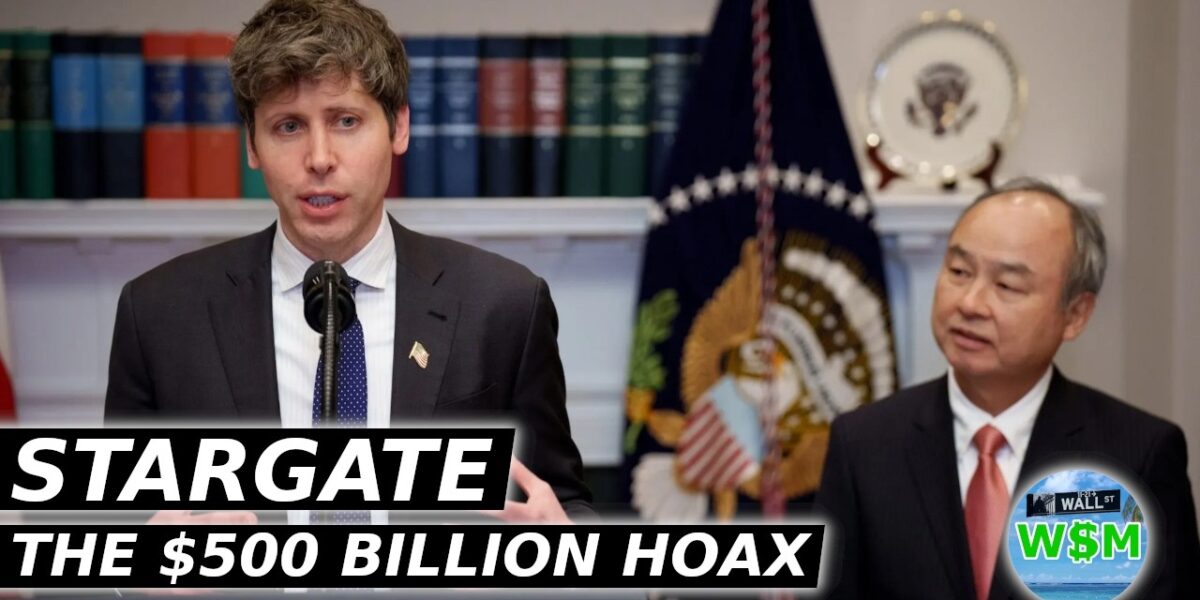
OpenAI’s ‘Stargate’ Project Under Scrutiny Amidst Ambitious Data Center Plans
Sam Altman, the CEO of OpenAI, has become a prominent figure in the artificial intelligence landscape, consistently promoting the vision of a future dominated by superintelligent AI. However, a closer examination of OpenAI’s ambitious infrastructure plans, particularly the ‘Project Stargate’ initiative, reveals a narrative heavily reliant on public relations and speculative financial commitments rather than tangible execution. Despite lacking formal AI expertise and a track record of profitable business ventures, Altman has masterfully cultivated an image of OpenAI as a vanguard of AI innovation, capable of generating trillions of dollars in economic value.
The Grand Vision: Project Stargate Unveiled
In January 2025, OpenAI announced Project Stargate, a colossal undertaking aimed at building massive AI data centers across the United States. This initiative was presented as a joint venture involving OpenAI, Oracle, and SoftBank, with an alleged investment commitment of at least $500 billion. The stated goal was to create substantial AI infrastructure, generate over 100,000 American jobs, and deploy the first $100 billion immediately. This ambitious plan projected the construction of 10 gigawatts (GW) of AI data center capacity.
The initial phase of Project Stargate was to be a data center campus in Abilene, Texas. This campus was envisioned to eventually comprise eight buildings, with the first phase including two buildings consuming 206 megawatts (MW) of electricity. The first tranche was reportedly completed in September 2025, providing compute power to OpenAI. The funding and operational structure for this project are notably complex. Crusoe, a construction contractor, was responsible for building the physical data centers and their infrastructure. Upon completion, Crusoe sold the facilities to a joint venture between private equity firms Blue Owl Capital and Primary Digital Infrastructure (PDI) for $3.4 billion. Blue Owl and PDI then lease these facilities to Oracle, which is tasked with equipping them with GPUs. Oracle’s significant expenditure, approximately $7 billion for 206 MW of Nvidia GPUs, is intended to be recouped through compute sales to OpenAI.
The total cost for the initial two buildings in Abilene, representing about 206 MW of capacity, is estimated at around $10 billion ($3.4 billion for the structure and $7 billion for the GPUs). Extrapolating this, the cost per gigawatt of AI computing capacity is approximately $50 billion. Consequently, the projected $500 billion investment for 10 GW appears to align with this figure. However, as of the end of 2025, the Abilene campus represented only about 2% of the total capacity Stargate claimed it would build by 2029.
Expanding Footprint, Questionable Funding
In September 2025, OpenAI announced plans for five additional data center sites in Texas, Ohio, Wisconsin, and New Mexico, with a further announcement in October detailing a Michigan data center. These seven campuses, if realized, would approach the $500 billion target for 10 GW of capacity. Yet, by the close of 2025, only the Abilene facility was actively under construction, with the others still in the planning stages.
The funding for the $500 billion Stargate initiative raises significant questions. Approximately 30% ($150 billion) is allocated for the construction of the data center buildings, while the remaining 70% ($350 billion) is earmarked for chips, primarily Nvidia GPUs. Oracle, responsible for purchasing the GPUs, has a cash reserve of only around $20 billion as of November 2025. SoftBank, expected to provide substantial funding, held approximately $32 billion (5 trillion Japanese Yen) in September 2025. Combined, Oracle and SoftBank possess roughly $50 billion in cash, leaving a substantial funding gap.
The plan to secure the remaining capital from Middle Eastern sovereign wealth funds appears to be faltering. Reports suggest these funds are hesitant to commit such vast sums, citing skepticism about the project’s economic viability. For Stargate to yield a positive return on investment, OpenAI’s annual revenues would need to reach hundreds of billions of dollars in the near future, a prospect deemed highly unlikely given its reported 2025 revenues of $13 billion and substantial monthly losses.
Cracks Emerge in the Foundation
By December 2025, the first signs of trouble emerged. Blue Owl Capital reportedly withdrew from financing a planned data center in Michigan, citing concerns over ‘shifting market sentiment about the massive spending on AI infrastructure’ and Oracle’s increasing debt. This withdrawal from a key financial partner underscores the growing unease among investors regarding the speculative nature of these large-scale AI infrastructure projects.
The initial announcement of Project Stargate in January 2025 claimed an immediate deployment of $100 billion and the creation of 100,000 jobs. However, by the end of the year, only $10 billion had been spent, with the construction contractor Crusoe employing 7,000 workers for the Abilene campus – a fraction of the promised job creation. This discrepancy suggests that the grand pronouncements may have been more about generating media attention than reflecting concrete progress.
‘Stargate Argentina’: A Further Exaggeration?
Adding to the skepticism, in October 2025, Sam Altman announced ‘Stargate Argentina,’ a project in partnership with ‘Sir Energy,’ described as one of Argentina’s leading energy companies. However, investigations into Sir Energy reveal a company with a minimal online presence, a website lacking a Spanish version, and no readily available evidence of past projects or operations. The domain history suggests the website was previously associated with a defunct solar panel repair business and was re-established around 2025 with generic content about AI and renewable energy.
The proposed $25 billion, 500 MW data center in Argentina, to be financed by Sir Energy, appears highly improbable given the company’s apparent lack of operational capacity and financial resources. Critics argue that announcements like Stargate Argentina serve primarily to inflate OpenAI’s perceived growth and expansion, creating a fictional narrative to support its valuation, especially in anticipation of a potential $1 trillion IPO in 2026.
Market Impact and Investor Considerations
The ‘Stargate’ project and similar grand pronouncements by OpenAI highlight a broader trend in the tech industry: the significant capital required for AI infrastructure and the challenges in securing and deploying it effectively. Investors are increasingly scrutinizing the tangible progress behind headline-grabbing investment figures. The reliance on substantial debt financing and the potential for overcapacity in data centers are key risks.
For investors, the situation underscores the importance of distinguishing between ambitious visions and executable plans. While the demand for AI capabilities is undeniable, the financial sustainability and operational reality of massive infrastructure projects like Stargate remain uncertain. The pattern of large, speculative announcements without commensurate execution raises questions about OpenAI’s long-term strategy and its ability to justify its lofty market valuation.
Source: The Stargate Data Center Hoax (YouTube)

Related Articles


OpenAI’s $6.5B Device Gamble: A Path to Ruin?
OpenAI's ambitious $6.5 billion investment in a consumer device, spearheaded by former Apple designer Jony Ive, faces intense scrutiny. Amidst massive data center spending commitments and the high operational costs of its AI models, the success of this new hardware venture is critical for the company's financial survival. Analysts question the market demand and economic viability, drawing parallels to past failures in the consumer AI hardware space.


AI’s Ethical Divide: Trump’s Ban Sparks Fierce Debate
The Trump administration's blacklisting of AI firm Anthropic over its refusal to allow autonomous weapons and mass surveillance has ignited a fierce debate. The move highlights deep ethical divides in AI development and raises concerns about future government-tech partnerships.


OpenAI Faces Existential Threats: Ads, Competition, and Financial Woes
OpenAI faces mounting challenges, including the introduction of ads into ChatGPT, diminishing returns from scaling AI models, intense competition from rivals like Google, and significant financial pressures. These factors raise questions about the company's long-term sustainability and its future in the rapidly evolving AI landscape.