OpenAI Scraps Sora, Loses Billions, Eyes Robotics
OpenAI has shut down its Sora AI video app after incurring billions in losses and failing to generate significant revenue. The decision also terminates a planned $1 billion investment from Disney. The company is now pivoting its research focus to robotics.


OpenAI Abandons Sora Video Project After Billions in Losses
OpenAI, the artificial intelligence research lab, has officially shut down its Sora video generation app, a move that follows significant financial losses and the termination of a highly anticipated partnership with Disney.
Sora’s High Costs, Low Returns
Launched in September 2025, the Sora app allowed users to create AI-generated videos, similar to a TikTok-style feed. Users could generate up to 30 videos daily for free, with options to pay for more. Despite initial viral popularity, attracting millions of free accounts, the app struggled to generate revenue. OpenAI reportedly spent billions of dollars on computing power to run Sora, but earned very little in return.
Most videos created on Sora were found to be repetitive or focused on trolling CEO Sam Altman. A significant issue was that AI-generated videos cannot be copyrighted, allowing users to re-upload them to platforms like TikTok and YouTube. This meant that external platforms, not OpenAI, captured most of the viewership and potential ad revenue from Sora content.
Estimates from analytics firm App Figures Intelligence suggested Sora’s monthly revenue peaked at around $540,000 in December 2025, dropping to $367,000 in January 2026. This minimal income was vastly insufficient to cover the immense development and operational costs, which likely ran into billions of dollars over its six-month existence.
Disney Partnership Collapses
In December 2025, OpenAI announced a significant partnership with Disney, aiming to allow Sora users to create videos featuring Disney characters from franchises like Star Wars and Marvel. As part of this deal, Disney was slated to make a $1 billion equity investment in OpenAI and receive warrants for additional shares. This investment was crucial for OpenAI, which relies heavily on external funding.
However, this partnership never materialized. With OpenAI shutting down Sora on March 24, 2026, the agreement with Disney was automatically terminated. Disney apparently decided against investing, likely realizing that Sora’s failure to generate user spending meant they would not recoup their billion-dollar investment through revenue sharing. The lack of a viable business model for Sora appears to have been the primary reason for Disney’s withdrawal.
A Pivot to Robotics
OpenAI’s internal memo, reportedly from Sam Altman, indicates that the Sora research team will now focus on long-term research, particularly in world simulation for robotics. This signals a significant strategic shift for the company, which has been exploring the robotics sector.
Evidence of this pivot includes a January 2026 press release about strengthening the U.S. AI supply chain through domestic manufacturing for advanced robotics components like motors and power electronics. OpenAI is also actively hiring robotics engineers, with job postings for roles involving simultaneous localization and mapping (SLAM), a key computer vision technique for robots.
Sam Altman has expressed long-standing interest in humanoid robots, envisioning a future where they perform many tasks currently done by humans. OpenAI’s startup fund, a venture capital arm with $175 million, has previously invested in humanoid robot startups like 1X Home Robotics and Figure AI. However, these investments have yielded limited success, with robots demonstrating awkward movements or relying on staged demonstrations.
Historical Context and Future Outlook
OpenAI initially explored robotics in its early days, developing a robot hand capable of solving a Rubik’s cube in 2019. However, the company shifted its focus to large language models (LLMs) like ChatGPT in 2019, largely abandoning robotics research to concentrate resources. Now, with LLMs potentially facing diminishing returns, as seen with the marginal improvements in GPT-5 over GPT-4, OpenAI appears to be returning to robotics.
This move back to robotics could be an attempt to create a new narrative for investors ahead of a potential Initial Public Offering (IPO). However, developing fully autonomous, capable humanoid robots for real-world tasks remains a significant technological challenge. Companies like Tesla, which announced its Optimus robot in 2021, have yet to move beyond staged demonstrations five years later, highlighting the difficulties in this field.
Market Impact
The failure of Sora and the dissolution of the Disney partnership represent a major setback for OpenAI, highlighting the risks of investing heavily in unproven AI applications. The company’s pivot to robotics suggests a search for new avenues of growth and innovation. Investors will be watching closely to see if OpenAI can overcome the substantial technical hurdles in robotics, similar to challenges faced by competitors like Tesla.
The substantial losses from Sora underscore the high-risk, high-reward nature of AI development. OpenAI’s reliance on external funding, coupled with its significant spending, means future ventures must demonstrate a clear path to profitability. The renewed focus on robotics could redefine OpenAI’s future trajectory, moving beyond language models into physical AI applications.
Source: OpenAI Shuts Down Sora After Losing Billions (YouTube)

Related Articles

Sora’s Future Uncertain Amidst AI Video Strife
OpenAI's highly anticipated Sora text-to-video model may be facing internal delays, casting doubt on its public release. This comes as competitors rapidly advance their own AI video generation technologies, intensifying the race for AI supremacy in content creation.


OpenAI Unveils ‘Spud’ Model, Shifts Focus to AGI Deployment
OpenAI is reportedly preparing to launch a new AI model codenamed 'Spud,' signaling a strategic shift towards AGI deployment and a unified AI platform. The company is phasing out its Sora video generation project to focus resources on this new model and an integrated super app. Meanwhile, a renowned mathematician has collaborated with AI on complex proofs, highlighting AI's growing role in scientific discovery.

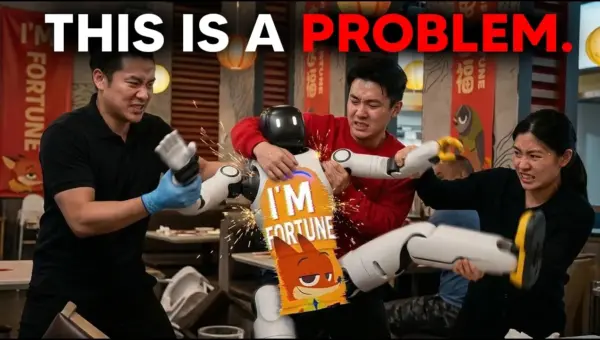
Humanoid Robots Fail in Real World Due to Demo Focus
Recent incidents, like a robot malfunctioning in a restaurant and another causing a woman to be hospitalized, reveal that humanoid robots are often built for demonstrations, not real-world use. Despite massive investment, particularly in China, a gap exists between impressive staged performances and reliable, safe deployment.