OpenAI Reclaims AI Lead with GPT-5.2 Launch
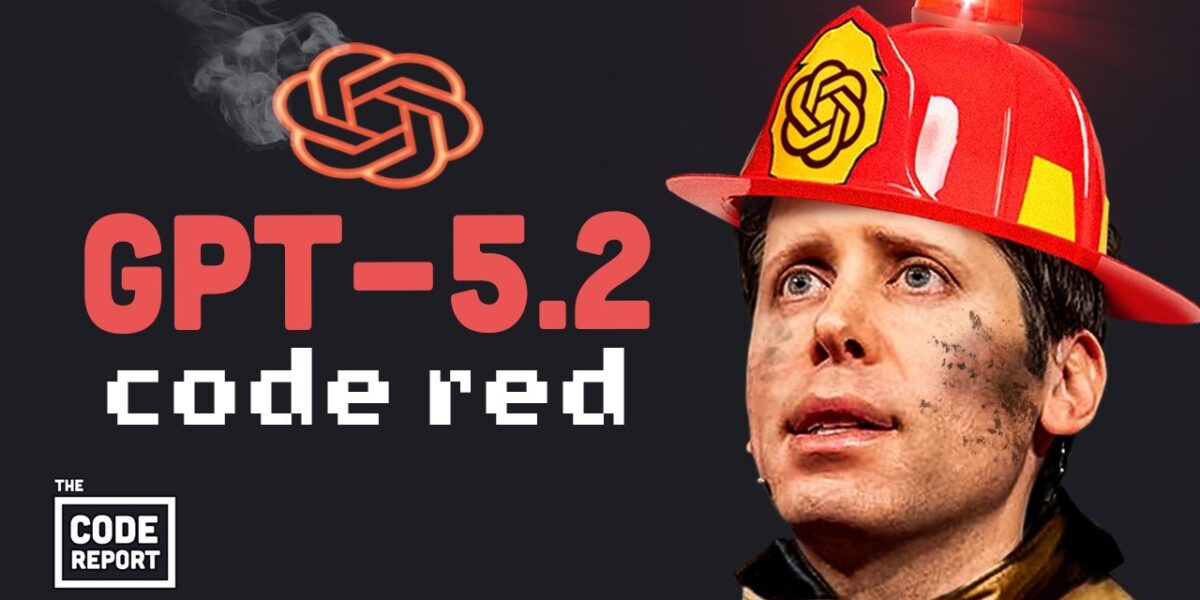
OpenAI has launched GPT-5.2, a new AI model reportedly reclaiming the lead in the AI race. It shows significant improvements on the ARC AGI benchmark, demonstrating enhanced reasoning and generalization capabilities, potentially signaling a major advancement towards artificial general intelligence.

OpenAI Reclaims AI Lead with GPT-5.2 Launch
The artificial intelligence landscape, characterized by its rapid and often unpredictable shifts, has witnessed another dramatic turn. Following a period where rivals like Google, with its Gemini models, appeared to be pulling ahead, OpenAI has responded with the release of GPT-5.2, a new iteration of its foundational language model. This release, according to internal discussions and early benchmark indicators, aims to reassert OpenAI’s dominance in the highly competitive AI race.
GPT-5.2’s Performance Leap
The announcement of GPT-5.2 has generated significant buzz, particularly due to its purported performance improvements across various critical AI capabilities. While specific official benchmarks are still emerging, early reports and internal assessments suggest a substantial leap forward. The model is reportedly outperforming existing leading models, including Google’s Gemini and Anthropic’s Claude Opus 4.5, in key areas such as software engineering and complex reasoning tasks.
The ARC AGI Benchmark: A New Standard?
A central point of discussion surrounding GPT-5.2 is its performance on the Abstraction and Reasoning Corpus (ARC) benchmark. The ARC is designed to assess a model’s ability to solve novel, unique problems that require pure reasoning rather than relying on memorization or brute-force pattern matching. These challenges are intentionally abstract and often counter-intuitive, presenting low-data puzzles that typically stump conventional AI approaches.
OpenAI has highlighted a significant efficiency improvement demonstrated by GPT-5.2 on the ARC benchmark. Reports indicate a 390x increase in efficiency from the previous ARC 03 model to the current 5.2 version within a single year. This dramatic improvement suggests a fundamental advancement in the model’s ability to generalize and apply reasoning to unseen problems, moving beyond mere sophisticated auto-completion.
Understanding the ARC Benchmark
For the uninitiated, the ARC benchmark is crucial for understanding the potential of advanced AI. Unlike many other benchmarks that can be gamed or fall prey to models trained on vast datasets containing similar problems, ARC presents puzzles that are fundamentally new. Success on ARC signifies an AI’s capacity for true generalization – the ability to understand underlying principles and apply them to entirely new situations, much like human intelligence does. This is a key distinction from models that might appear intelligent due to extensive training data but lack genuine problem-solving acumen.
Broader Implications and Industry Shifts
The implications of GPT-5.2’s advancements extend beyond academic benchmarks. OpenAI’s recent $1 billion deal with Disney to integrate iconic characters into AI-generated photos and videos is a prime example of this expanding capability. This partnership suggests a future where users can leverage OpenAI’s technology to create custom content featuring beloved characters from franchises like Star Wars or Toy Story. While this opens up creative avenues, it also raises significant concerns about intellectual property, content generation ethics, and the potential for misuse.
The rapid pace of development also impacts the broader AI ecosystem. The competition between OpenAI, Google, and others fuels innovation but also creates challenges for developers and users trying to keep pace. Evaluating the tangible benefits of new models like GPT-5.2 can be difficult for the average user, as improvements in areas like hallucination reduction or coding proficiency may not always be immediately apparent in everyday use.
The Future of AI Development
The release of GPT-5.2 reignites the debate about the trajectory of artificial general intelligence (AGI). While the ARC benchmark’s impressive results suggest a move towards more generalized intelligence, the question remains whether this represents a true step towards AGI or another cycle of hype. The AI industry continues to push boundaries, with new models and capabilities emerging at an unprecedented rate, promising to reshape industries and daily life in profound ways.
Developer Tools and Infrastructure
In the realm of practical AI application, tools that facilitate deployment and management of AI-powered applications are becoming increasingly vital. Platforms like Railway, a sponsor mentioned in the original discussion, aim to simplify the process of hosting production-ready deployments and managing infrastructure. Such services offer features like one-click environment setup, automatic scaling, and pay-as-you-go pricing, which are essential for developers working with complex AI models and applications. These tools are critical for translating the power of new models like GPT-5.2 into real-world, scalable solutions.
Why This Matters
GPT-5.2’s purported advancements, particularly its performance on the ARC benchmark, signal a significant step forward in AI’s ability to reason and generalize. This could have far-reaching consequences, from accelerating scientific discovery and complex problem-solving to enabling more sophisticated creative tools. The partnership with Disney also highlights the growing integration of AI into entertainment and content creation, raising both exciting possibilities and ethical considerations regarding intellectual property and authenticity. As AI models become more capable and versatile, their impact on industries, creative expression, and the very nature of problem-solving will continue to expand, making the ongoing race for AI supremacy a critical development to watch.
Source: OpenAI was dead… Then GPT-5.2 dropped (YouTube)

Related Articles


AI’s Economic Shift: Ownership is the New Wage
Artificial intelligence is projected to significantly reduce the economic value of human labor within a decade. Experts suggest that capital ownership, rather than wages, will become the primary means of wealth accumulation. Investors are urged to consider this shift in their long-term strategies.


Nvidia Earnings Signal AI Revolution’s Next Phase
Nvidia's latest earnings report reveals accelerating revenue growth and profitability, signaling a new phase in the AI revolution driven by sophisticated AI agents. The company's strong performance underscores the growing demand for computational power as AI transitions into a core digital infrastructure component.

AI Fails 96% of Real-World Tasks, New Study Reveals
A new study using the Remote Labor Index (RLI) reveals that current AI models fail at 96.25% of real-world professional tasks, significantly underperforming human freelancers. The research challenges the prevailing hype around AI's immediate job replacement capabilities and investment valuations.