Ocean Mysteries Hint at Extraterrestrial Life
Harvard astrophysicist Avi Loeb proposes that alien life, or 'cryptoterrestrials,' might already exist on Earth, potentially hidden in our oceans. He suggests analyzing the isotopic composition of discovered materials is key to determining their origin outside our solar system. This idea challenges traditional approaches to searching for extraterrestrial life.


Ocean Mysteries Hint at Extraterrestrial Life
Scientists are exploring a fascinating idea: could alien life already be on Earth, hidden in our oceans? Professor Avi Loeb, a Harvard astrophysicist, believes we might not be alone. He suggests that if extraterrestrial beings are here, they could be living among us unnoticed. Loeb is particularly interested in the possibility of ‘cryptoterrestrials’ – life forms that are not from our solar system.
Testing for Alien Origins
The key to identifying such life, according to Loeb, lies in its basic building blocks. All matter on Earth, and indeed throughout our solar system, has a specific chemical makeup. This makeup includes different versions of elements called isotopes. Isotopes are like different flavors of the same element, created by nuclear processes in stars and throughout space.
Loeb explains that by analyzing the isotopic composition of any discovered material, scientists can determine its origin. If the isotopes match those found naturally in our solar system, the material is terrestrial or from our cosmic neighborhood. However, if the isotopic ratios are different, it strongly suggests an origin from outside our solar system.
This method provides a clear way to distinguish between earthly life and potential alien visitors. Loeb emphasizes that isotopes are very difficult to change. They are a direct result of nuclear reactions, like those happening inside stars or in the early universe. Therefore, checking these ‘isotopic abundances’ is a reliable test for extraterrestrial origins.
The Search Continues
Loeb is known for his work on the ‘Oumuamua object, which passed through our solar system in 2017. He proposed that it might have been an alien probe. His current focus on potential life within Earth’s oceans stems from the idea that our planet’s vast, unexplored waters could harbor unknown life forms. These could be organisms that evolved elsewhere and somehow arrived here, or perhaps life that originated on Earth but is fundamentally different from what we currently understand.
The scientific community is divided on such ideas. While many scientists remain focused on searching for life on other planets or moons, Loeb’s approach is more direct. He suggests that we should be looking for evidence right here at home. The oceans, covering over 70% of our planet’s surface, remain largely unexplored. They represent a vast frontier where truly alien life could potentially exist, hidden from our current detection methods.
Loeb’s work encourages a broader definition of what extraterrestrial life might look like and where it could be found. It challenges us to consider that the universe’s mysteries might not be light-years away, but perhaps deep within our own planet’s waters.
Global Impact
The possibility of ‘cryptoterrestrials’ or alien life originating from outside our solar system, even if currently on Earth, would fundamentally alter our understanding of life in the universe. If confirmed, it would mean that interstellar travel or migration might be more common than previously thought. This could spark a new era of scientific discovery and philosophical reflection.
Historical Context
Throughout history, humanity has looked to the stars and wondered about alien life. From ancient myths to modern science fiction, the idea has persisted. However, scientific efforts have largely focused on finding life beyond Earth, such as on Mars or distant exoplanets. Professor Loeb’s work represents a notable shift, bringing the search closer to home, specifically to Earth’s own hidden environments.
Economic Leverage
Currently, there is no direct economic leverage tied to the search for cryptoterrestrials. However, a confirmed discovery would undoubtedly lead to massive global investment in research and technology. This could include new deep-sea exploration tools, advanced material analysis techniques, and international collaborations. The economic implications would be enormous, potentially reshaping entire industries dedicated to understanding and interacting with this new life.
Regional Alliances and Power Balances
The search for extraterrestrial life is a global endeavor. If evidence of cryptoterrestrials were found, it could foster unprecedented international cooperation. Nations might form alliances to share research, resources, and findings. Conversely, competition could arise over who controls access to information or potential discoveries. This could shift global power dynamics, with nations leading in astrobiology and related technologies gaining significant influence.
Future Scenarios
One scenario is that Loeb’s hypothesis remains speculative, and no evidence of non-solar system material is found in biological entities on Earth. Another possibility is that traces of non-terrestrial material are found, but they are determined to be from natural cosmic dust, not biological organisms. The most dramatic scenario is the confirmed discovery of biological material with isotopic signatures clearly indicating an origin outside our solar system. Such a discovery would have profound implications for science, religion, and humanity’s place in the cosmos.
Source: Avi Loeb on ‘aliens under the ocean’ (YouTube)

Related Articles

Trump Pushes UFO Files Release, Igniting Global Curiosity
Former President Trump has ordered the release of government files on UAP, a move that follows public comments from Obama and Vance. This directive ignites global curiosity about potential extraterrestrial evidence, with experts like Avi Loeb suggesting the possibility of technology from ancient civilizations.

Trump Orders UAP Files Released, Sparking Global Speculation
Former President Trump has ordered the release of government files on UAPs and extraterrestrial life, reigniting global speculation. This move follows whistleblower claims of secret retrieval programs and comments from former President Obama. Physicist Avi Loeb believes this indicates unexplained phenomena and hopes for scientific access to data, while also discussing the potential risks and opportunities of encountering advanced civilizations.
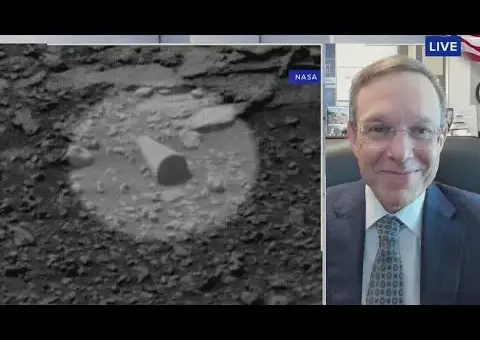
Harvard Professor Challenges NASA on Mars Object
Harvard Professor Avi Loeb is questioning NASA's explanation of a 'party hat'-shaped object on Mars. While NASA calls it a natural rock, Loeb believes it warrants further investigation and highlights the importance of curiosity-driven science.