Nvidia Unveils Vera Rubin: A Leap in AI Efficiency
Nvidia's new Vera Rubin system promises a tenfold increase in AI performance per watt, addressing critical energy demands. Featuring advanced liquid cooling and NVLink technology, it aims to overcome AI's growing power consumption bottleneck.

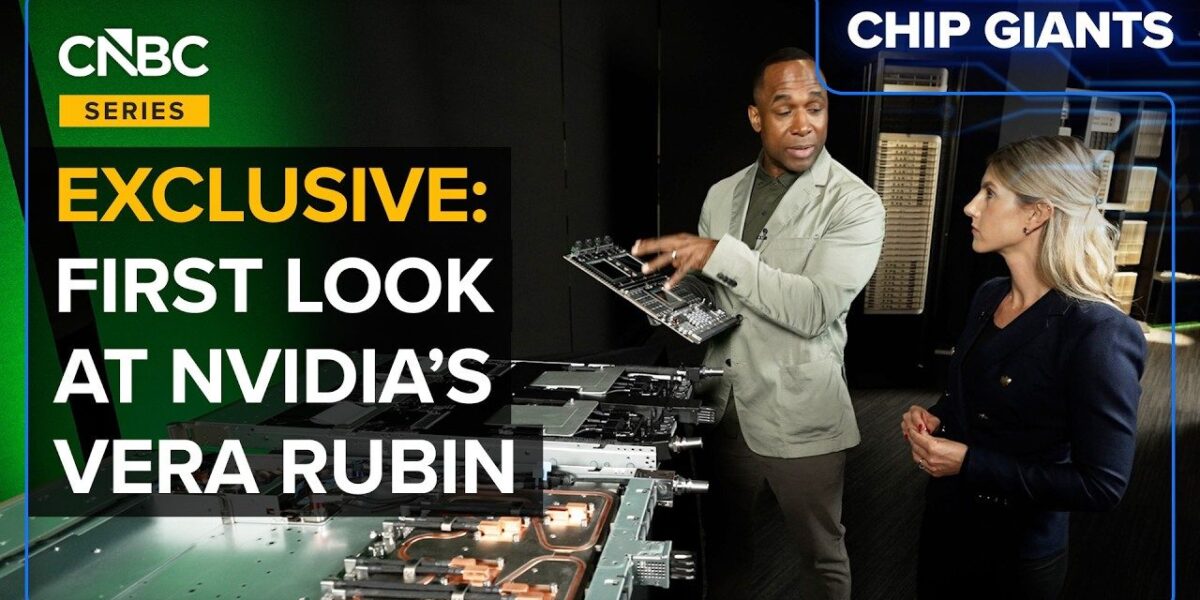
Nvidia Unveils Vera Rubin: A Leap in AI Efficiency
Nvidia’s latest innovation, the Vera Rubin rack-scale system, is poised to redefine the landscape of artificial intelligence data centers. Building upon the success of its predecessor, the Grace Blackwell system, Vera Rubin promises a tenfold increase in performance per watt, directly addressing the burgeoning energy demands that threaten to bottleneck AI development. This advancement signifies a critical step in making AI more sustainable and scalable.
The Energy Bottleneck and Nvidia’s Solution
The rapid expansion of AI capabilities is increasingly constrained by energy consumption. As AI models become more complex and data-intensive, the power required to train and deploy them escalates dramatically. Nvidia’s Grace Blackwell system, a 72-GPU configuration that has seen significant adoption by tech giants like Microsoft, Google, Amazon, and Meta, has already pushed the boundaries of performance. However, the next frontier lies in efficiency. Nvidia claims that Vera Rubin will achieve approximately ten times greater performance per watt compared to Blackwell, a monumental improvement designed to alleviate energy concerns within AI infrastructure.
Inside Vera Rubin: A Complex Ecosystem
The Vera Rubin system is far more than just a collection of GPUs. It represents a highly integrated and complex ecosystem comprising an estimated 1.3 million components sourced from over 80 suppliers across more than 20 countries. This intricate web includes not only the core GPUs but also compute trays, chassis, side rails, and bus bars. Nvidia has engineered this system for volume production, with shipments slated to begin later this year. The company has meticulously designed a standard reference architecture to manage this vast supply chain, ensuring consistency and reliability across diverse manufacturing origins, from China and Israel to Mexico and the U.S.
Grace Blackwell’s Success and Vera Rubin’s Advancements
Nvidia’s Grace Blackwell system, launched in 2024, revolutionized AI data centers by disaggregating compute, networking, and memory infrastructure to function as a cohesive unit. This approach, which made the entire rack behave like a single, highly efficient GPU, led to a more than 100% surge in Nvidia’s stock price. The Blackwell system features 72 GPUs, nearly 800 other chips, and a total of 1.2 million components manufactured across approximately 350 factories. Key partners in its production include TSMC for silicon, Foxconn for assembly components, and Delta Electronics for liquid cooling elements.
Vera Rubin builds upon this foundation, introducing a ‘Rubin pod’ consisting of 1,152 GPUs spread across 16 racks. This next-generation system incorporates about 100,000 more components than Grace Blackwell and, while consuming roughly double the energy, delivers exponentially higher compute power. Nvidia has re-engineered all six core chips for Vera Rubin:
- Vera CPU: Offers approximately twice the performance per watt compared to the previous generation Grace CPU.
- Rubin GPU: Achieves around 50 petaflops of AI performance, a 2.5x increase.
Each rack within the Vera Rubin system houses 18 compute trays, with each tray featuring two Vera Rubin superchips. These superchips integrate one Vera CPU and two Rubin GPUs, among other components. A significant memory upgrade comes from the High Bandwidth Memory (HBM4) stacks, with eight stacks lining the top and bottom of each Rubin GPU, supplied by industry leaders like SK Hynix and Samsung.
Addressing Supply Chain and Overheating Concerns
Nvidia acknowledges the inherent risks in managing such a complex global supply chain, including potential memory shortages and the impact of tariffs. To mitigate these, the company emphasizes meticulous forecasting and alignment with its supply chain partners. Regarding overheating, an issue reported in early Blackwell deployments, Nvidia has implemented a fully liquid-cooled architecture for Vera Rubin. This system, featuring cold plates on CPUs and GPUs, eliminates hoses, cables, and fans, ensuring efficient heat dissipation. While this necessitates robust liquid cooling infrastructure in data centers, Nvidia notes that closed-loop liquid cooling systems can paradoxically lead to lower overall water consumption compared to traditional evaporative cooling methods.
Networking and Connectivity: The NVLink Advantage
Central to Vera Rubin’s performance is Nvidia’s NVLink interconnect technology. The NVLink Switch chip doubles the line rate from 1.8TB per second to 3.6TB per second, enabling all GPUs and CPUs to function as a unified entity. Nine NVLink Switch trays connect the 72 GPUs, facilitating data transfer at an astonishing 260TB per second through an NVLink spine, which utilizes approximately two miles of copper cabling per rack. The system also incorporates BlueField DPUs for storage and security, and ConnectX-9 networking controllers, underscoring Nvidia’s strategic acquisition of Mellanox for nearly $7 billion in 2020.
Market Position and Competitive Landscape
Vera Rubin racks weigh nearly two tons and contain an estimated 220 trillion transistors. Despite its complexity, Nvidia states it is simpler to maintain than the Grace Blackwell system, with compute trays replaceable in minutes compared to hours for Blackwell. However, the increased performance and complexity come at a higher cost, with analysts estimating a 25% price increase per rack over Grace Blackwell, potentially ranging from $3.5 million to $4 million. Despite the higher upfront cost, the cost per AI-generated token is expected to be significantly lower with Vera Rubin.
Nvidia is also navigating a competitive landscape. AMD is set to release its Helios rack-scale system later this year, providing customers with a viable alternative. Furthermore, major cloud providers like Amazon (AWS), Google, and Microsoft are developing their own in-house AI chips, such as AWS Trainium 2 and Google’s Tensor Processing Units (TPUs). However, these companies continue to rely on Nvidia’s platforms, a testament to their power and efficiency.
Looking ahead, Nvidia is already prototyping its next-generation architecture, Kyber, which will feature 288 GPUs in a rack with only a 50% increase in weight, further pushing compute density. The Vera Rubin Ultra, utilizing the Kyber Rack design, is expected in 2027. This continuous innovation aims to reduce points of failure, enhance integration, and ultimately lower the total cost of ownership for AI infrastructure.
Market Impact and Investor Outlook
The introduction of Vera Rubin underscores Nvidia’s dominance in the AI hardware market. The system’s enhanced efficiency and performance are crucial for meeting the escalating demand for AI computation. Investors will be closely watching the ramp-up of Vera Rubin production and its adoption by major cloud providers and enterprises. The company’s commitment to continuous architectural leaps, as demonstrated by the Kyber prototype, suggests a sustained competitive advantage.
However, potential headwinds include the complexity of the supply chain, geopolitical factors affecting component sourcing, and the growing in-house chip development by hyperscalers. The increasing energy requirements, even with efficiency gains, will also remain a critical consideration for data center operators. Despite these challenges, the sheer demand for AI processing power positions Nvidia’s next-generation systems, like Vera Rubin, for continued strong growth. The company’s strategy of offering annual architectural upgrades encourages customers to adopt new generations, ensuring a consistent demand cycle.
Source: Deconstructing Nvidia’s Vera Rubin — The Successor To Blackwell That’s 10x More Efficient (YouTube)

Related Articles


Nvidia Earnings Signal AI Revolution’s Next Phase
Nvidia's latest earnings report reveals accelerating revenue growth and profitability, signaling a new phase in the AI revolution driven by sophisticated AI agents. The company's strong performance underscores the growing demand for computational power as AI transitions into a core digital infrastructure component.


Global Private Credit Crisis Deepens with UK Lender Collapse
A $2.7 billion collapse of a UK mortgage lender has sent shockwaves through global financial markets, amplifying concerns about the stability of the private credit sector. The failure of MFS and its alleged fraudulent practices are exposing major U.S. institutions and raising questions about the sustainability of AI sector financing.


Big Tech’s Land Grab: Small Towns Face Existential Crisis
Big Tech's aggressive acquisition of land is transforming rural America, displacing farmers and straining resources. Data centers consume vast amounts of water and energy, while offering minimal local employment and demanding significant tax breaks, leaving communities questioning the true cost of technological progress.