Nvidia Fuels Robotics Revolution with AI “Three-Computer Stack”
Nvidia is advancing the robotics revolution with its "three-computer stack" approach, integrating AI training, high-fidelity simulation via Omniverse, and real-world deployment hardware. This strategy aims to overcome data scarcity challenges and accelerate the development of intelligent, generalist robots across various industries.


Nvidia Fuels Robotics Revolution with AI “Three-Computer Stack”
The long-anticipated robotics revolution is accelerating, driven by advancements in artificial intelligence that are moving beyond data centers and into the physical world. Nvidia, a company increasingly synonymous with AI development, is at the forefront of this shift, leveraging its powerful computing infrastructure to enable sophisticated robotic systems. The company’s strategy hinges on a “three-computer stack” designed to handle the complex lifecycle of robotic AI, from initial training to real-world deployment.
The “Three-Computer Stack” Explained
Spencer Hang, product lead for robotic software at Nvidia, outlined the company’s comprehensive approach. The core of this strategy involves three distinct computing phases:
- Training the Brain: This phase utilizes high-performance computing systems, such as Nvidia’s DGX, to train the foundational AI models. These models, often Vision-Language-Action (VLA) models or other large foundational models, are the cognitive engines that will power the robots.
- Simulating the World: Before robots interact with the physical environment, they need extensive practice. Nvidia employs powerful simulation platforms, notably its Omniverse, to create digital twins of the real world. This allows AI models to train and, crucially, be evaluated in a safe, virtual environment where complex interactions can be tested and refined. This simulation also plays a vital role in generating synthetic data, which is essential for overcoming the scarcity of real-world robotic data.
- Deploying in the Real World: The final stage involves deploying the trained AI models onto specialized hardware. Nvidia’s IGX and Jetson platforms are designed for this purpose, providing the necessary computational power for robots to operate autonomously and execute tasks in physical environments.
Bridging the Data Gap: Simulation and Synthetic Data
A significant hurdle in developing advanced physical AI is the lack of comprehensive real-world data, particularly for complex physical interactions. Unlike Large Language Models (LLMs), which benefited from centuries of human-written text, physical AI lacks a comparable corpus for data such as contact forces between different materials or the nuances of rigid-soft body interactions. Video data, while useful for understanding semantic relationships (e.g., knowing a cutting board belongs in a kitchen), does not capture the physics of interaction.
“For physical AI we don’t have the same information for contact data. We don’t know how to we haven’t captured what is it like when you take a rigid body like a finger—like a bone or or or a metal hand—and interact with something very very soft. That interaction that data doesn’t exist,” explained Hang. “Video data gives us the ability to have this cognitive reasoning. It gives you semantic reasoning. It gives you the ability to understand and interpret the world. But what it doesn’t do is tell you how the world is going to interact when you start interacting with it.”
Nvidia’s Omniverse platform addresses this by enabling high-fidelity simulations that can generate vast amounts of synthetic data. This synthetic data, meticulously crafted and augmented, compensates for the scarcity of real-world examples, allowing AI models to learn complex manipulation skills, such as distinguishing between the force needed to grasp an egg versus a baseball.
From Specialist to Generalist: The Evolution of Robot Skills
The development of robotic capabilities is moving from highly specialized, single-task robots to more generalist systems capable of adapting to various situations. Nvidia envisions a future where robots can learn and combine fundamental “atomic skills”—like grasping, manipulating, or balancing—to perform complex composite tasks. This mirrors human learning, where basic actions are combined to master more intricate activities.
Hang likened this progression to human development: “We’re at the point where we’re trying to train atomic skills. How to grab things? Well, how are you manipulating things? Very these are all the same skills that a toddler or three-year-old is trying to work on. And then over time, you take these and you start building them like Lego blocks together.”
The goal is to create generalist robots that can learn on the job, much like a recent college graduate who possesses broad capabilities but needs further specialization. This requires robust training methodologies and, crucially, effective validation.
Validation and Hardware: Closing the Loop
Ensuring that AI models perform reliably in the real world involves rigorous testing. Nvidia employs a multi-stage validation process:
- Software-in-the-Loop (SIL): The simulated robot and environment are tested virtually.
- Hardware-in-the-Loop (HIL): The real robot’s onboard computer (e.g., AGX) processes simulated data from the virtual environment, allowing it to operate as if it were in the real world without physical risk.
- Real-World Deployment: The final stage where the robot operates in its intended physical environment.
This process is critical, especially for tasks requiring high precision, like surgical procedures. The fidelity of the simulation and the capabilities of the robot’s hardware are interdependent. As robotic hardware, particularly dexterous hands with more degrees of freedom, becomes more advanced, it enables the training of more sophisticated AI policies.
Hang noted, “The mechatronics become more advanced and start to mature, which means that the hardware can now actually do what these policies should be trained to do. And so it’s a mix of—is your policy trained up enough? And on the other side, it’s mechatronically, do I have the right hardware in order to do it?”
The Rise of Benchmarks and the Future of Physical AI
Similar to the benchmarks used to evaluate LLMs (e.g., in math, science, literature), the robotics industry is developing standardized tests to measure the capabilities of AI models. Nvidia’s Isaac Lab Arena, built on its Isaac Lab framework, allows for the creation of diverse environments, scenarios, and tasks to systematically test robotic policies. These benchmarks are evolving from academic exercises to industrial applications, focusing on real-world integration challenges like micro-assembly or complex bin-picking.
The ultimate objective is to “close the loop”—to ensure that what is trained and validated in simulation translates seamlessly into successful real-world performance. As Nvidia continues to advance its AI infrastructure and simulation capabilities, the physical AI revolution, powered by intelligent robots, appears closer than ever.
Market Impact
Nvidia’s strategic focus on the robotics ecosystem, particularly its “three-computer stack” approach, positions the company as a key enabler of the burgeoning physical AI market. By providing the foundational hardware and software infrastructure for training, simulation, and deployment, Nvidia is creating a powerful flywheel effect. Advances in simulation and AI model development will drive demand for more powerful computing hardware (GPUs, specialized AI chips), while the increasing deployment of robots will necessitate further software and platform development. This integrated approach not only benefits Nvidia but also fuels innovation across various sectors, including industrial automation, logistics, healthcare, and potentially consumer robotics. The development of standardized benchmarks and the increasing sophistication of robotic hardware and software suggest a sustained period of growth and investment in the robotics industry.
What Investors Should Know
Investors should monitor Nvidia’s progress in the robotics space, paying attention to the adoption of its Jetson and IGX platforms, the success of its Omniverse simulation environment, and the development of its AI frameworks like Isaac. The growth of physical AI is intrinsically linked to advancements in computing power, simulation fidelity, and the availability of skilled AI talent. Companies that can effectively bridge the gap between AI development and real-world robotic application are poised for significant long-term growth. The ongoing convergence of AI and robotics signifies a major technological shift with the potential to reshape numerous industries and create substantial investment opportunities.
Source: E23: The Robotics Revolution Is Closer Than You Think (Here's Why) (YouTube)

Related Articles

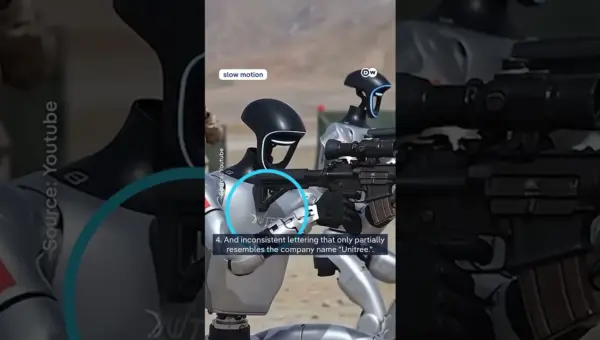
China’s ‘Robot Army’ Viral Videos Exposed as AI Fakes
Viral social media posts claiming China has built a robot army have been debunked as sophisticated AI-generated fakes. Analysis of the videos revealed numerous glitches, proving they are not real footage of military robots. While humanoid robot development is ongoing, these specific viral clips are fabricated.


Pentagon Taps AI for War; OpenAI Steps In After Firm Refuses
The Pentagon's use of AI in military operations, including leveraging Anthropic's Claude and Palantir's Maven system, has sparked controversy. OpenAI's subsequent deal with the military after Anthropic's refusal has led to significant public backlash and a 'Quit GPT' movement.


AI’s Power Play: Will Tech Giants Escape Regulation?
Senator Bernie Sanders warns that the AI industry's push to avoid regulation poses an existential threat. As tech giants invest heavily to lobby against oversight, questions arise about controlling AI's unchecked ambition and its impact on humanity and the economy.