Navy Ship Aids Lunar Mission, Boosting US Space Power
The USS John P. Murtha's return to San Diego with the Artemis II Orion capsule highlights the U.S. Navy's vital role in space exploration. This successful recovery showcases American technological prowess and reinforces its global leadership in venturing beyond Earth.

Navy Ship Aids Lunar Mission, Boosting US Space Power
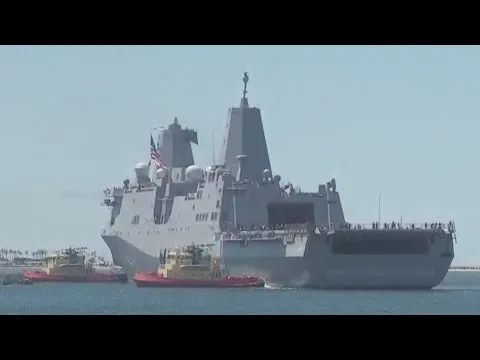
The USS John P. Murtha recently returned to Naval Base San Diego, bringing with it a piece of history: the Orion space capsule from NASA’s Artemis II mission. This event marks a significant moment, not just for space exploration, but also for the U.S. Navy’s role in supporting ambitious national goals. The successful recovery of the capsule highlights the growing importance of naval assets in advancing America’s presence in space and its global leadership.
Artemis II: A Giant Leap for Humanity
The Artemis II mission was a groundbreaking 10-day journey. Four astronauts traveled farther than any humans before, completing a loop around the Moon. They even ventured to the far side of the Moon, an area no human had ever reached. The Orion capsule reentered Earth’s atmosphere at nearly 24,000 miles per hour. It faced temperatures around 5,000 degrees Fahrenheit during its fiery return.
USS John P. Murtha: More Than Just a Ship
The arrival of the USS John P. Murtha at Naval Base San Diego was a complex operation. Because the Orion capsule was secured in the ship’s well deck, the Murtha had to dock backward. Tugboats carefully maneuvered the large vessel into its spot. This unusual parking job was necessary to safely keep the valuable capsule on board.
The Murtha is home to 6,700 crew members. These sailors and Marines were directly involved in the splashdown recovery operation. They worked diligently to ensure the safe retrieval of the astronauts and the Orion capsule. The astronauts were flown off the ship by helicopter shortly after recovery. They are now back in Houston, likely debriefing about their historic journey.
Behind the Scenes: The Navy’s Crucial Role
While the astronauts are rightly celebrated as heroes, the success of Artemis II depended on many others. The U.S. Navy played a vital supporting role. Marine Colonel, who helped plan the recovery, expressed immense pride. Everything went according to plan, a testament to careful preparation and execution.
Recovering the capsule in the Pacific Ocean presented challenges. Strong currents made the process take a little longer than expected. The Murtha was positioned about 50 to 60 miles offshore from San Diego. Even the unloading of the Orion capsule on land was a practiced event. The team had used a replica capsule for drills weeks earlier, ensuring they were ready for the real thing.
History in the Making: Preserving the Capsule
Bringing the Orion capsule aboard the Murtha required precision. Cranes were used to lower ramps onto the ship. The capsule was then slowly brought out. This was a delicate task, as the capsule is a piece of history. Engineers and scientists at NASA are eager to study it.
They are particularly interested in the heat shield. They need to understand how it performed during the extreme conditions of reentry. Recovering the capsule carefully was important to preserve its condition. This ensures that any damage observed is from space travel, not from the ocean waves. The intricate process of getting the capsule onto the Murtha demonstrated the Navy’s capability to support advanced space missions.
Global Impact: Why This Reshapes the World Order
The successful collaboration between NASA and the U.S. Navy on the Artemis II mission sends a clear message. It shows that the United States remains at the forefront of space exploration. This partnership highlights the increasing importance of military assets in civilian scientific endeavors. It also reinforces America’s technological and logistical capabilities on a global scale.
As nations increasingly look to space for resources, security, and prestige, such joint operations become more critical. The ability to safely recover complex spacecraft is essential for future lunar and even Martian missions. This demonstration of power and capability could influence international cooperation and competition in space for years to come.
Historical Context: A New Era of Exploration
Space exploration has a long history of involving military support. Early space programs, like Mercury and Gemini, relied heavily on naval vessels for crew recovery. The USS Lake Champlain, for example, recovered astronaut Alan Shepard after his first flight in 1961. The Artemis II recovery echoes these historical precedents. It shows how established military infrastructure can be adapted for new, cutting-edge missions.
Economic Leverage: Investments in the Future
While not directly involving sanctions or trade figures, the Artemis II mission represents a significant investment. Funding space exploration programs demonstrates a nation’s commitment to technological advancement. This investment can drive innovation in materials science, engineering, and computing. These advancements often have civilian applications, boosting the economy. Furthermore, a strong space program can attract talent and private investment, creating jobs and economic growth.
Regional Alliances and Power Balances
The success of Artemis II strengthens the United States’ position as a leader in space. It can also serve as a model for future international collaborations. Partnerships in space can foster diplomatic ties and shared goals between nations. However, it also highlights the competitive aspect of space exploration, as other countries also pursue ambitious space programs.
Future Scenarios
Looking ahead, the U.S. Navy’s role in space missions is likely to grow. Future Artemis missions will involve longer stays on the Moon and potentially human missions to Mars. These will require even more sophisticated logistical and recovery support. The successful recovery of Orion sets a strong precedent for these future endeavors. It suggests that U.S. naval power will continue to be a key factor in America’s ability to explore and operate in space.
Source: USS John P. Murtha returns to San Diego after supporting Artemis II mission | NewsNation Live (YouTube)

Related Articles
Astronaut Reveals Moon Base Plan for Mars Missions
Veteran astronaut Butch Wilmore explained that establishing a base on the Moon is crucial for future Mars missions. He noted the need to learn how to operate far from Earth before attempting the journey to Mars. The current era of space exploration is exciting but requires sustained effort and public support.


US Military Explores Secret Tech From Unknown Origins
Former NASA surgeon Dr. Gregory Rogers' testimony about seeing footage of a US Air Force-identified craft has sparked renewed interest in UAP. This, alongside accounts of advanced aerial vehicles and the exploration of psionic contact methods, points to a growing, albeit secretive, engagement with unexplained phenomena by military and private sectors. Experts suggest retrieved technology may be influencing innovation, while calls for greater public disclosure intensify.


Artemis II Astronauts Return: A Giant Leap for Space Exploration
The Artemis II mission has successfully returned to Earth, concluding a groundbreaking voyage that sent astronauts further into space than ever before. The mission tested critical technologies for future lunar and Martian exploration and provided valuable scientific data. Experts emphasize the mission's inspirational value and its role in humanity's expansion into the solar system.