Navy Secures Artemis II Crew, Capsule Amidst Fiery Re-entry
The U.S. Navy is executing a complex recovery operation for the Artemis II astronauts and the Orion capsule following their return from lunar orbit. This mission highlights the crucial role of naval support in human spaceflight and marks a significant step in NASA's ambitious deep-space exploration goals.

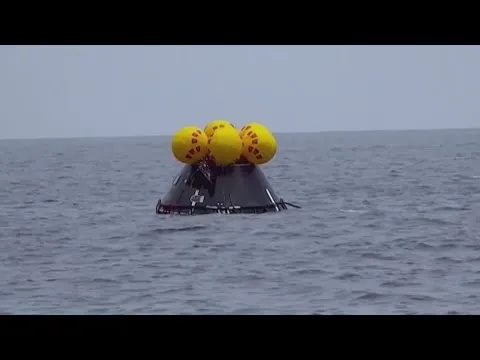
Navy Secures Artemis II Crew, Capsule Amidst Fiery Re-entry
The world watched with anticipation as the Artemis II astronauts prepared for their return to Earth. The U.S. Navy, in a meticulously planned operation, is ready to retrieve the Orion capsule and its four-person crew from the Pacific Ocean. This mission marks a significant step in humanity’s return to lunar exploration, with the Navy playing a crucial role in ensuring the safe recovery of the astronauts and their spacecraft.
The splashdown is scheduled for 05:00:07 PM local time in Southern California. Residents near the coast might witness a bright streak across the sky and possibly hear a sonic boom as the capsule re-enters Earth’s atmosphere at speeds around 25,000 miles per hour. The re-entry process itself is a critical and potentially dangerous phase, with the capsule’s heat shield expected to endure temperatures reaching an estimated 5,000 degrees Fahrenheit.
NASA engineers have made adjustments to the Orion capsule’s heat shield following issues observed during the Artemis I mission in 2022, where parts of the shield broke away. The success of the Artemis II mission so far has instilled confidence, supported by favorable weather conditions in San Diego.
Navy’s Recovery Operation Detailed
The USS John P. Murtha, a naval vessel, is positioned over 50 miles off the coast, serving as the central hub for the recovery effort. It carries a specialized splashdown recovery team, ready to act swiftly upon the capsule’s landing. This operation is the result of months of joint training involving NASA, the U.S. Navy, and the Coast Guard. Every step of the recovery is carefully choreographed to ensure the safety of astronauts Reid Wiseman, Jeremy Hansen, Christina Koch, and Victor Glover.
Two Sea Hawk helicopters are assigned to retrieve the astronauts from the water and transport them to the USS John P. Murtha. The pilots have undergone extensive training for this precise task. Once the capsule hits the water, the recovery team will maintain a safe distance until debris from the re-entry has settled. Upon receiving clearance from the recovery command team, they will approach the capsule to safely extract the astronauts.
Astronaut and Capsule Transport
Following their recovery, the astronauts will be flown by Navy helicopters from the USS John P. Murtha to Naval Air Station North Island in San Diego. If all crew members pass their medical checks, they will then travel to Houston. The Orion capsule itself will be retrieved by a specialized team and loaded onto the USS John P. Murtha for transport back to Naval Base San Diego.
NASA intends to thoroughly study the capsule to understand how it withstood its historic journey to the far side of the Moon. The size of the Orion capsule, described as being similar to a minivan, highlights the remarkable feat of the astronauts enduring re-entry after a 10-day mission.
Global Impact
The successful recovery of the Artemis II crew and capsule is more than just a technical achievement; it signifies a renewed push in human space exploration. This mission, and the complex recovery operation, demonstrates the growing capabilities of international space agencies and their partners. The data gathered from the Orion capsule’s performance will be vital for future lunar missions, including potential landings and sustained presence on the Moon. This also paves the way for future missions to Mars, showing that complex deep-space journeys are becoming more achievable.
Historical Context
The U.S. Navy has a long history of supporting human spaceflight, dating back to the Mercury and Gemini programs in the 1960s. These early missions relied heavily on naval vessels and personnel for astronaut recovery. The current operation echoes these historical precedents, showcasing the enduring partnership between space exploration and naval capabilities. The careful planning and execution mirror the precision required in past recovery efforts, adapted for the advanced technology of the Orion spacecraft.
Future Scenarios
The successful return of Artemis II is expected to boost public and political support for further deep-space missions. Future scenarios could include more frequent lunar missions, the establishment of a lunar base, and ultimately, human missions to Mars. The lessons learned from the Artemis II recovery will be crucial for planning even more complex missions in the years to come. The cooperation shown between NASA and the Navy also suggests a model for future international collaborations in space.
Source: Navy prepares for Artemis II splashdown and recovery | NewsNation Live (YouTube)

Related Articles


Orion Heat Shield Mysteriously Damaged, NASA Adjusts Course
NASA's Orion spacecraft experienced unexpected damage to its heat shield during the Artemis 1 mission's re-entry. Scientists have identified gas buildup during skip re-entry as the cause and are adjusting the trajectory for Artemis 2 to prevent further spallation. A more porous material will be used for Artemis 3.


Artemis II Astronauts Face Fiery Re-Entry After Lunar Orbit
The Artemis II astronauts are returning to Earth after a historic journey around the Moon, facing a critical and fiery re-entry into the atmosphere. Space expert Dallas Campbell explains the intense 'moment of tension' as the Orion spacecraft travels at 25,000 mph, relying on its heat shield and parachutes for a safe splashdown. The mission marks a significant step in humanity's return to deep space and paves the way for future lunar exploration.


Artemis II Crew Channels ‘Apollo 13’ in Space
The Artemis II crew drew parallels to the dramatic events of 'Apollo 13' during their mission. Astronauts faced technical challenges and found moments for levity, highlighting the realities of space travel.