NASA’s Fiery Return: Artemis’s Riskiest 20 Minutes
NASA's Artemis program faces a perilous 20-minute re-entry into Earth's atmosphere. Traveling at 25,000 mph, the Orion capsule endures extreme heat and a communication blackout before deploying a complex parachute system. This critical phase ensures the safe return of astronauts from deep space missions.

NASA’s Fiery Return: Artemis’s Riskiest 20 Minutes
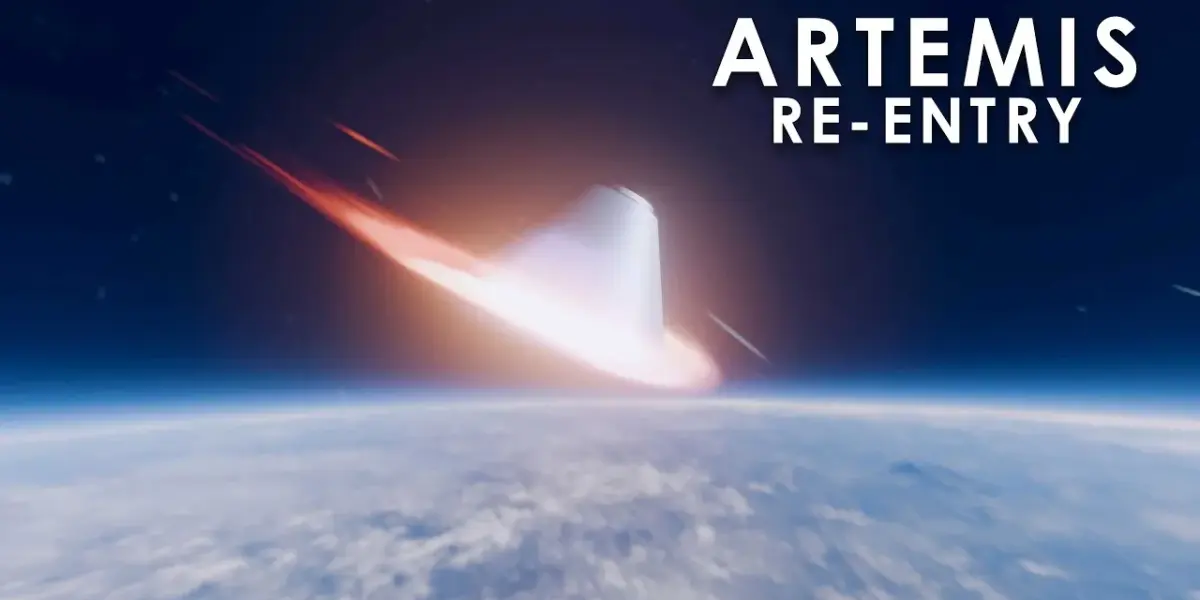
Imagine a 26-ton spacecraft hurtling towards Earth at 25,000 miles per hour. How do you stop something that fast? NASA’s Artemis program faces this exact challenge. The answer is surprisingly simple, yet incredibly dangerous: slam it into a wall of air. This intense process creates 5,000 degrees of heat and a complete loss of communication for several minutes. It’s a maneuver requiring extreme precision, like skipping a stone across a pond at 20 times the speed of sound.
Saying Goodbye to the Service Module
About 20 minutes before hitting the atmosphere, the astronauts must say goodbye to the European service module. This module has been their vital lifeline, providing power and life support throughout their journey. However, it lacks a heat shield. Explosive bolts fire, and the module separates, burning up like a fiery meteor over the ocean. The four astronauts are then alone in the Orion capsule, a small, sturdy cone facing the immense challenge ahead.
Entry Interface: Hitting the Atmosphere
At 75 miles above Earth, the capsule reaches entry interface. It’s traveling at a staggering 25,000 mph, or Mach 32. To understand this speed, consider that each kilogram of the spacecraft carries nearly 2,000 times more energy than a commercial jet. The capsule hits the air so forcefully that the gas cannot move out of the way. Instead, it compresses, creating a white-hot shock wave reaching 5,000 degrees Fahrenheit – about half the temperature of the sun’s surface.
The Plasma Cage and the Skip
This extreme heat strips electrons from the air, surrounding Orion in a glowing cage of plasma. This plasma sheath blocks all radio signals, cutting off communication with mission control. For several tense minutes, the world can only see a blank telemetry screen, waiting as four humans ride a fireball through the sky. To survive this violent return, Orion uses a clever tactic: it skips. Instead of a steep, lethal dive, the capsule’s shape generates lift. It bounces off the upper atmosphere, much like a stone skipping across water. During the Artemis I test flight, a particularly deep skip caused parts of the heat shield to chip. NASA has since adjusted the trajectory for Artemis II, using a gentler, lofted approach. This modified path allows the heat shield to manage the intense gases without cracking, while keeping the G-forces manageable for the crew.
Parachutes and Splashdown
About four minutes after the peak heating, the fire begins to subside. The roar of the plasma fades, and the crew’s voices can be heard again. However, they are still at 25,000 feet, and the most dangerous part of the flight remains. Any miscalculation here could break the spacecraft apart. With the speed now manageable, it’s time to slow down dramatically. The nose cover blows off, and two small drogue parachutes deploy to stabilize the capsule and pull it upright. Then, three massive main parachutes unfurl, slowing the multi-ton spacecraft from hundreds of miles per hour down to a gentle 20 mph drift. The journey ends with a splashdown in the Pacific Ocean, but even this final moment is carefully calculated. Onboard software adjusts the capsule’s roll one last time to ensure it hits the waves at the perfect angle, protecting the crew’s spines.
The Journey to the Moon and Back
The entire Artemis mission starts with a powerful launch from NASA’s Kennedy Space Center. The Space Launch System rocket, with its massive engines and boosters, unleashes 8.8 million pounds of thrust. Within minutes, spent boosters and the core stage fall away. The Orion capsule, with its European service module, then embarks on its journey. To reach the moon, the upper stage fires one last time, accelerating Orion to over 24,000 mph and breaking Earth’s gravity. After detaching the upper stage, Orion coasts for about 240,000 miles. For Artemis II, the crew will use a free-return trajectory, flying around the moon and using its gravity to slingshot back to Earth. Future missions planning lunar landings will use a stable, egg-shaped orbit, allowing astronauts to transfer to a lunar lander.
Comparing Re-entry: Artemis vs. Crew Dragon
NASA’s Artemis return is a complex, multi-stage process. In contrast, SpaceX’s Crew Dragon uses a slightly different approach. After detaching from the International Space Station, Crew Dragon performs burns to adjust its orbit. It then jettisons its trunk, which contains solar panels, and the capsule begins its descent. Traveling at over 17,500 mph, it also experiences extreme heat and a communication blackout. At around 18,000 feet, two drogue parachutes deploy, followed by four main parachutes at 6,000 feet. Crew Dragon splashes down in the Atlantic or Gulf of Mexico, with recovery teams arriving quickly.
Why This Matters
The Artemis program represents a significant step in humanity’s return to the Moon and eventual journey to Mars. The re-entry phase, in particular, highlights the extreme engineering challenges and risks involved in space travel. Successfully returning astronauts safely from deep space requires mastering incredibly violent atmospheric entry. The precision, the heat management, and the parachute systems are critical elements that must work flawlessly. Lessons learned from Artemis I’s heat shield issues, leading to the modified trajectory for Artemis II, show NASA’s commitment to continuous improvement and crew safety. This rigorous approach ensures that future, more ambitious missions can be undertaken with the highest possible chance of success. The comparisons with SpaceX’s Crew Dragon also illustrate the different engineering philosophies and technologies being developed in the new era of commercial spaceflight, pushing the boundaries of what’s possible.
Implications and Future Outlook
The success of the Artemis program’s re-entry procedures is crucial for establishing a sustainable human presence beyond Earth. It not only demonstrates NASA’s capability but also builds confidence for longer-duration missions and future voyages to Mars. The technology developed for heat shields, parachutes, and trajectory control will be vital. As private companies like SpaceX continue to innovate with their own re-entry systems, a healthy competition and collaboration emerge. This drives faster progress and potentially lower costs for accessing space. The future likely holds even more advanced re-entry techniques, perhaps involving aerodynamic controls or even experimental braking systems. Each successful return mission refines our understanding and enhances our ability to explore the cosmos safely.
Source: Artemis Re-Entry | NASA Most Dangerous 20 Minutes (YouTube)

Related Articles


Texas Engineer Leads Artemis II Heat Shield Effort
Texas engineer Ronnie Backus discusses his critical role in developing the Orion spacecraft's heat shield for the Artemis II mission. After over a decade of work, Backus and his team have implemented new strategies to ensure a safe return to Earth, addressing concerns from previous missions. The mission represents a significant step in human space exploration, fulfilling a childhood dream for the West Texas native.


Space Toilet Woes: Artemis II Fixes Clog With Sun Power
Artemis II astronauts faced a frozen waste pipe just after launch, proving space toilets are critical. Mission control used solar heat to thaw the clog, leading to a memorable "go for toilet" announcement. This incident highlights the human realities of space exploration.


Artemis II Astronauts Homebound After Historic Moon Mission
The Artemis II astronauts are nearing Earth after completing a historic mission around the Moon, with splashdown expected tonight. Meanwhile, First Lady Melania Trump has broken her silence on Jeffrey Epstein, and the NFL is under federal investigation for its streaming practices.