NASA Reconnects with Artemis II Crew After Lunar Blackout
NASA has reconnected with the Artemis II astronauts after a communications blackout while flying behind the moon. The crew successfully completed their lunar flyby, documenting the moon's surface and witnessing Earthrise. This mission is a key step in NASA's plan to return humans to the moon.


NASA Regains Contact with Artemis II Astronauts After Moon Flyby
NASA has successfully reestablished communication with the four astronauts aboard the Orion spacecraft following a planned communications blackout as they flew behind the moon. The Artemis II crew, on a critical mission to test systems for future lunar exploration, returned to contact with mission control in Houston shortly after completing their closest approach to the lunar surface. This milestone marks a significant step in NASA’s ambitious Artemis program, which aims to return humans to the moon and establish a long-term presence there.
Artemis II Crew Completes Lunar Flyby
The Artemis II mission, carrying Commander Reid Wiseman, Pilot Victor Glover, Mission Specialist Christina Koch, and Mission Specialist Jeremy Hansen, is currently on a trajectory that includes a close flyby of the moon. During this phase, the spacecraft reached its closest point to the moon, approximately 4,670 miles above the lunar surface. This maneuver is designed to test Orion’s systems in deep space and gather valuable data for future missions.
Science Operations Continue During Blackout
Even while out of contact with Earth, the Artemis II crew continued their assigned tasks. NASA’s Science Evaluation Room (SIR), located within the mission control center, is staffed by a multidisciplinary team of experts. These scientists, including specialists in lunar geology, impact cratering, volcanism, and imaging, provide real-time support to the crew. A dedicated Science Mission Operations Room also processes data and supports rapid analysis. Science Officer Kelsey Young acts as the main link between the science team and flight controllers, ensuring scientific objectives are met.
Astronauts Document Lunar Surface
During the lunar flyby, astronauts Victor Glover and Christina Koch were positioned at observation windows, meticulously documenting the moon’s surface. One astronaut used a zoom lens to capture images, while the other used a portable computing device (PCD) to make annotations and record audio observations. These detailed reports, known as situation reports (sit reps), include information on crew positioning, observations, any unexpected findings, hardware status, and the crew’s emotional responses. These recordings and observations are crucial for understanding the lunar environment and refining future mission plans.
The ‘Blackout’ and Earthrise
The period of lost communication, lasting about 40 minutes, occurred as the Orion spacecraft passed behind the moon. This is a normal part of the mission profile. Upon reemerging from behind the moon, the crew had the opportunity to witness and photograph Earthrise, a breathtaking view of Earth appearing over the lunar horizon. This iconic sight, captured from over 252,000 miles away, serves as a powerful reminder of humanity’s place in the cosmos and the significance of space exploration. The crew is now back in contact with Earth and continuing their journey home.
Future of Lunar Exploration
The Artemis II mission is a vital precursor to more complex lunar endeavors, including the eventual landing of astronauts on the moon and the establishment of a sustainable lunar base. The data and experiences gained from this flyby will inform the development of future spacecraft, technologies, and operational procedures. NASA’s continued progress in the Artemis program signals a renewed commitment to human spaceflight and lunar exploration, paving the way for scientific discovery and potential resource utilization on the moon.
What’s Next for Artemis?
With contact reestablished and the lunar flyby successfully completed, attention now turns to the remainder of the Artemis II mission and its safe return to Earth. Following this, NASA will analyze the vast amount of data collected during the flight. The success of Artemis II will directly influence the planning and execution of subsequent missions, including Artemis III, which aims to land the first woman and the next man on the lunar surface. The agency’s progress is closely watched as it charts a course for humanity’s return to the moon and beyond.
Source: WATCH: NASA regains contact with Artemis II crew on Orion spacecraft (YouTube)

Related Articles


Moon Mission Sparks New Space Race Era
The Artemis II mission's return from the Moon marks a new era in space exploration, potentially sparking a modern space race. The mission provided new scientific data and breathtaking views, while also highlighting the inherent risks of deep space travel. This renewed focus on lunar exploration has significant geopolitical and economic implications for global powers.

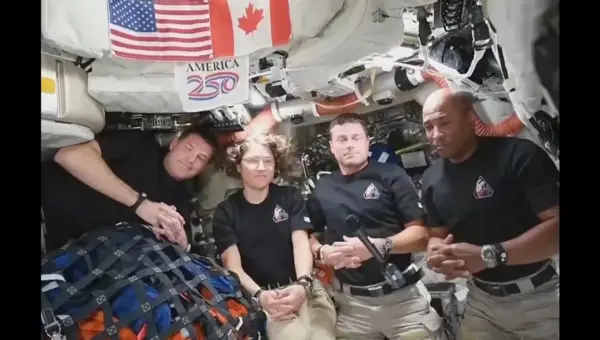
Astronauts’ Silent Treatment Exposes Trump’s Space Rift
An awkward call between Donald Trump and the Artemis 2 astronauts, marked by prolonged silence from the crew, highlights a perceived disconnect in values and leadership. The incident contrasts with past presidential interactions and raises questions about Trump's stance on space exploration versus his proposed budget cuts.


Artemis II Crew Makes History, Sees Far Side of Moon
The Artemis II mission crew has made history by becoming the first humans to see the far side of the Moon with remarkable clarity. As they journey home, their mission has provided unprecedented views and scientific data. Meanwhile, escalating tensions in the Middle East and political developments in North Korea are also making headlines.