NASA Aims for Moon Base, Eyes Mars Leap
NASA plans to build a $20 billion lunar base over seven years, aiming to establish humanity's first permanent outpost beyond Earth. This ambitious project, part of the Artemis program, serves as a crucial stepping stone for future Mars missions, offering a safer testing ground for deep space technologies and astronaut training.

NASA Aims for Moon Base, Eyes Mars Leap
NASA is planning to build the first permanent human outpost beyond Earth on the Moon. This ambitious project, part of the Artemis program, aims to pave the way for future missions to Mars. The agency announced a major update to its lunar base plans, committing approximately $20 billion over the next seven years. This investment signals a renewed focus on deep space exploration and establishing a sustained human presence beyond our planet. The goal is to create an evolutionary path, starting with an outpost that can serve as a crucial stepping stone.
Why the Moon First?
The decision to establish a base on the Moon before heading to Mars is strategic. The Moon is much closer to Earth, making it a safer testing ground for technologies and procedures. If a problem arises, astronauts can return to Earth in about three to four days. In contrast, a trip to Mars, even when the planets are aligned, takes about six months one way. This significant time difference means that any major issue on a Mars mission could take years to resolve, posing a much greater risk to the crew. The Moon offers a similar, yet more accessible, environment to practice working in reduced gravity and a dusty atmosphere.
Challenges of the Lunar Environment
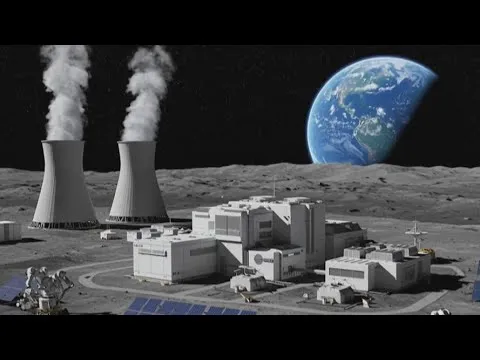
Living and working on the Moon presents unique challenges. Lunar dust, in particular, is a major concern. Unlike Earth or Mars, the Moon has no wind to smooth out the sharp edges of dust particles. This makes the dust very abrasive, posing a threat to equipment and potentially to astronauts’ health if inhaled. The proposed lunar base includes renderings of pressurized buildings where humans can live and work comfortably. These plans also show cooling towers, solar arrays, lunar rovers, and even a nuclear reactor to provide power. The idea is to create a functional outpost, though questions remain about long-term habitability and the extraction of resources like water ice.
Artemis 2 and Future Missions
The Artemis program is NASA’s effort to return humans to the Moon. The Artemis 2 mission, which is set to launch soon, will be a critical step. After a series of delays, the rocket is now expected to launch next week. Following successful tests, including a wet dress rehearsal, engineers have fixed minor issues. Former NASA astronaut Leroy Chiao, who commanded the International Space Station, believes the launch will likely happen on schedule. He notes that NASA has spent over $104 billion in the last decade on space efforts, including civil, military, and commercial projects. The Artemis program is seen as the next chapter in this ongoing pursuit of space exploration.
Global Impact and Future Scenarios
NASA’s $20 billion investment in a lunar base is more than just a scientific endeavor; it’s a geopolitical statement. It signals the United States’ continued leadership in space exploration. Other nations and private companies are also investing heavily in space, creating a competitive yet collaborative environment. The success of the Artemis program could spur further international cooperation or lead to new rivalries over lunar resources. The development of a permanent lunar outpost could also accelerate the timeline for human missions to Mars, potentially within the next few decades. However, the program’s success depends on sustained funding and overcoming the significant technical hurdles presented by the lunar environment. The ability to reliably resupply the base from Earth with essentials like oxygen, water, and food will be crucial, especially in the early stages.
Historical Context
This new push to the Moon echoes the original Space Race between the United States and the Soviet Union. While the original race was driven by Cold War competition, today’s efforts are more focused on scientific discovery, technological advancement, and long-term human expansion into space. The International Space Station (ISS), a collaborative project involving multiple countries, serves as a testament to what can be achieved through international partnership. The Artemis program, while led by NASA, also involves international partners, continuing this legacy of cooperation while also competing for technological and strategic advantages in space.
Source: Former astronaut reacts to NASA's $20B moon base plans | The Hill (YouTube)

Related Articles

Astronaut Recounts Space Medical Scare, Informs Future Missions
Astronaut Mike Fincke detailed a recent medical emergency aboard the ISS that led to his return to Earth. While doctors ruled out serious conditions like stroke, the exact cause is still being studied, with theories pointing to a space-related anomaly. The experience is providing crucial data for future long-duration missions, including NASA's Artemis program.


Astronaut Recovers From Mystery Space Illness, Inspires Future Missions
Astronaut Mike Fincke has shared details about a mysterious medical emergency he experienced aboard the International Space Station, which led to his early return to Earth. While the exact cause is still under investigation, doctors believe it was space-related, providing crucial data for future deep space missions.


NASA Pivots: Mars Nuclear Probe, Moon Base Ahead
NASA is pivoting its exploration strategy, prioritizing a nuclear-powered Mars probe and accelerating plans for a moon base. The International Space Station's future is uncertain, with a shift towards commercial platforms. Meanwhile, new telescope data reveals overmassive black holes in dwarf galaxies and captures stunning images of Saturn and the Crab Nebula.