Mystery of the Rising Weight: A Physics Puzzle Solved
A surprising physics demonstration shows a weight rising after a connecting rope is cut. The counterintuitive outcome is explained by the stored energy and rapid contraction of springs in the system.

A Counterintuitive Phenomenon Challenges Our Understanding of Gravity
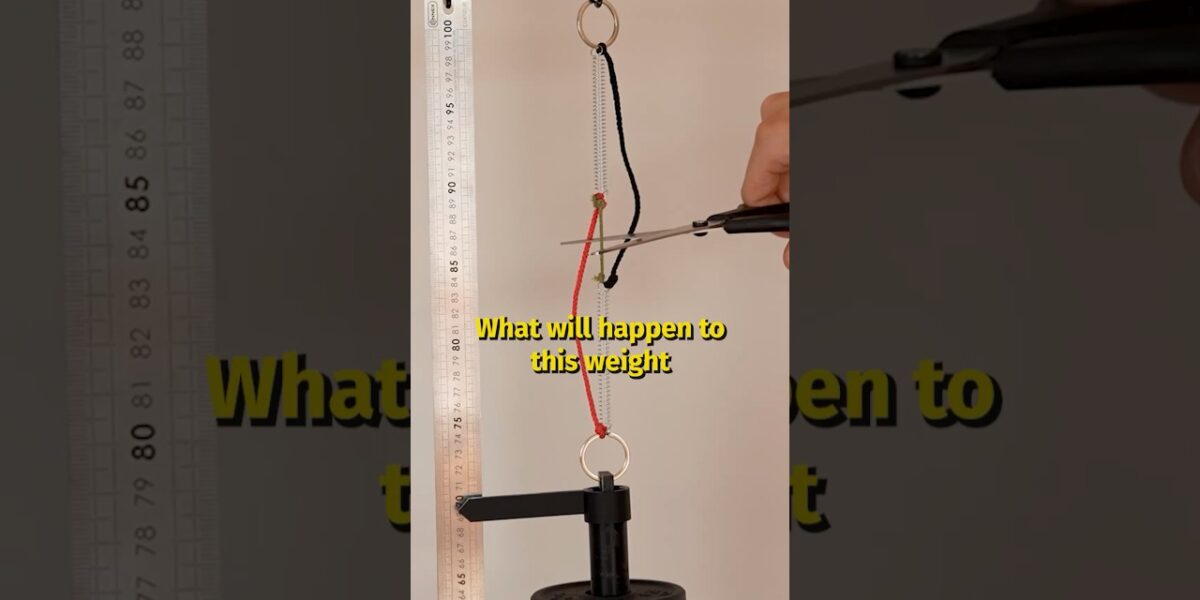
Imagine a seemingly simple physics experiment: a weight suspended by a rope. When the rope is cut, we intuitively expect the weight to fall. However, in a recent demonstration, a weight attached to a green rope unexpectedly rose after the rope was severed. This counterintuitive outcome, initially baffling, offers a profound lesson in the principles of tension, springs, and the often-overlooked forces at play in everyday objects.
The Setup: More Than Meets the Eye
The experiment involves a specific arrangement of springs and ropes. A spring is initially suspended from an overhead hook. Connected to this spring, via a green rope, is a second spring, which in turn supports a weight. Two additional ropes, one red and one black, are also present but are slack, meaning they are not bearing any load and play no role in supporting the weight. The critical element is the green rope, which acts as the intermediary between the upper spring and the weight-bearing lower spring.
The Conventional Expectation Versus Reality
Our everyday experience with gravity dictates that if an object is held up by a rope and that rope is cut, the object will fall. This is because the rope provides an upward tension force that counteracts the downward pull of gravity. When the rope is removed, the supporting force vanishes, and gravity takes over. However, the demonstration presented here defies this expectation. Instead of falling, the weight inexplicably moves upward.
Unraveling the Mystery: The Role of Springs
The key to understanding this phenomenon lies in the presence and properties of the springs. The setup features two springs, not just a simple rope-and-weight system. Let’s break down the forces at play:
Spring 1 (Upper Spring):
This spring is attached to the overhead hook. When the weight is suspended below it, this spring is stretched. The tension in this upper spring is pulling upwards on the green rope and, consequently, downwards on the hook from which it hangs. The magnitude of this tension depends on how much the spring is stretched.
Spring 2 (Lower Spring):
This spring is directly attached to the weight. It is also stretched due to the weight it is supporting. The tension in this lower spring is pulling upwards on the weight (counteracting gravity) and downwards on the green rope.
The Green Rope: The Crucial Link
The green rope connects the bottom of the upper spring to the top of the lower spring. It transmits the forces between these two components. Crucially, the green rope is under tension because both the upper spring is pulling down on it, and the lower spring is pulling up on it.
The Moment of Truth: Cutting the Green Rope
When the green rope is cut, the connection between the two springs is severed. This is where the counterintuitive behavior emerges:
- Release of Tension in the Green Rope: The tension that was holding the system together is instantly removed.
- Behavior of the Upper Spring: The upper spring, which was stretched and exerting a downward pull on the green rope (and thus a resistance to being pulled further up by the hook), is now free. Because it was already under tension, it will rapidly contract, pulling itself upwards towards the hook.
- Behavior of the Lower Spring and Weight: The lower spring, still attached to the weight, was also under tension, pulling upwards on the weight to counteract gravity. When the green rope is cut, the downward pull from the upper spring is removed. The lower spring, now only needing to support the weight against gravity, will also contract. However, the initial upward motion of the upper spring is the dominant factor causing the weight to appear to rise.
The upward movement of the weight is primarily a consequence of the rapid contraction of the *upper* spring. As the upper spring snaps back towards its equilibrium position (closer to the hook), it effectively pulls the point where the green rope was attached upwards. Since the lower spring and weight are still connected to this contracting upper spring (via the remnants of the green rope attachment), they are carried along with this upward motion. The lower spring also contracts, but its contraction is less dramatic and is overshadowed by the initial upward surge caused by the upper spring’s recoil.
Historical Context and Similar Phenomena
While this specific demonstration is striking, the underlying physics principles are well-established. Concepts like elastic potential energy stored in springs, tension, and Newton’s laws of motion are fundamental to understanding such scenarios. Similar phenomena can be observed in situations involving recoiling elastic bands or the sudden release of tension in complex mechanical systems. The common thread is the conversion of stored potential energy into kinetic energy upon the release of a constraint.
Looking Ahead: The Importance of Understanding Forces
This seemingly simple experiment serves as a powerful reminder that our intuitive understanding of physics can sometimes be incomplete. The presence of stored energy in stretched springs dramatically alters the outcome of cutting a connecting element. Understanding these forces is not just an academic exercise; it has practical implications in engineering, from designing safe structures to developing efficient machinery. It underscores the importance of carefully analyzing all components and forces in a system, especially when dealing with stored energy, to predict behavior accurately.
The mystery of the rising weight is a testament to the subtle yet powerful forces that govern our physical world, urging us to look beyond the obvious and delve deeper into the mechanics that shape our reality.
Source: What happens if you cut the green rope? (YouTube)

Related Articles


Heisenberg’s 1925 Quantum Leap Still Puzzles
In 1925, Werner Heisenberg's groundbreaking work laid the foundation for quantum mechanics, a theory that revolutionized physics but whose fundamental implications remain a profound mystery 100 years later. This exploration delves into the birth of this strange new physics.


Spinning Wonders: Unraveling Gyroscopic Precision’s Mysteries
An experimental approach using analogies to linear momentum helps demystify the counterintuitive behavior of spinning objects known as gyroscopic precision. This phenomenon, where a spinning object reacts to force at a 90-degree angle, is crucial for understanding everything from frisbees to spacecraft.

Quantum Mystery: Fields or Potentials?
The Bohm-Aharonov effect, demonstrated experimentally, suggests quantum particles are influenced by magnetic potentials even when magnetic fields are absent. This challenges classical physics' view of potentials as mere mathematical tools.