Moon’s Shrinking Core Creates Vast Scarps on Surface
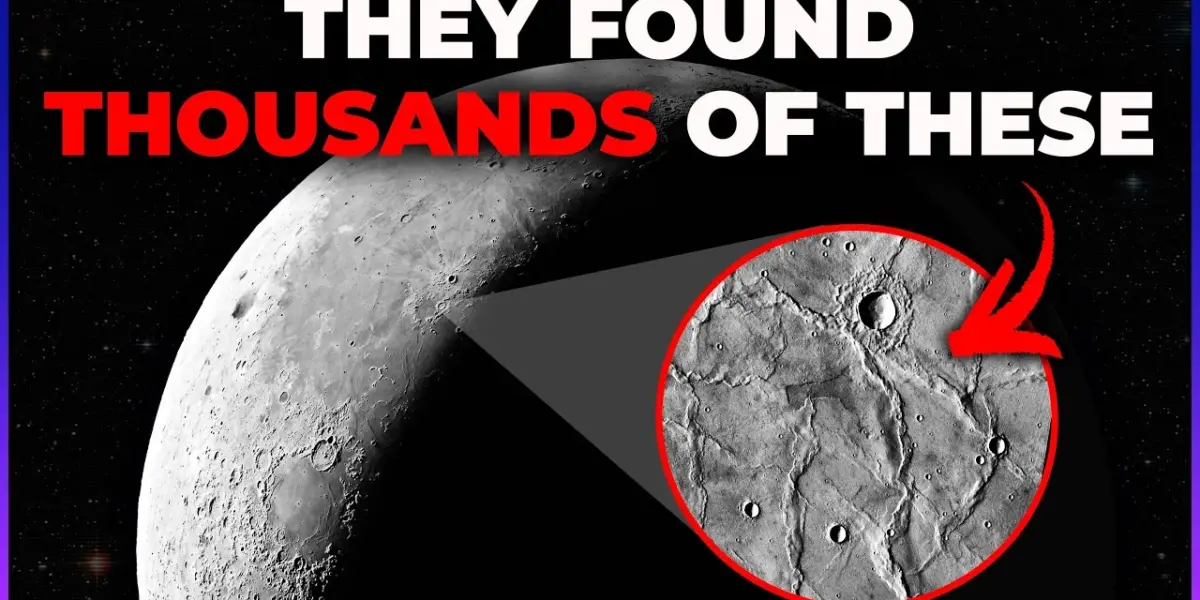
Thousands of newly identified scarps on the Moon reveal that its interior is actively cooling and shrinking, causing the lunar crust to fracture. This ongoing geological activity, driven by global contraction, results in these massive cliff-like features and suggests the Moon is more geologically active than previously thought.

Moon’s Shrinking Core Creates Vast Scarps on Surface
The Moon, our closest celestial neighbor, is not a geologically dead world. While it lacks the dynamic plate tectonics of Earth, new research reveals that the Moon is actively changing beneath its dusty surface. Scientists have discovered thousands of previously unknown scarps – long, linear cliffs – indicating that the Moon is shrinking as its interior cools. This ongoing contraction causes the lunar crust to fracture, pushing up these massive geological features.
A Shifting Lunar Landscape
These scarps, often less than a kilometer deep, are essentially wrinkles on the Moon’s surface. They are caused by a process called global contraction. As the Moon’s interior slowly cools, it loses volume, forcing the outer shell to compress. Imagine a drying apple wrinkling as it loses moisture; the Moon experiences a similar effect on a grand scale.
Dr. Cole Nipover, a research geologist at the Smithsonian National Air and Space Museum, has been instrumental in cataloging these features. “We’ve identified thousands of these scarps across the Moon, far more than we ever expected,” he explains. “This tells us a lot about the Moon’s interior structure and how it’s continuing to cool down.”
Visible Evidence of Lunar Activity
These scarps are not just theoretical concepts; they are visible on the lunar surface. The first human encounter with such a feature was during the Apollo 17 mission, which landed in the Taurus-Littrow Valley. This valley is cut by the Lee-Lincoln scarp, a prime example of these fault structures. Initially, scientists identified only dozens of these scarps, primarily in the bright, rugged lunar highlands. However, with improved high-resolution imagery from the Lunar Reconnaissance Orbiter Camera, thousands have now been found across the entire lunar surface, including the darker plains known as the maria.
Young Features in an Ancient World
What makes these scarps particularly fascinating is their geological youth. While the Moon is about 4.4 billion years old, these scarps are estimated to be only hundreds of millions of years old. This relative youth is evident in their sharp, crisp appearance. The lunar surface is constantly bombarded by micrometeoroids and larger impactors, which churn the regolith (lunar soil) and gradually round off features. “If you see a feature that is not degraded, not rounded, your mind immediately jumps to, ‘Oh, this is geologically young,'” says Dr. Nipover.
This contrasts sharply with most lunar topography, which appears rounded and smooth due to billions of years of space weathering. Even young impact craters, with their sharp rims and distinct floors, eventually degrade into muted expressions on the surface. The crispness of the scarps indicates they have not been exposed to these erosional processes for long.
Earth vs. Moon: A Tale of Two Tectonics
On Earth, fault formation is driven by plate tectonics. Gigantic plates of the Earth’s crust move, collide, and slide past each other, creating earthquakes and shaping the planet’s surface. The Moon, however, is a “one-plate” body. It lacks these mobile tectonic plates. Instead, its geological activity is primarily driven by the internal cooling and shrinking mentioned earlier.
The forces generated by this global contraction are significant, measured in tens to hundreds of megapascals. While smaller, tidal stresses from Earth’s gravitational pull also play a role, influencing the orientation of faults, they are not the primary cause of their formation. These tidal stresses arise from the Moon slowly moving away from Earth and its slightly non-circular orbit.
Moonquakes: A Real Possibility for Future Astronauts
The discovery of these active faults raises questions about future human missions to the Moon. Could astronauts experience moonquakes? The answer is yes, it’s certainly possible. The Apollo missions placed seismometers on the lunar surface, which detected over 13,000 seismic events between 1969 and 1977.
Most of these were deep moonquakes, occurring near the core-mantle boundary. Others were caused by impacts. However, 28 of these events were identified as shallow moonquakes, with magnitudes significant enough to cause shaking. The leading theory is that these shallow moonquakes are linked to the slip and formation of these shallow thrust faults. While the likelihood of experiencing one at any given time is low due to their infrequent occurrence, astronauts working near these fault zones would need to be aware of this potential hazard.
Boulder Falls and Geomorphic Clues
Evidence of moonquakes may already be visible in the form of boulder falls and landslides. Recent studies have analyzed features in the Taurus-Littrow Valley, coinciding with the formation age of the Lee-Lincoln scarp. The shaking from a magnitude 3 moonquake, similar to what might occur along these faults, would be sufficient to dislodge boulders and trigger landslides, explaining observed geological events.
Asymmetry Between Near and Far Sides
Dr. Nipover’s research also touches on the Moon’s perplexing asymmetry between its near and far sides. The near side, which always faces Earth, features the dark maria and brighter highlands. The far side, conversely, is heavily cratered with fewer maria. A leading hypothesis suggests the far side has a thicker lithosphere (the rigid outer shell) than the near side. While current fault research doesn’t probe deep enough to definitively confirm this, the length of scarps could potentially be proportional to lithosphere thickness, offering a future avenue for investigation.
Future Exploration: Probing Beneath the Surface
Looking ahead, Dr. Nipover is eager to conduct missions that can directly study these faults. “We don’t really have good constraints on how a fault forms in a planetary regolith,” he states. Future missions equipped with ground-penetrating radar or seismic instruments could provide crucial subsurface imaging.
Such data would help scientists understand the micro-scale structure of these faults and, in turn, provide better constraints on the Moon’s thermal history. By studying the geometry and distribution of these scarps, researchers can refine models of how much the Moon has contracted, its cooling rate, and the rate of its ongoing geological activity. Dr. Nipover suggests focusing on the near-side maria for future exploration, as these regions offer opportunities to sample both tectonic features and volcanic history.
Broader Implications for Solar System Science
The study of lunar faults has broader implications for understanding rocky bodies across the solar system. Comparing the Moon’s one-plate tectonics to the processes on Mercury, which exhibits similar but larger-scale contraction features, helps scientists refine models of planetary formation and evolution. Studying Venus’s complex tectonic landscape and the cryovolcanism on icy moons like Europa also benefits from understanding these fundamental geological processes. By unraveling the secrets held within the Moon’s shrinking core and its resulting surface scarps, we gain invaluable insights into the dynamic nature of worlds beyond our own.
Source: How Moon's Ridges Reveal Secrets About Its Geology (YouTube)

Related Articles

Juno Probe Uncovers Jupiter’s Fuzzy Core and Hidden Secrets
NASA's Juno mission has revealed that Jupiter's core is "fuzzy," challenging theories of planetary formation. The probe also captured stunning images of polar cyclones, analyzed atmospheric composition, and provided new insights into Jupiter's powerful magnetic field and auroras.


Uranus’s Interior May Be Rockier Than Believed
New research suggests Uranus's interior might be rockier than previously thought, challenging the 'ice giant' classification. Advancements in telescopic observations are also revealing a more dynamic atmosphere and complex magnetosphere, prompting renewed interest in a return mission.


Sun’s Evolution to Render Earth Uninhabitable
Earth faces a profound transformation over the next billion years, primarily driven by the Sun's increasing luminosity. This will lead to dramatic climate shifts, the loss of oceans, and ultimately, the extinction of all life on our planet.