Michigan Senator: Synagogue Fire A ‘Five-Alarm Fire’ Amid Rising Antisemitism
Michigan State Senator Jeremy Moss described a synagogue fire as a "five-alarm fire," highlighting the alarming rise in antisemitism. He stressed the need for collective action beyond the Jewish community to combat this growing crisis and the challenges of balancing security with open worship.


Michigan Senator Sounds Alarm on Antisemitism After Synagogue Fire
WEST BLOOMFIELD, MI – A “five-alarm fire” is how Michigan State Senator Jeremy Moss, the sole Jewish member of the state Senate, described the escalating threat of antisemitism following a blaze at a synagogue in West Bloomfield. The incident, which thankfully resulted in no injuries, has sent waves of fear and anguish through the Metro Detroit Jewish community, highlighting a growing crisis that Moss argues requires a collective response beyond its own ranks.
Community Under Attack
Speaking in the immediate aftermath of the fire, Senator Moss emphasized the profound impact of the attack, stating, “This was an attack on a building, but this is the heart of the Jewish community in Metro Detroit.” He noted the concentration of synagogues, Jewish schools, and the Jewish Federation Building in the area, underscoring that the incident was not just an isolated act but a deeply felt assault on the community’s core.
“Thank God nobody inside was hurt. But it permeates terror throughout the rest of our community,” Moss said. “And we’re already grappling with this untenable rise in antisemitism, which is causing enough agony and anguish in the community. But to have an incident like this, it spreads fear and anguish throughout the rest of the community, which I think everybody here is feeling today.”
State Resources Deployed for Security
In response to the persistent threat, Moss highlighted the state legislature’s efforts to bolster security for Jewish institutions. “We’ve allocated tens of millions of dollars specifically to Jewish security,” he stated, acknowledging the “sad reality” that such measures are necessary.
He explained that over the past decade, radicalization from both the right and the left has increasingly targeted Jewish people and institutions as scapegoats for conspiracy theories. “So we have delivered resources from the state level to create security infrastructures,” Moss added, pointing to the rapid, multi-agency police response at the scene as evidence of the existing communication and rapid response systems funded by the state.
The Delicate Balance: Security vs. Openness
The question of how much more can be done to “harden” these institutions against attack remains a difficult one. Moss, drawing on his experience as a synagogue board member during the Tree of Life shooting in Pittsburgh, spoke to the inherent tension between ensuring security and maintaining a welcoming atmosphere.
“We know we have to protect our congregants, but we also want to be a welcoming and opening synagogue. Nobody wants to pray in a fortress,” he explained. “So the Jewish community is already grappling through these questions of how do we maintain our security but how do we maintain our freedom to worship freely in this country.”
Antisemitism: A Crisis Requiring Broader Support
Moss unequivocally stated that combating antisemitism cannot be solely the responsibility of the Jewish community. “There aren’t that many of us, not just here in Michigan but around the country,” he said, illustrating the challenge with the disproportionate reach of online content. He noted that a single antisemitic TikTok video with 16 million views far outnumbers the global Jewish population of 15 million, making real-time rebuttal impossible for the community alone.
“So this is a moment of crisis within the Jewish community that depends on everyone else to join. We can’t do it on our own. There is no single funding or single security solution. It’s all of the rest of us that have to stand up and speak out and call it out in order for it to tamper down.”
He characterized the issue as a crisis extending far beyond the Jewish community, impacting “the American community, of the world community.” The stark reality, he noted, is that often more people are amplifying antisemitic content online than there are Jews in the world.
Bipartisan and Internal Challenges
As a Democrat and a leader in the state Senate, Moss has been vocal about antisemitism emerging from various political factions. He acknowledged the need for Democrats to confront antisemitism within their own political coalitions, citing instances such as the vandalism of the Jewish Federation building on the anniversary of October 7th and the targeting of University of Michigan Regent Jordan Acker by activists.
“This anti-Semitism is on both extremes,” Moss asserted. “And so as Democrats, we also have to be willing to take on those within our own political coalition to be able to snuff it out.”
A Return to Overt Hatred
Moss expressed deep concern over the overt nature of contemporary antisemitism, contrasting it with his own upbringing. “This is not what I grew up with. We kind of lived in a calmer, more harmonious and more integrated society where antisemitism was not in your face when I was growing up. It was in textbooks, it was in family stories, it was in black and white film reels.”
He lamented the current reality: “Well, I’m watching the video from Temple Israel today up the road for me in real color. This is now here.” The senator drew parallels to other recent incidents, including the attack on peaceful activists in Boulder, Colorado, and the shooting of Israeli embassy staffers at a Jewish event, emphasizing that Jews should be able to live freely without harassment.
Moss also pointed out a critical nuance in media coverage of the embassy staffer incident: the attackers targeted them not as embassy staff, but as individuals leaving a Jewish institution, highlighting the broader antisemitic motivation.
The Shifting Landscape of Antisemitism
Reflecting on the past decade, Moss noted a significant shift in how antisemitism is perceived and amplified. “It was only about 10 years ago when if there were or there was a Holocaust denier, that person would be shunned or laughed at, mocked. Now Holocaust deniers have large platforms or they’re given even larger platforms to voice that denialism and to voice that antisemitism and hatred.”
He concluded with a somber assessment: “It is a different world we’re living in, and as you said, a scary one, five alarm fire.”
Source: 'Five-alarm fire': MI State Sen. speaks out on anti-semitism following synagogue shooting (YouTube)

Related Articles

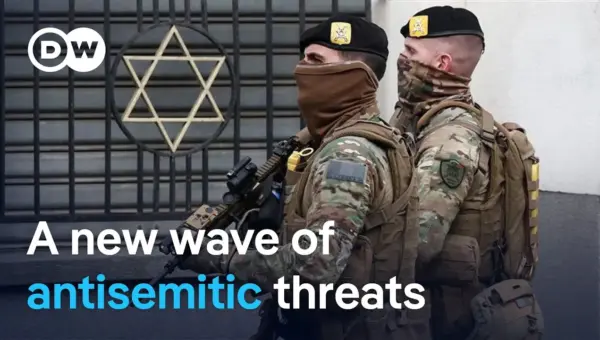
Europe Sees Surge in Anti-Semitic Attacks, Experts Warn
Jewish communities in Europe and North America are facing a surge in anti-Semitic attacks, fueled by global tensions and extremist narratives. Experts warn that recruitment methods are evolving, with state actors potentially playing a role in funding and coordinating attacks. Authorities are struggling to adapt their counter-extremism strategies to this new hybrid threat.


Iran Linked To London Ambulance Arson Via Criminal Ties
A group with alleged ties to Iran has claimed responsibility for setting fire to Jewish charity ambulances in North London. Experts suggest Iran may be using unwitting criminals as "useful idiots" to carry out attacks and sow disruption. The incident highlights concerns over Iran's use of proxies and the targeting of Jewish communities.


London Ambulances Torched in Suspected Antisemitic Hate Crime
Four ambulances belonging to a Jewish charity in London were destroyed in a suspected antisemitic arson attack. British police are investigating the incident, which has been condemned by Prime Minister Keir Starmer as a "despicable act of evil." Efforts are underway to replace the vehicles and provide support to the affected community.