Meta’s Muse Spark: A Multimodal AI Leap Forward
Meta has launched Muse Spark, a natively multimodal AI model capable of understanding text, images, audio, and video. The model introduces innovative features like 'Contemplating Mode' for collaborative AI reasoning and 'thought compression' for increased efficiency, marking a significant advancement in AI capabilities and cost-effectiveness.

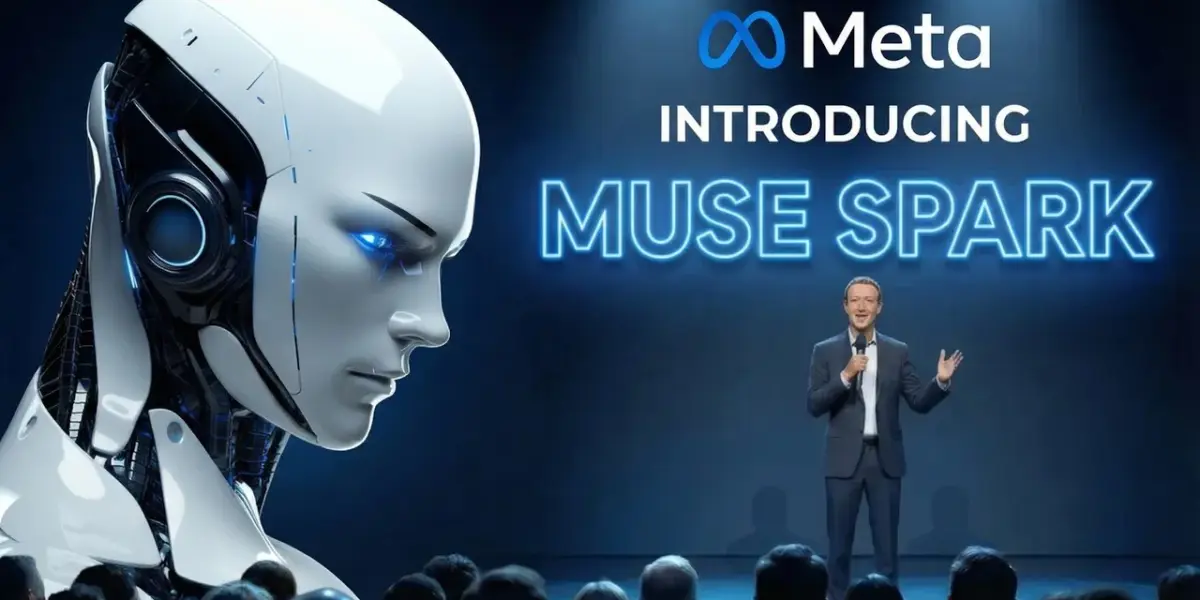
Meta Unveils Muse Spark, A Natively Multimodal AI Model
Meta has officially launched Muse Spark, a significant new artificial intelligence model from its Intelligence Labs. This marks a new era for Meta’s AI development, as Muse Spark is the first in its Muse family of models. What makes this release particularly noteworthy is that Muse Spark is natively multimodal, meaning it was built from the ground up to understand and process various types of data simultaneously.
Understanding Multimodality in AI
In AI, multimodality refers to a model’s ability to work with different kinds of information, such as text, images, audio, and video. Think of it like a person being able to read a book, watch a movie, and listen to a song all at once. Most AI models are trained on just one type of data, usually text. Muse Spark, however, is designed to handle all these data types together. This native multimodal capability is where Muse Spark shows its strongest performance compared to many competitors.
Performance Benchmarks: Where Muse Spark Shines
Meta’s new model performs exceptionally well in areas requiring multimodal understanding. While it doesn’t always outperform top-tier models like GPT-4 or Gemini 3 across every single benchmark, its strength lies in its integrated approach to different data types.
On the Artificial Analysis Index, which combines results from many different benchmarks, Muse Spark is positioned behind models like Claude Opus. However, this shows a huge improvement over Meta’s previous efforts, like Llama 4 Maverick. Muse Spark is clearly a frontier-class model.
Real-World Multimodal Tests
One compelling example of Muse Spark’s multimodal prowess comes from a test involving a handwritten chalkboard menu from a restaurant called Yezis. This was a challenging task due to the handwritten text, reflections on the glass, and multiple price sections. When asked to identify menu items, Muse Spark was able to correctly interpret the information most of the time. This is a significant feat, as many other models struggle with such complex visual and textual data combined.
Meta’s approach to training models natively for multimodality, unlike models that are primarily text-based, leads to powerful reasoning capabilities. This is evident in how Muse Spark handles tasks that require understanding visual and textual information together.
Real-Time Data and Deep Search Capabilities
Surprisingly, Muse Spark also excelled in a real-time data test, an area where models like Grok are often considered leaders. When asked to find current stock prices for major tech companies like Nvidia, AMD, and Intel, Muse Spark provided the most up-to-date information. This capability is also reflected in its strong performance on the Deep Search QA benchmark, which tests a model’s ability to find and process information from various sources.
Introducing Contemplating Mode: AI Collaboration
A unique feature Meta has introduced with Muse Spark is something called ‘Contemplating Mode.’ This is an advanced system where multiple AI agents collaborate in parallel to solve complex problems, especially those requiring scientific reasoning. It’s like having a team of AI experts brainstorm together.
Meta’s testing shows this mode is competitive with other leading models like Gemini Deepthink and GPT Pro. By having multiple agents work together, Muse Spark can achieve better results and is more efficient in its reasoning process. This collaborative approach has shown impressive results, even surpassing other models when tools are not used.
For instance, on the ‘Humanity’s Last Exam’ benchmark, Muse Spark using Contemplating Mode is performing at a state-of-the-art level, just slightly behind GPT 5.4 Pro. The accuracy of this mode increases as more agents are involved, suggesting that collaborative AI reasoning is a promising direction for future development.
Innovative ‘Thought Compression’ for Efficiency
Meta has also developed a technique called ‘thought compression.’ This addresses a common issue where AI models can use a lot of computational resources (tokens) to reason through problems. By penalizing the model for taking too long to think, Meta found that Muse Spark learns to compress its reasoning process.
Imagine being asked to explain a complex topic in fewer words. You become more concise and efficient. Muse Spark does this automatically through reinforcement learning. This means the model can get smarter while using fewer tokens, making it cheaper and faster to run. This is a significant innovation, especially for Meta, which plans to deploy AI to billions of users.
Efficiency Gains in Training
Meta’s research also highlights significant improvements in training efficiency. They have developed a new ‘training recipe’ that optimizes architecture, data curation, and other factors. This allows Muse Spark to extract much more capability from the same amount of computing power compared to competitors.
For example, models like Llama 4 Maverick needed 10 times more computing power to reach the same performance level as Muse Spark. Deepseek required eight times more, and Kimmy needed three times more. This efficiency translates to massive cost savings and faster iteration cycles for Meta, allowing them to develop better models more quickly.
Focus on Healthcare Applications
Meta has also focused on specific applications, including healthcare. They collaborated with over a thousand physicians to create training data that leads to more factual and comprehensive responses. Muse Spark can now generate interactive displays to explain health information, such as nutritional content of foods or the muscles used during exercise.
Image Generation and Limitations
While Muse Spark is multimodal, its current image generation capabilities rely on external tools. When using the app, image generation is handled by Midjourney. While Midjourney produces aesthetically pleasing images, it’s important to note that these may not always be the most accurate visual representations, especially for tasks requiring precise details.
Why This Matters
Meta’s Muse Spark represents a substantial step forward in AI development, particularly in its native multimodal capabilities and efficiency innovations. The ability for an AI to seamlessly understand and process text, images, audio, and video opens up new possibilities for applications in education, healthcare, creative industries, and everyday user experiences.
The ‘Contemplating Mode’ hints at a future where AI systems collaborate internally to solve complex problems, potentially leading to more robust and reliable AI assistants. Furthermore, Meta’s focus on ‘thought compression’ and training efficiency means that powerful AI can become more accessible and cost-effective to deploy at scale. This could accelerate the integration of advanced AI into a wider range of products and services, impacting how we interact with technology daily.
Source: Metas MUSE SPARK Just Surprised The AI Industry – Meta Muse Spark Explained (YouTube)

Related Articles


OpenAI CEO Sam Altman’s Truthfulness Questioned in New Report
A new profile in The New Yorker raises serious questions about OpenAI CEO Sam Altman's truthfulness and leadership. The report, based on interviews with over a hundred sources, details allegations of deception and conflicting business practices. This scrutiny comes as OpenAI's influence grows in a largely unregulated AI industry, prompting calls for greater transparency and accountability.


Mind Control Tech Frees Man From ALS Paralysis
A groundbreaking brain implant from Neuralink has enabled Brad Smith, who lost his ability to speak due to ALS, to communicate and control computers using only his thoughts. The technology allows him to type, play games, and even have his AI-cloned voice speak for him, significantly improving his quality of life and independence.


AI Models Can Now Learn Like Humans Do
New AI models can now learn and adapt like humans, building on past knowledge without forgetting. This "continual learning" avoids the costly retraining needed for current AI and promises more versatile and efficient AI systems for various applications.